Is a Project Manager a Good Job?
With the high surge of transitioning into the tech field, it is safe to ask ‘is a project manager a good job in 2026?’
If you have spent any time browsing LinkedIn or job boards recently, you have likely seen the title “Project Manager” appearing in almost every industry imaginable.
From the glass towers of the City of London to the rapid-growth tech hubs in Manchester, the demand is undeniable.
But when you are looking to pivot your career or move up the corporate ladder, you need more than just “demand.”
You need to know if a project manager is a good job for your specific lifestyle, temperament, and long-term financial goals
Having watched professionals navigate the UK job market, I can tell you that project management is often the “hidden” bridge for those wanting to exit stagnant roles and enter the high-stakes world of corporate leadership.
However, it isn’t all colourful Gantt charts and celebratory launch parties. It is a role defined by pressure, people, and the relentless pursuit of “done.”
This blog is a breakdown of the realities of the profession in 2026, helping you decide if this path is your next big win or a high-stress detour you would rather avoid.
What Does a Project Manager Actually Do?
Project management is one of the Best Tech & Digital Skills to Learn for 2026. Before looking at the perks, let’s strip away the jargon. In my experience, many people think being a project manager is just about telling people what to do.
In reality, it is much more about ensuring that the right things happen at the right time, often while navigating a sea of conflicting interests. So what does a project manager actually fo? Let’s dive in.
Planning and Strategic Scheduling
Every project starts with a vision, but a vision without a plan is just a daydream. As a PM, you are the architect of the timeline.
You will spend a significant portion of your week defining the Scope which is exactly what is being built or delivered, and breaking it down into manageable tasks.
You aren’t just looking at what needs to happen today; you are looking six months down the line to spot potential bottlenecks before they happen.
Coordinating Diverse Teams
You are the glue. On any given day, you might be speaking with software engineers, marketing executives, legal advisors, and external vendors.
A recent report on the state of project management found that professionals now spend an average of 68% of their time on formal projects rather than routine operations.
Your job is to translate the technical requirements of the builders into the business language of the stakeholders.
This requires a high level of emotional intelligence and the ability to speak multiple corporate languages fluently.
Managing Deadlines, Budgets, and Risks
I call this the Meat of the role. You are the guardian of the triple constraint: Time, Cost, and Quality.
If a project is running over budget, you are the one who has to find where to trim the fat or how to negotiate for more funding.
Risk management is equally vital. You aren’t just reacting to problems, you are identifying “what could go wrong (risks) and having a Plan B ready before they become issues.
Stakeholder Communication
If you enjoy the “people” aspect of business, this is where you will thrive. Stakeholders are anyone with an interest in the project, from the CEO to the end-user.
You will spend a lot of time in meetings, sending status updates, and managing expectations. A huge part of the job is saying “no” to new requests in a way that makes the stakeholder feel heard but keeps the project on track.
See Also:
Why Project Management Is Considered a Good Job
When people ask me, Is a project manager a good job? They are usually looking for a reason to commit to the training and certification process.
In the current UK climate, there are several compelling reasons why this career remains a top-tier choice. Check them out
Strong Demand Across Industries
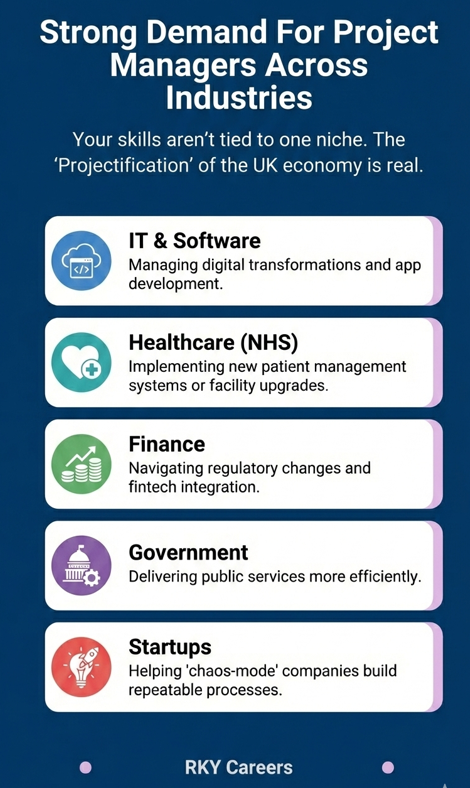
The “Projectification” of the economy is real, permit my use of grammar. Companies no longer just operate; they evolve through projects.
This means your skills aren’t tied to one niche. If the tech sector slows down, you can pivot to healthcare or infrastructure. Here are various industries you can work with
- IT and Software: Managing digital transformations and app development.
- Healthcare (NHS): Implementing new patient management systems or facility upgrades.
- Construction: Oversight of major UK infrastructure projects, such as rail or sustainable housing.
- Finance: Navigating regulatory changes and fintech integration.
- Government: Delivering public services more efficiently.
- Startups: Helping “chaos-mode” companies build repeatable processes.
Competitive Salaries and Benefits
Let’s talk numbers. How Much Project Managers Earn in the UK? The UK project management market remains incredibly lucrative compared to many other administrative or general management roles.
Salary data from Indeed UK shows average project manager earnings range between £48,000 and £55,000 annually, with senior roles frequently exceeding £70,000..
| Experience Level | Estimated Salary Range (UK) |
| Junior / Entry Level | £32,000 – £45,000 |
| Mid-Level PM | £48,000 – £65,000 |
| Senior Project Manager | £70,000 – £95,000 |
| Programme/Portfolio Director | £100,000+ |
Beyond the base salary, PMs often receive performance bonuses, private healthcare, and increasingly, flexible or remote working arrangements.
For many, a project manager is a good job simply because it offers a clear path to a six-figure income without requiring a medical degree or a career in high-frequency trading.
Transferable Skills That Future-Proof Your Career
In an era where AI is automating many technical tasks, the human-centric skills of a PM are becoming more valuable, not less. By mastering project management, you are essentially getting a masterclass in:
- Strategic Thinking: Learning how a business actually grows.
- Conflict Resolution: Managing difficult personalities and competing priorities.
- Data Literacy: Using tools and metrics to drive decision-making.
These skills are portable. If you decide to start your own business or move into a completely different field later, your ability to get things done will make you an asset anywhere.
Clear Career Progression
One of the most frustrating things about many jobs is hitting a ceiling. That rarely happens here. The hierarchy is well-defined.
You might start as a Project Coordinator or Junior PM, but within a few years, you can move into Senior PM roles.
From there, you can transition into Programme Management (overseeing multiple related projects) or Portfolio Management (ensuring the company is doing the right projects to meet its goals).
For those with an eye on the boardroom, the path to a Chief Operating Officer (COO) or PMO Director is well-trodden.
See Also:
The Downsides of Being a Project Manager
You will be really cheated if I only tell you the highlights. Although project management is a great no-code Tech Careers for Beginners in 2026, let’s be honest, to truly answer the question, “Is being a project manager a good job?” we have to look at the dark side of the role as well.
High Responsibility and Pressure
You are the single point of failure for a project. When things go well, the team gets the credit. But when things go wrong, the PM is usually the first person called into the Director’s office.
This level of responsibility can be invigorating for some, but for others, it leads to significant stress.
You have to be comfortable with the weight of the budget and the timeline sitting squarely on your shoulders.
You’re Accountable, Even When It’s Not Your Fault
This is perhaps the most challenging part of the job. A developer might fall ill, a supplier might go bust, or a global pandemic might shift your supply chain.
None of these is your fault, but they are all your problem. You have to find solutions to obstacles you didn’t create, often working with people over whom you have no direct line-management authority.
Work-Life Balance Can Be Challenging
While many PM roles offer remote work, the mental load is high. As a deadline approaches, Go-Live periods might require late nights or weekend check-ins.
It is not a clock-in, clock-out kind of job. You are often the person thinking about the project risks while you are trying to enjoy your Sunday roast.
See Also:
Is a Project Manager a Good Job for You?
Not everyone is wired for this role. I have seen brilliant, highly organised people fail as PMs because they lacked the soft skills, and I’ve seen charismatic leaders fail because they couldn’t handle the administrative rigour.
You will likely thrive if you:
- Enjoy structure and organisation: You are the person who actually likes using a planner or a digital Trello board to organise your life.
- Like leading without being authoritarian: You can influence people through logic and relationship-building rather than just giving orders.
- Handle ambiguity well: You don’t panic when the plan changes; you just start drafting Version 2.0.
- Communicate confidently: You can stand in front of a room of executives and give a clear, concise update, even when the news isn’t great.
You might want to reconsider if you:
- Avoid accountability: If the idea of being the fall guy for a team mistake keeps you up at night, this might not be for you.
- Dislike meetings: PMs spend 50-70% of their time communicating. If you prefer to sit in a corner and work solo, you will find this role draining.
- Prefer repetitive tasks: If you like a predictable day where you do the same thing every Monday at 9:00 AM, the volatility of project work will frustrate you.
See Also:
Project Manager Job Outlook in the UK (2026)
As we navigate 2026, the UK job market for project managers is evolving. The focus has shifted from “traditional” waterfall methods to much more fluid, Agile, and hybrid approaches. PMI estimates the global economy will require about 25 million new project professionals by 2030.
Since it is one of the Careers With Global Demand, there has been increase in the the sectors that is needed.
- Digital Transformation: The surge in AI integration means companies need PMs who can oversee the implementation of machine learning tools and data privacy frameworks.
- Public Sector Demand: With ongoing infrastructure upgrades and the modernisation of the civil service, the public sector is hiring PMs at a record pace.
- Green Energy & Sustainability: There is a massive need for PMs to lead Net Zero initiatives and renewable energy projects across the UK.
- The Rise of the “Hybrid” PM: Employers are no longer looking for people who just know the theory; they want PMs who understand the technical side of the business (e.g., a PM who understands a bit of coding or a PM who understands clinical trials).
According to recent ONS employment reports, management roles continue to see some of the most consistent growth in the UK, even during economic fluctuations. This makes project management one of the “safest” bets for long-term job security.
How to Become a Project Manager (Even Without Experience)
If you are thinking of How to Become a Project Manager, the beauty of this career is that you don’t necessarily need a specific university degree. Many of the best PMs I know started as teachers, retail managers, or military personnel. They simply learned how to translate their “life skills” into “PM language.”
Entry Paths
- Project Administrator / Coordinator: This is the best way to get your foot in the door. It is a Entry Level Project Manager role. You support a Senior PM with documentation, scheduling, and meeting minutes.
- Internal Transition: If you are already working in a company, look for “Project Champion” roles or volunteer to help with a small internal change initiative.
- The “Accidental PM”: Many people are already doing project management under titles like “Operations Lead” or “Team Leader.”
Certifications That Actually Matter
In the UK, certain letters after your name carry more weight than others. And in the PM industry this letters give you an edge over many others. And guess what, you don’t need a degree to get any of this certifications. You can get enrolled in one of the Best Online Courses for Job Seekers for project managers.
- PRINCE2 (Projects in Controlled Environments): The “gold standard” for UK government and large corporate roles. It’s very structured.
- AgilePM: Essential if you want to work in tech or fast-moving startups. It focuses on flexibility and iterative delivery.
- PMP (Project Management Professional): More common in US-based multinationals but highly respected globally.
- CAPM (Certified Associate in Project Management): A great entry-level cert if you have zero experience.

Rkycareers bootcamp offers CPD-accredited project management training with practical work experience and a career support session that will help you land your first role as a project manager.
Before applying, ensure you Optimise Your CV to Get Interviews in the UK, to highlight your transferable skills. Turning Your LinkedIn into a Job Magnet is a good option to Get Hired Faster by employers
Employers value your ability to solve problems and manage stakeholders far more than your ability to memorise a textbook.
Register today to begin your PM journey
See Also:
Conclusion
So, let’s bring it home. Is a project manager a good job? Yes. But with a caveat.
It is a fantastic job if you are someone who thrives on variety, enjoys solving complex puzzles, and wants a career that offers both financial stability and a sense of accomplishment.
There is a unique thrill in seeing a project go from a messy whiteboard sketch to a finished product that people actually use.
However, if you are looking for a low-stress, “easy” route to a high salary, you will likely find the reality of the role quite jarring. It requires thick skin, a calm head, and a genuine love for the “grind” of organisation.
For the right person, especially those looking to pivot into the corporate or tech world it is one of the most rewarding and future-proof paths available in 2026.
FAQs: Is a Project Manager a Good Job
Is project management stressful?
Yes, it can be. Stress levels usually peak during the final stages of a project or when unexpected risks materialise.
Is project management a high-paying job in the UK?
Absolutely. Compared to the UK national average salary, project management is significantly higher.
Can I become a project manager without a degree?
Yes. While some graduate schemes require a degree, many employers value certifications (like PRINCE2 or Agile) and relevant experience (like team leadership or coordination) much more than a university diploma.
Is project management a good career for career changers?
It is one of the best. Because the core skills, communication, planning, and leadership are universal, people from sectors like teaching, healthcare, and the military often transition into PM roles very successfully.