Which Is Better in the UK: Data Analyst vs Business Analyst Career?
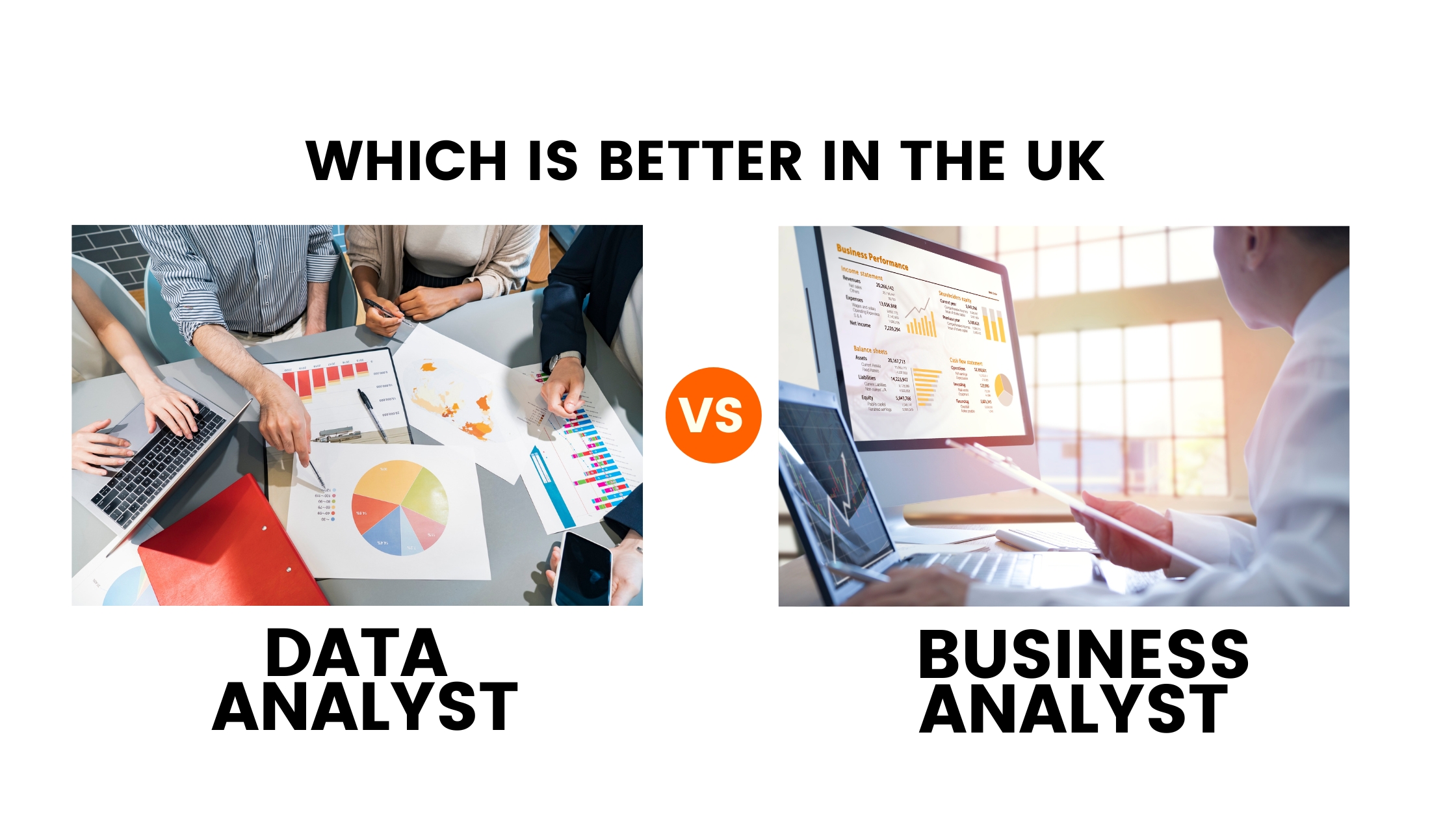
Which is better in the UK: data analyst vs business analyst career? That’s the question many people ask.
I’ll walk you through the roles. I’ll keep the language simple. Short sentences. Clear facts. Friendly tone.
Both roles work with data. Yet they do different things. A data analyst cleans, processes, and explores data. They build charts, run queries, and make dashboards.
The UK National Careers Service describes data analysts as people who use statistics and software to turn raw numbers into insight.
A business analyst studies the business. They gather requirements from teams and translate them into actions.
The National Careers Service explains that business analysts focus on business needs, processes, and systems.
What each role actually does
But what are data analysts, exactly?
They extract meaning from tables, test hypotheses, write SQL and build dashboards in Power BI or Tableau.
They often work with data engineers and data scientists. Many sources note that data analysts use technical tools more often than business analysts.
But what is a business analyst?
A business analyst focuses on the “why” behind business problems. Also, a business analyst write user stories and requirements.
They link business goals to technical work and work with stakeholders across the company. This role often needs strong communication and process-mapping skills.
How these roles differ in daily responsibilities
Daily life looks different for each role. A data analyst might spend hours in SQL. They clean messy data, test models and refine charts. It also checks data accuracy. Their day is technical and detail-led.
A business analyst spends time in meetings. They ask questions, write precise requirements, map workflows and check that solutions meet business needs. Their day is people-led and process-focused.
Here are quick contrasts:
- Object of analysis: data vs business processes.
- Tools: SQL, Python, BI tools vs Visio, stakeholder tools, and documentation.
- Output: dashboards and reports vs requirements and project plans.
How they complement each other in UK businesses
Teams that pair these skills win. The data analyst finds the fact. The business analyst turns that fact into action.
One builds a dashboard that shows a drop in sales. The other asks why sales dropped. The BA then helps design the fix. This partnership speeds decisions. It also reduces mistakes.
In many UK firms, data analysts and business analysts work closely. The BA frames the question. The data analyst answers it with evidence. Together, they guide strategy and improve processes.
Skills Required for Data Analyst vs Business Analyst Roles
When looking at Business Analyst vs Data Analyst, choosing between these careers often comes down to skills. Below is a breakdown of the core abilities each role needs.
Keep in mind: some skills overlap. Many people can switch from one role to another with the proper training.
Technical skills (SQL, Excel, Python, Power BI, Tableau)
Data analysts need solid technical skills since it ranks as one of the Highest Paying Tech Jobs UK 2025. They must query databases with SQL, use Excel daily and often code in Python or R.
They build dashboards in Power BI and Tableau. These tools help them clean data, run analyses, and deliver insight.
Business analysts may use some of these tools. But they rarely need deep coding skills. Excel and basic SQL help.
More often, they use tools for diagrams and documentation. Think Visio, Lucidchart, Jira, and Confluence.
What is the technical skill mix for each role?
- Data Analyst: SQL, Python/R/R, Excel, Power BI/Tableau, data cleaning, basic statistics.
- Business Analyst: Excel, basic SQL (nice-to-have), process modelling, documentation tools, user stories.
Business and communication skills (stakeholder management, reporting)
Business analysts live in stakeholder conversations. They must explain complex points in simple, clear language. Also, run workshops, negotiate and prioritise. This makes stakeholder management a core skill.
Data analysts must also tell a story. They present results to non-technical people. That means clear reports and simple dashboards.
Communication is key for both roles. The difference is emphasis: BAs do more facilitation. Data analysts do more technical translation.
Yes, that’s important.
Analytical thinking and problem-solving abilities
Both roles need strong analytical minds, must question assumptions and test ideas with data. They solve problems differently:
- Data analysts use algorithms, statistics, and code to test ideas.
- Business analysts apply frameworks, process maps, and stakeholder insight to design solutions.
How can you use this technique to grow? Start small. Practice on real data sets. Run a short workshop.
Then reflect on what worked. Repeat. Over time, you’ll build the mix of skills employers want.
See Also
Salary Comparison in the UK (2025 Data)
Choosing between careers often comes down to pay. Let’s look at the 2025 numbers for the UK. Salaries vary by experience, city, and industry.
London usually pays more. Public sector roles can pay less than those in finance and technology.
The numbers below are current estimates from UK job sites and salary guides. I include ranges, typical midpoints, and direct sources.
Use these as realistic guides. They help you compare the two careers. Remember: salary is one factor. Job fit, growth and work style matter too. Now let’s break this down by role and experience.
Average data analyst salaries by experience
- Entry-level data analysts in the UK usually start around £24,000–£30,000.
- Mid-level analysts (2–5 years of experience) typically earn between £32,000 and £45,000.
- The 75th percentile salary for Senior Data Analysts has been around £77,500, and the 90th percentile around £95,000.
For example, Reed’s data shows an average data analyst salary of around £49,362, with many listings clustering between £45k– £56k.
But what are data analyst earnings, exactly? Entry pay depends on skills like SQL and BI tools. If you add Python, statistics or cloud skills, you climb faster.
London roles often pay a premium, sometimes 10–20% more than the national average.
In specialist finance or trading teams, senior analysts can earn far more than the market median. Use these ranges to set expectations. Pay rises come with both technical depth and impact on business decisions.
Average business analyst salaries by experience
Business analyst salaries in the UK also vary by experience and sector.
- Entry-level BAs commonly start around £28,000–£35,000.
- Mid-level BAs typically earn £31,000–£53,000.
- Senior or specialised business analysts, especially those in consulting or finance, can reach £60,000–£80,000.
Glassdoor reports an average business analyst salary of £45,600 per year, with a typical 25th–75th percentile range of about £34,500–£61,200.
What is a good way to read these figures? Look at percentiles. The 25th percentile represents a realistic starting pay.
The 75th percentile points to experienced pay. If you want faster salary growth as a BA, focus on industry knowledge, stakeholder influence and certifications.
BAs who become product or programme leads often quickly advance into manager pay bands.
Top-paying industries for analysts in the UK
Top-paying sectors for both data and business analysts are finance, tech, consulting, and some areas of healthcare and energy.
Finance and fintech often offer one of the Top Ten Highest Salaries in the UK. Tech firms, especially scaleups and big cloud companies, pay well for analysts who can move fast and ship insight.
Consulting firms pay clearly for breadth and client-facing skill; their senior analysts often move into high-fee consulting roles.
For example, London specialist reports show that senior data roles in finance can command salaries well above market medians, and many London senior roles fall within the £70k–£90k band.
But what industries are hiring most right now? Banking and financial services still hire strong analytics teams.
Health tech and NHS analytics teams are expanding data functions too. Public sector roles grow for policy and performance analysis, though pay is usually below that in the private sector.
If high pay is a top goal, target finance, fintech, big tech, or leading consultancies.
See Also
Education and Certifications Needed
A clear learning path helps you move into either career. Formal degrees help. But certifications and practical training speed hiring for many entry-level roles.
Employers now value demonstrable skills and projects almost as much as a degree. Below is a list of recommended certification paths for each role.
Also, list practical UK bootcamps and explain what each offers, including RKY Careers, per your request.
Recommended paths for data analysts (Google Data Analytics, Microsoft, CompTIA)
To Become A Data Analyst, or you want to start Transitioning to a New Industry in the UK with a solid foundation. Google’s Data Analytics Certificate is beginner-friendly and focuses on practical skills like cleaning, analysis, and visualisation.
Microsoft offers role-based paths (Power BI certifications) that show hands-on BI skills.
CompTIA’s Data+ is another practical, vendor-neutral cert that covers data literacy, analysis, and governance. Employers value any of these when paired with portfolio projects.
How can you use this technique? Build a small project for each skill you have. Using SQL, extract and summarise a public dataset.
For Power BI or Tableau, publish a dashboard. With Python, do a simple analysis and document it.
These projects are proof that you can apply tools, not just pass tests. Employers often request a portfolio or GitHub profile during interviews.
Recommended paths for business analysts (BCS, IIBA, AgileBA)
For business analysts, industry certifications demonstrate competence in process and methodology. For a start, you can get an Entry Level Business Analyst Certification.

Source: bcs.org
The UK’s BCS (British Computer Society) offers widely respected BA certificates.

Source: iiba.org
IIBA (International Institute of Business Analysis) offers the ECBA, CCBA and CBAP tracks for novice to expert levels.
AgileBA is helpful if you work in agile product or delivery teams. These certifications teach frameworks for requirements, stakeholder mapping and solution validation.
Yes, that’s useful: start with a foundation certificate (BCS or ECBA). Then pursue AgileBA or CCBA as you take on real projects.
Combine certifications with on-the-job examples and case studies you can talk through in interviews. That mix of theory and evidence is what recruiters want.
Bootcamps and online courses in the UK
Bootcamps fast-track practical skills. Here are five respected options, with a short note on each:
- RKY Careers: UK-focused bootcamps in data analysis, business intelligence and business analysis.

Source: rkycareers
They run practical live training, offer UK-style projects, CV and LinkedIn support, and provide UK job-ref references for project work.
Good for people targeting UK entry roles and visa-aware job search help.
- General Assembly: Well-known global bootcamp with UK data analytics cohorts. Offers intensive courses in SQL, Excel, Python, Power BI and portfolio-building.
Source: generalassembly
Career services and hiring partnerships are part of the package. Tuition is higher, but outcomes are strong for career-changers.
- Makers (Makers.tech): UK-based tech bootcamp with data and data engineering paths. Focuses on employer-led outcomes and real-world projects.
Suitable for graduates who want deep technical training and employer network access.
- Le Wagon: global coding bootcamp with data/data-science tracks in select cities.
Suitable for full-stack or data-focused roles when you need coding depth and a strong alum network. They offer intense, short-format training.
- Springboard (online): Offers mentored, career-track programs in data analytics and data science with job guarantees in some markets.
You can motivate self-learners who want one-to-one mentoring and a structured capstone project.
Each bootcamp differs in cost, length and outcomes. If you want a shorter path, choose a 12-week intensive.
If you need slower pacing, pick a part-time option. Regardless of route, pick a program that helps you build a portfolio of real projects.
Employers value evidence more than luxe certificates.
See Also
- Building a Job-Ready Portfolio for Data Analyst Roles
- How to Ask Thoughtful Questions at the End of an Interview
Job Outlook and Growth Opportunities in the UK
Demand for analyst skills remains strong in 2025. Employers need people who can turn data into decisions.
Both roles are expected to grow. But growth shapes differ by industry and role. Here, I outline which industries hire the most, how progression looks, and remote/hybrid work trends.
UK industries hiring analysts in 2025
Four industries stand out:
- Finance & Fintech: Big banks, investment firms and fintechs hire heavy analyst talent. They need data to price risk, personalise offers, and automate decisions.
These sectors pay well and hire both data and business analysts. Expect analytics roles in risk, trading, and customer analytics.
- Healthcare & Health Tech: The NHS and private health-tech firms expand analytics teams. They use data for patient outcomes, capacity planning and digital services.
Public health programs and research labs need analysts, also. Pay varies, but mission-driven roles are common.
- Technology & SaaS: Tech firms hire analysts to measure product metrics, user funnels, and growth experiments.
Data analysts work closely with product teams. Business analysts focus on product requirements and feature rollouts.
- Public sector & Government: Central and local government bodies hire analysts for policy, performance monitoring and service delivery.
Growth here is steady. Roles often focus on transparency, regulation and public planning.
Which is better in the UK: data analyst vs business analyst career? The answer depends on the industry you want.
Finance and tech favour deep data skills. Public sector roles favour process and policy understanding. Health tech values a mix of both.
Career progression paths (senior, consultant, manager roles)
Data Analyst Career Progression and Business Analyst career ladders often follow a similar arc:
- Senior Analyst: Focuses on complex analysis, mentorship and technical leadership. Senior analysts build robust models and influence designs. They still write code or lead deep analyses.
- Consultant / Specialist: Often in consultancies or as internal specialists. Consultants handle project-based work, client relationships, and strategic recommendations. They bill hours or lead engagements.
- Manager / Head of Analytics or BA Lead: Moves from hands-on work to people and project leadership. Managers set strategy, prioritise work, and handle budgets and stakeholder alignment. Pay and responsibility increase significantly.
How do these differ? Seniors still do hands-on analysis. Consultants sell solutions and manage client expectations. Managers shift to team leadership and delivery oversight.
Moving from senior to manager requires communication, hiring, and strategy skills; the jump is as much about people as about tech. If you want a leadership path, develop stakeholder skills early.
Remote and hybrid job trends in the analyst market
Remote and hybrid work are common in analyst roles. UK surveys find hybrid work is now standard for many knowledge roles.
The Global Survey of Working Arrangements found UK workers average about 1.8 remote workdays per week, higher than the global average.
This trend shows analysts can often work flexibly, especially when tasks are analysis and meetings rather than lab or site-based work.
And what does that mean for you? If remote work matters, focus on roles in tech, consultancy, and fintech.
These sectors are most open to hybrid or fully remote analysts. Public sector and on-site health roles may need more office presence.
If you want geographic flexibility, build visible outputs, dashboards, documented projects and strong communication that prove you can deliver remotely.
See Also
Which Career Should You Choose?
Which is better in the UK: data analyst vs business analyst career? The honest answer is: it depends on your strengths and goals.
Consider lifestyle too. Data analyst days can feel solitary and focused. Business analyst days often involve meetings and negotiations. Think about what gives you energy.
Which is better in the UK: data analyst vs business analyst career? Use that question to guide choices.
Try short projects in both fields. Test SQL tasks for one week. Run a requirements workshop another week. The more you try, the clearer the fit.
Best option for technical professionals
If you like tooling and coding, pick data analyst work. Data roles reward SQL, Python and BI skills. You will build models, queries and dashboards. You will run tests and validate numbers.
Technical people often enjoy the depth here. Data analytics career UK roles often lead to data scientist or data engineering paths.
That path moves you toward advanced modelling and machine learning if you want it. Data analyst roles also let you specialise by industry. Finance and ad-tech often need strong technical chops.
If you love scripting, data analyst training UK programs will feel natural. That said, many technical people also enjoy business analysis.
They like blending code with product thinking. If you prefer coding and analysis most days, then technical work as a data analyst is the best option.
Which is better in the UK: data analyst vs business analyst career? For technical people, data analyst usually wins because of the depth of technical work and clear upskilling routes.
Best option for strategic / business-minded professionals
If you like talking to people and shaping solutions, the business analyst route is strong. Business analysts translate strategy into requirements.
They work with stakeholders and product teams. They map processes and design improvements. If you want to lead programmes or influence policy, this path offers that.
Business analysis career path UK roles often move into product management, programme leadership, or consultancy.
Strategic thinkers who enjoy workshops, writing user stories, and negotiating trade-offs will find BA work satisfying.
Business analyst certifications UK help show employers you know the craft. Also, BAs can use light data skills to strengthen decisions.
Many senior BAs blend analysis with strategy. Which is better in the UK: data analyst vs business analyst career? For strategic minds, business analyst often offers faster moves into leadership and broader business influence.
How to switch between both roles in the UK
Switching is common and practical. To move from BA to data analyst, build technical skills. Learn SQL first. Do simple Python or R tasks.
Build a small dashboard. Show it in a portfolio. Take data analyst training UK courses and add projects.
Recruiters value proof of applied skills. To move from data analyst to BA, boost stakeholder and process skills.
Practice writing user stories. Run a mock workshop. Get a BCS or IIBA certification and highlight your communication examples. Many employers welcome hybrid profiles.
They pay for people who can code and influence. Want a roadmap? Do a three-step plan: learn one new technical skill, complete one portfolio project, and lead one business-facing task.
Repeat until you can show both sides. Entry-level analyst jobs UK often hire candidates with mixed skills. Use those roles to switch.
Which is better in the UK: data analyst vs business analyst career? The best answer is the career you can grow in, given your skills and the work you enjoy.
FAQs: Which Is Better in the UK: Data Analyst vs Business Analyst Career?
Who earns more in the UK, a data analyst or a business analyst?
Salaries overlap. Senior roles in finance or tech can pay more for data analysts. Senior business analysts in consulting can also earn high pay. See salary sections above for ranges.
Which is easier to start, data analysis or business analysis?
Business analysis can be easier to start if you have strong communication and process skills. Data analysis is easy to start if you learn SQL and build projects. Both routes have entry-level options.
Can a business analyst become a data analyst in the UK?
Yes. Learn SQL and a BI tool. Build a portfolio with real datasets. Take data analyst training UK courses. Show practical projects to employers.
What qualifications do you need to be an analyst in the UK?
Degrees help, but practical certificates and projects matter more. Consider Google Data Analytics, Power BI certificates, BCS or IIBA for BA, and recognised bootcamps like RKYCareers.