Signs You Will Not Get the Job After the Final Interview
You left the interview feeling uncertain. Maybe the conversation felt rushed, or the interviewer barely made eye contact. Now you are refreshing your inbox and wondering what went wrong. Recognising the signs you will not get the job offer early can actually work in your favour.
Here’s why: it frees you to refocus your energy, apply elsewhere, and avoid the painful wait of false hope. Understanding these signals is not about being pessimistic. It is about being smart with your time and your career strategy.
How to Tell If You Will Not Get the Job Offer
Most candidates leave interviews unsure of how they performed. That is completely normal. However, there is a meaningful difference between ordinary post-interview nerves and clear, pattern-based signals that things did not go well.
Here is the reality: hiring managers are trained to remain professional regardless of their internal decisions. That means a friendly, polite interview does not always equal a positive outcome. The clues are often subtle, and they tend to live in the gaps, what was not said, what was not asked, and what happened (or did not happen) after you left the room.
The sooner you learn to spot these signals, the sooner you can redirect your energy toward opportunities where you have a genuine shot.
Why It’s Important to Read Interview Signals Carefully
Most candidates walk out of interviews unsure. That uncertainty is normal. However, there is a significant difference between natural nerves and clear signs that things did not go well.
Reading interview signals carefully saves you weeks of anxious waiting. It also gives you a head start on your job search, while other candidates sit and hope.
Look: interviews are a two-way process. The hiring manager is evaluating you, but you should be evaluating them too. Their body language, their questions, and their words all tell a story.
Understanding Recruiter Behaviour and Hiring Patterns
Recruiters follow patterns. When they are genuinely interested in a candidate, they tend to sell the role. They discuss timelines, ask about your availability, and introduce you to other team members.
When they are not interested, the interview becomes transactional. They collect the information they need and move on.
Understanding these patterns helps you separate genuine enthusiasm from professional politeness. Both can look very similar in the moment, but they feel different in hindsight.
Clear Signs You Will Not Get the Job Offer
Now, let us get into the specific red flags. These are the signs you didn’t get the job that most candidates either miss or choose to ignore.
The Interview Was Cut Short
Every interview has a scheduled duration. If yours ended significantly earlier than expected, that is worth noting.
Hiring managers who are excited about a candidate tend to go over time. They ask follow-up questions. They explore your background in depth. An interview that wraps up 15 to 20 minutes early, without explanation, is a warning sign.
Here’s one example: a candidate scheduled for a 45-minute interview wraps up in 25 minutes. The interviewer thanks them, stands up, and offers no indication of next steps. That is not a great sign.
Lack of Enthusiasm From the Interviewer
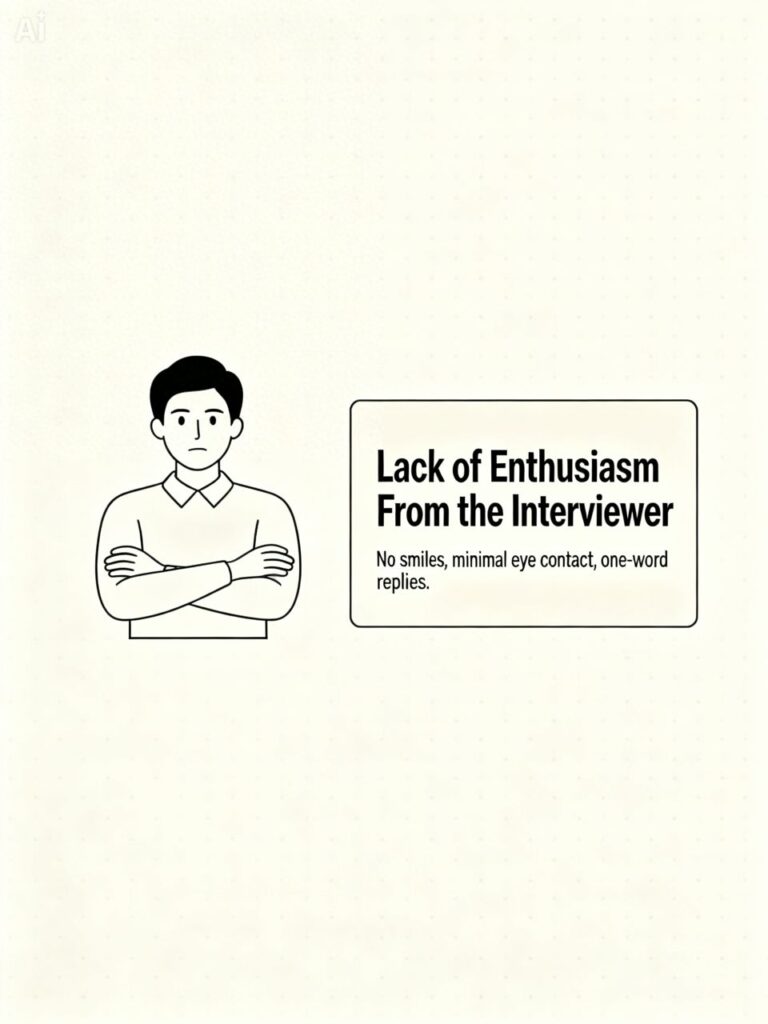
Tone matters enormously in interviews. A hiring manager who is excited about you will lean in, ask thoughtful follow-up questions, and smile genuinely.
Contrast that with an interviewer who gives short responses, seems distracted, or checks their phone. That disengagement often reflects a decision that has already been made, or is leaning strongly in one direction.
Vague Answers About Next Steps
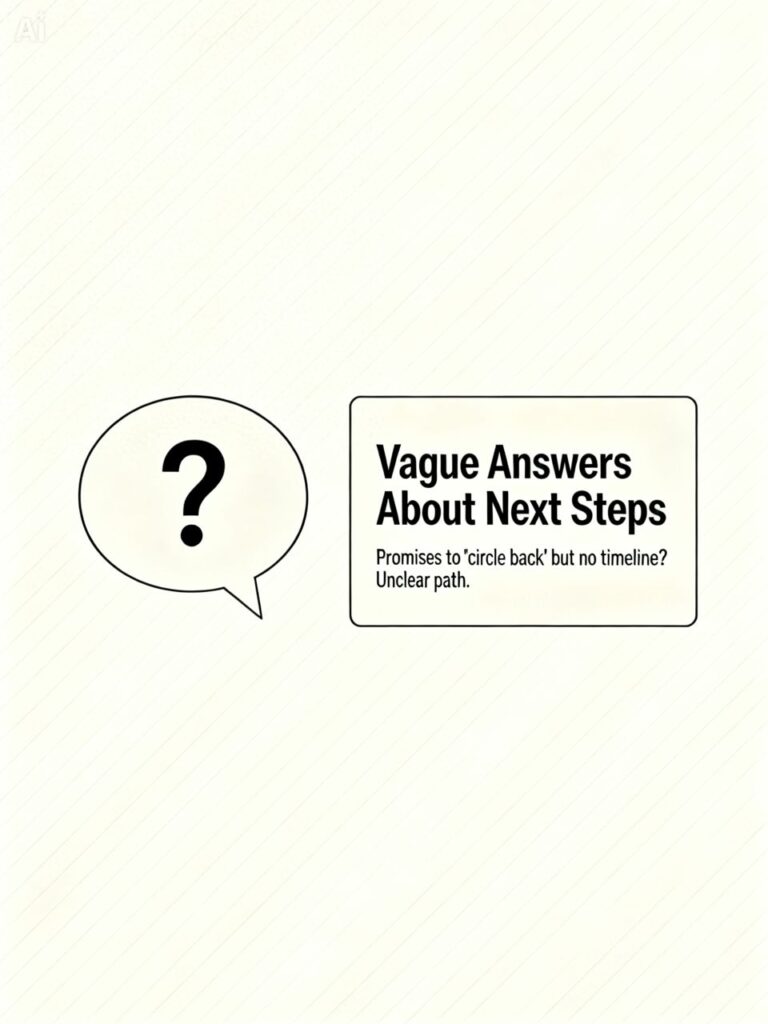
This is one of the clearest job interview rejection signs there is. At the end of a successful interview, most hiring managers will outline a clear timeline. They might say, “We are interviewing candidates this week and will be in touch by Friday.”
But what if they say, “We will be in touch” with no specifics? Or, “Our timeline is still being confirmed”? Those vague responses often signal that you are not the top-choice candidate.
No Discussion About Salary or Start Date
Here’s the deal: when a company wants to hire you, they naturally begin to imagine you in the role. That means discussing practical details, when you could start, what salary range you are looking for, and whether there are any logistical concerns.
If none of that came up during the interview, it is a reasonable sign that the hiring manager did not picture you in the position long enough to consider those details.
You’re Not Introduced to the Team
Many companies, especially for senior or specialist roles, will arrange for candidates to briefly meet the team. It might be a casual walk through the office or a quick introduction to a future colleague.
If you were not introduced to anyone else and the role clearly involves working with a team, that omission can be telling. Hiring managers save team introductions for candidates they are genuinely considering.
Subtle Red Flags After the Interview
The interview room is not the only place where signs of employers not interested show up. What happens in the days and weeks after your interview can be just as, if not more, revealing.
These post-interview signals are often overlooked because candidates are too busy replaying the conversation in their heads to pay attention to what is happening around them.
Delayed or No Follow-Up Communication
Timing matters. If a company is excited about a candidate, they move quickly. A delay of more than a week, with no update, is one of the stronger signs that an employer is not interested.
According to the Greenhouse 2024 State of Job Hunting report, 61% of job seekers have been ghosted after a job interview, a nine-percentage-point increase since April 2024. Ghosting is not always confirmation of rejection, but extended silence rarely signals good news.
Generic or Automated Responses
Receiving an automated “We are reviewing applications” email after your interview is not encouraging. Companies that are seriously considering you tend to send personalised responses or reach out directly.
A generic holding message, especially one that does not reference your specific interview, often suggests you are in a large pool rather than on a shortlist.
Job Posting Remains Active for Long Periods
Check the job listing after your interview. If the role has been re-posted or is still actively accepting applications two weeks after your interview, that is a meaningful sign.
It suggests the company either did not find the right candidate in the current round, or they did, and it was not you.
Read Also:
Signs During the Interview That Things Went Wrong
Sometimes, signs of an interview going badly are visible in real time, not just in hindsight. Learning to identify these signals during the conversation is valuable, both for managing your composure in the moment and for interpreting the outcome accurately afterwards.
The key is to observe calmly without over-reacting, and to notice patterns rather than isolated moments.
Interviewer Seems Distracted or Disengaged
A distracted interviewer is rarely a good sign. If the hiring manager was checking their watch, seemed to rush through questions, or gave shallow responses to your answers, they may have already decided you are not the right fit.
Now: this does not automatically mean rejection. Hiring managers are human. They have busy days. But consistent disengagement throughout the interview is a pattern worth acknowledging.
Questions Are Very Basic or Rushed
Strong candidates get probing questions. Interviewers want to understand how they think, how they handle pressure, and how they approach complex challenges.
Basic, surface-level questions, especially if they are asked quickly without depth, can suggest the interviewer is going through the motions. They may be completing a process rather than genuinely exploring your fit for the role.
You’re Not Asked About Availability or Long-Term Plans
Here’s something we can both agree on: a company that wants to hire you will ask when you can start. They will want to know your notice period. They might also ask about your longer-term career goals to assess cultural alignment.
If none of those questions came up, that absence speaks volumes. It is one of the clearest hiring manager red flags candidates tend to overlook at the moment.
Signs You Still Might Get the Job (Don’t Panic Yet)
Before you write off your chances entirely, take a breath. Not every delay, vague response, or quiet inbox is a rejection. Hiring is a complex and often chaotic internal process and many signals that feel like bad news are simply the result of organisational friction that has nothing to do with your performance or suitability.
Delays Due to Internal Hiring Processes
Many organisations have lengthy internal approval chains. A hiring manager might love you but still need sign-off from HR, a director, or even a board member before extending an offer.
According to GoodTime’s 2025 Hiring Insights Report, 60% of companies reported an increase in their time-to-hire in 2024, up from 44% in 2023. Slow responses are increasingly common and not always a rejection signal.
Multiple Candidates Still Being Evaluated
Timing matters here too. If you were interviewed early in a hiring cycle, the company may still be speaking with other candidates before making a decision.
This is standard practice. It does not mean you are out of the running. In fact, research from high5test.com shows the average time-to-hire is approximately 44 days across most industries, meaning a week of silence is often just part of the process.
Company Communication Delays
Budget freezes, leadership changes, or internal restructuring can slow everything down. These situations are frustrating but entirely outside your control.
A polite follow-up email (which we cover below) can help you get clarity without appearing desperate or pushy.

At RKY Careers, we help professionals like you nail every stage of the hiring process — from interview preparation to career branding and job placement support. Our personalised approach has helped over 1,500 professionals land roles they love.
Book a Free Career Consultation
What to Do If You Think You Didn’t Get the Job
Even if you are fairly certain about the signs you will not get the job offer, there are strategic steps you can take right now.
Read Also:
- Personal Branding for Job Seekers: What Matters Most in 2026
- How to Build a ‘Hire-Me’ Presence Online in 30 Days
Send a Professional Follow-Up Email
Send a brief, polished follow-up email within 24 to 48 hours of your interview. Thank the interviewer for their time. Reiterate your interest in the role and briefly highlight one or two key strengths that make you a strong fit.
According to Apply Buddy, a well-crafted thank-you note can leave a lasting impression, even turning a borderline decision in your favour.
Example follow-up structure:
| Section | What to Include |
| Opening line | Thank the interviewer by name |
| Middle | Reiterate your interest + one specific highlight from the conversation |
| Closing | Express eagerness to hear about next steps |
| Sign-off | Professional and warm |
Request Feedback for Improvement
If you receive a rejection, do not simply move on. Politely ask for feedback. Most candidates never do this, which means those who do stand out immediately.
The Greenhouse 2024 Candidate Experience Report found that 79% of candidates would reapply to a company if they received feedback after rejection. Feedback is not a consolation prize, it is career intelligence.
Also, according to Apply Buddy, using feedback to prepare specifically for behavioural interview questions can significantly improve your performance in future interviews.
Continue Applying for Other Roles
This is critical. Do not pause your job search while waiting to hear back from one company.
The data is clear: research shows that many candidates now submit anywhere from 32 to over 200 applications before receiving an offer. Keeping your pipeline active is not a sign of disloyalty. It is a smart strategy.
Read Also:
- How to Overcome Interview Anxiety and Project Confidence
- How to Talk About Your Skills in an Interview
Common Mistakes That Lead to Rejection
Sometimes, the job application rejection signs have nothing to do with the company and everything to do with how you showed up. Many interview red flags for candidates are entirely preventable. Understanding what typically causes rejection puts you in a far stronger position the next time you sit across from a hiring manager.
Poor Preparation for the Interview
This one is blunt but important. According to TeamStage, 47% of recruiters will immediately reject candidates who show no knowledge of the company.
Walking into an interview without researching the company’s products, culture, and recent news is one of the fastest ways to lose the role.
Preparation is not optional. It is the foundation of a strong interview performance.
Not Aligning Your Skills With the Job
One of the most common interview mistakes to avoid is talking about your experience in general terms rather than linking it directly to the job description.
Hiring managers are looking for evidence that you can solve their specific problems. Vague answers about “leadership skills” or “being a team player” without concrete examples will rarely impress.
Here’s how to avoid this: before every interview, map each of your key skills to a specific requirement in the job description. Then prepare a short story for each one using the STAR method (Situation, Task, Action, Result).
Weak Communication or Lack of Confidence
Job application rejection signs often show up in how candidates carry themselves, not just what they say.
According to TeamStage, candidates only have seven seconds to make a good first impression. Poor posture, weak handshakes, or a hesitant tone can all signal a lack of confidence, even when the candidate is highly qualified.
Also, interview feedback clues from rejected candidates frequently highlight communication as the deciding factor. Speak clearly, make eye contact, and show genuine enthusiasm for the role.
Finally, consider the ‘what happens if you don’t get hired’ question practically. Think of each rejection as data. It tells you something about where to improve, what to emphasise, and how to present yourself more compellingly next time.
Read Also:
FAQs
How do you know if you didn’t get the job after an interview?
Common signs you will not get the job offer include a shortened interview, vague next-step responses, no salary discussion, and prolonged silence afterwards..
Is no response after an interview a bad sign?
Not always, but it often is. Research shows that 61% of job seekers have been ghosted after interviews. A week of silence is concerning. Two weeks or more, with no update despite a follow-up, is a strong indicator of rejection.
How long should I wait before assuming rejection?
A general rule: if the company gave you a specific timeline and you have not heard back five to seven business days past that date, send a follow-up email. With no timeline given, wait seven to ten business days before following up.
Can a bad interview still lead to a job offer?
Yes, sometimes. Internal timelines, distracted interviewers, and personal circumstances can all create poor interview experiences that do not reflect the outcome.
Should I follow up after an interview?
Absolutely. Sending a professional thank-you email within 48 hours is standard practice. If you have not heard back within the agreed timeline, a brief follow-up is appropriate and professional.