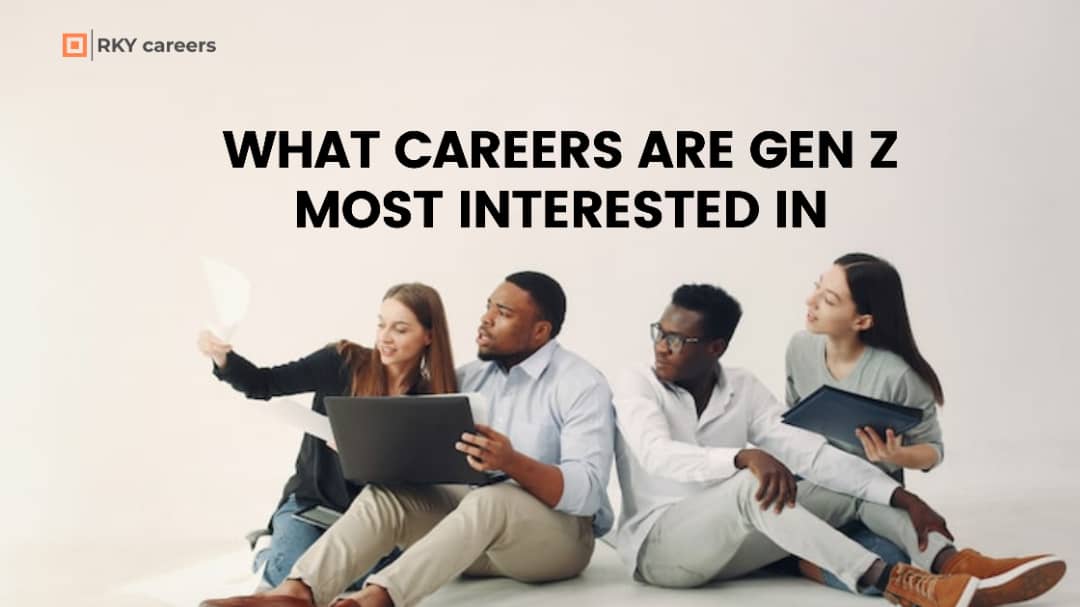
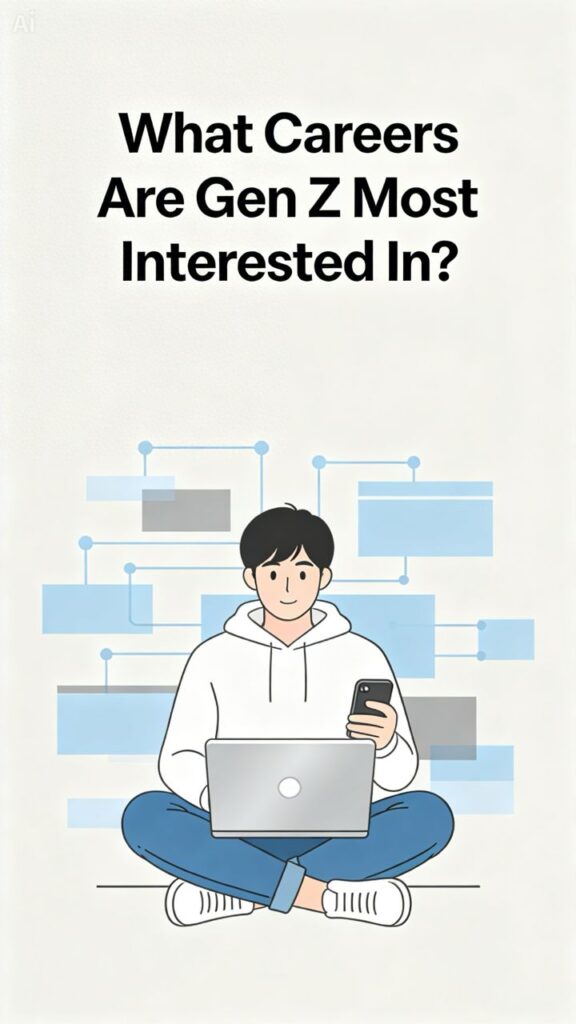
What Careers Are Gen Z Most Interested In? Top Jobs in 2026
If you’ve been paying attention to the job market lately, you already know something is shifting. A new generation of workers has arrived, and they’re doing things differently. So, what careers are Gen Z most interested in? The answer is more nuanced, more diverse, and more fascinating than most people expect.
From software development to skilled trades, from financial analysis to freelancing, Gen Z is not just entering the workforce, they’re reshaping it entirely. Understanding their career choices isn’t just useful for employers. It’s essential knowledge for anyone navigating the modern job market.
Why Gen Z Career Choices Are Different
Here’s the deal: Gen Z isn’t playing by the same rules as previous generations.
Born roughly between 1997 and 2012, this generation grew up during financial crises, a global pandemic, and the rapid rise of AI. Those experiences didn’t just shape their worldview, they shaped their career decisions in profound ways.
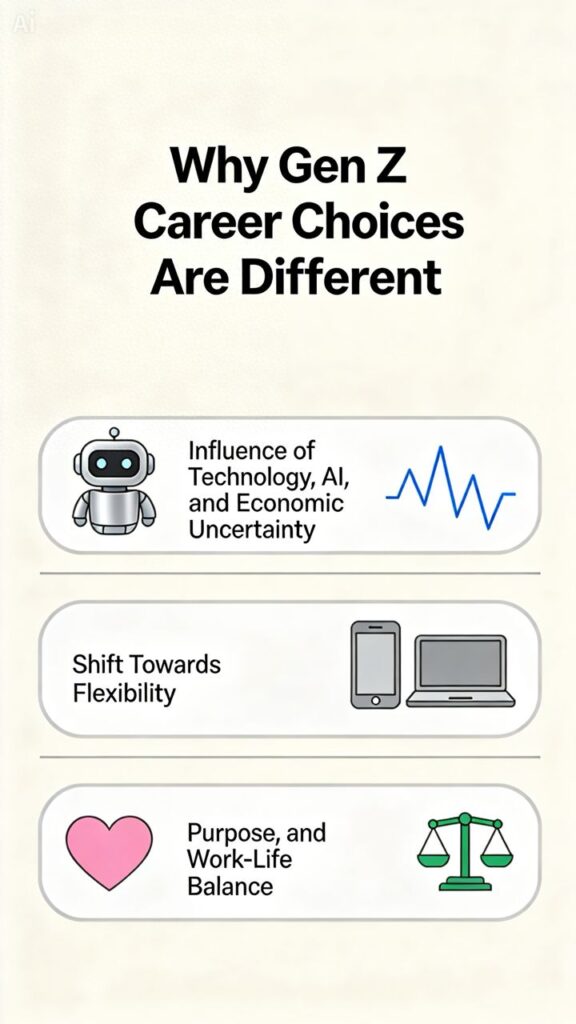
Influence of Technology, AI, and Economic Uncertainty
Technology is the air Gen Z breathes. Unlike older generations, they didn’t adapt to digital tools, they were raised on them. That background has made them acutely aware of how automation and AI are changing the types of jobs that will exist in ten years’ time.
Look: this awareness is driving them toward roles that are either AI-powered or AI-resistant. They want to be the people building and managing intelligent systems, not the people being replaced by them.
Economic uncertainty has played an equally significant role. Many Gen Zers watched their parents lose jobs during the 2008 financial crash. Then they experienced pandemic-induced instability themselves. As a result, financial security and career resilience are top priorities when choosing a career path.
According to Randstad’s latest global report, entry-level job postings for roles requiring 0–2 years of experience have declined by an average of 29 percentage points since January 2024. That’s a tough landscape to enter. Yet Gen Z isn’t sitting still, they’re finding creative ways to build skills, launch side hustles, and create their own opportunities.
Shift Towards Flexibility, Purpose, and Work-Life Balance
But here’s the kicker: Gen Z doesn’t just want a good salary. They want work that means something.
According to Deloitte’s 2025 Gen Z and Millennial Survey, 89% of Gen Z consider a sense of purpose to be very or somewhat important for their job satisfaction and well-being. That’s not a preference, it’s a non-negotiable.
Furthermore, flexibility isn’t a perk for Gen Z. It’s a baseline expectation. Deloitte’s 2024 Gen Z and Millennial Survey confirmed that work-life balance is the top consideration when Gen Z is choosing an employer, with 44% saying they would turn down employers that don’t align with their values around work-life balance.
So what careers are Gen Z most interested in? Primarily those that offer both purpose and flexibility. That’s the foundation. Everything else builds from there.
Read Also:
- 2026 Career Paths in Healthcare, Tech, Finance, and Creative Industries
- How Can I Decide What Career Is Right for Me?
Top Careers Gen Z Is Most Interested In (2026 Trends)
Now: let’s get into the specifics. What are the actual popular careers for Gen Z right now? Here’s a breakdown by sector, with the data to back it up.
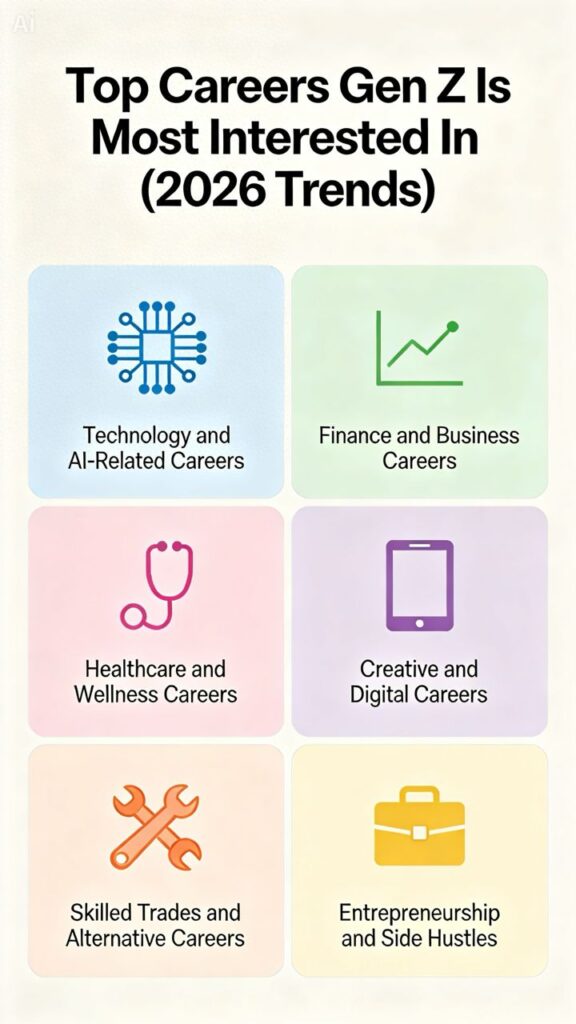
Technology and AI-Related Careers
This is probably where you expected Gen Z to land, and you’re right.
Software development, data analysis, and artificial intelligence roles are among the most sought-after Gen Z career trends of our time. Gen Z sees tech careers not just as lucrative, but as future-proof. They understand that AI isn’t going anywhere, so they’d rather be steering it.
Top roles in this category include:
- Software development – consistently high demand, strong salary, and remote-friendly
- Data analysis – growing across every industry, from finance to healthcare
- AI and machine learning – among the fastest-growing fields globally
Randstad’s report reveals that 75% of Gen Z are using AI to upskill, far more than any other generation, signalling that this cohort understands the value of adapting to technological change proactively.
The message is clear: Gen Z wants to work with AI, not against it.
Finance and Business Careers
Bold promise? Gen Z isn’t abandoning traditional sectors.
Finance remains a strong draw, particularly for Gen Zers who prioritise salary growth and career progression. Investment banking, financial analysis, and accounting offer clear pathways to high income, which matters to a generation dealing with rising costs of living.
Popular finance roles for Gen Z include:
- Investment banking
- Financial analysis and reporting
- Accounting and compliance
The appeal here is rooted in practicality. Finance careers offer structured growth paths, strong salaries, and transferable skills that remain relevant even as industries evolve. That stability is enormously attractive to a generation that grew up watching economic systems buckle.
Healthcare and Wellness Careers
You may be wondering: why is healthcare still so popular with such a tech-savvy generation?
The answer is twofold: job security and purpose. Nursing, mental health support, health tech, and telemedicine roles all offer what Gen Z wants, meaningful impact and reliable employment.
Gen Z is particularly drawn to:
- Nursing and healthcare support roles
- Mental health and counselling careers
- Health tech and digital telemedicine roles
Health tech, in particular, sits at the intersection of Gen Z’s two biggest interests: purpose-driven work and technology. It’s a growing space with significant career opportunities, and Gen Z is paying attention.
Creative and Digital Careers
Here’s one area where Gen Z has carved out entirely new categories.
Content creation, social media management, and graphic design have all become viable. and in some cases, highly lucrative, career paths. Gen Z grew up on Instagram, YouTube, and TikTok. Many have already built audiences and income streams before they’ve graduated.
Key creative careers Gen Z is exploring:
- Content creation and video production
- Social media management and strategy
- Graphic design and digital art
However, Gen Z is also cautious here. They understand that AI tools are starting to automate certain creative tasks, from copywriting to basic design. That awareness is pushing many toward creative roles that require human judgement, emotional intelligence, and originality.
Skilled Trades and Alternative Careers
This is crazy, but one of the most surprising Gen Z career trends involves turning away from office life altogether.
According to LinkedIn’s 2026 Grads Guide, 72% of young office workers are considering a switch to skilled trades, such as electrician, mechanic, and construction worker. In fact, 12% have already made the move.
Skilled trade roles attracting Gen Z include:
- Electricians and electrical engineers
- Technicians and mechanical specialists
- Construction and project-based trades
Why the shift? It’s economic pragmatism. Skilled trades offer steady demand, high pay, minimal student debt, and crucially, they are highly AI-resistant. For a generation thinking long-term about career security, that combination is compelling.
Entrepreneurship and Side Hustles
Now we get to perhaps the most defining Gen Z career trend of all.
LinkedIn’s 2026 Grads Guide found that 21% of Gen Z have started a business or side hustle to kickstart their career, with 22% building apps, websites, or projects to showcase their skills.
That’s roughly 1 in 5 Gen Zers creating their own opportunities, rather than waiting for someone to hire them.
Common Gen Z entrepreneurial paths include:
- Freelancing and consultancy
- E-commerce and digital products
- Startups and tech ventures
This entrepreneurial spirit reflects something deeper: a distrust of traditional employment structures and a desire for autonomy. Gen Z doesn’t just want a seat at the table, many want to build their own.
Read Also:
- Personal Branding for Job Seekers: What Matters Most in 2026
- How to Identify Your Career Goals and Find a Fulfilling Path
Key Factors Influencing Gen Z Career Choices
So what actually drives these decisions? Understanding what careers are Gen Z most interested in requires understanding why they make the choices they do.
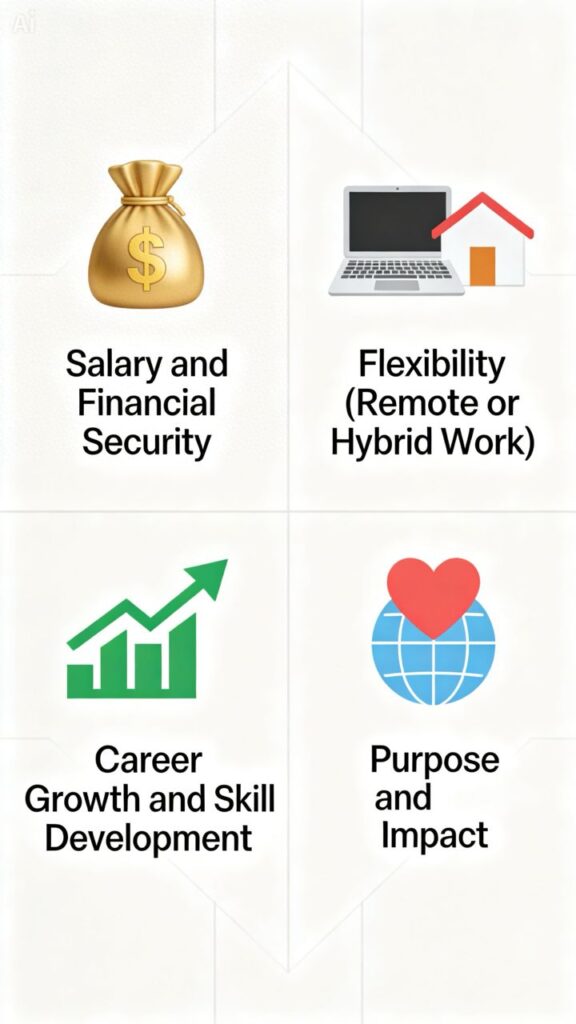
Salary and Financial Security
Let’s be honest, money still matters.
Research shows that 85% of Gen Zers cite barriers such as the higher cost of living as a significant financial challenge, making salary a major factor in their career decisions. They need income that keeps pace with rising rents, inflation, and student debt repayments.
However, Gen Z views salary differently than older generations. They want fair pay, but they’re not willing to sacrifice everything else just for it.
Flexibility (Remote or Hybrid Work)
This is non-negotiable for Gen Z.
Careers with flexibility and purpose are consistently ranked above high-paying but rigid roles. Remote-capable or hybrid jobs are significantly more attractive to this cohort. A role that offers a £5,000 lower salary but full flexibility will often beat a higher-paying desk job in Gen Z’s decision-making process.
Career Growth and Skill Development
Gen Z is ambitious, but not in a traditional climb-the-ladder sense.
They want to grow quickly, learn continuously, and build a portfolio of valuable skills. Mentorship, training opportunities, and clear progression frameworks are powerful attractors. Static roles with no development path are deal-breakers.
Purpose and Impact
Here’s something we can both agree on: money alone doesn’t motivate people long-term.
Gen Z has internalised this truth perhaps more than any generation before. Purpose and impact sit at the core of their career choices. They want to know that their work contributes to something meaningful, whether that’s healthcare, education, sustainability, or community.
Read Also:
Work Preferences Shaping Career Choices
Understanding Gen Z job preferences means looking beyond what they want to do, and examining how they want to work.
Preference for Hybrid Work Over Fully Remote
Surprise: Gen Z doesn’t actually want to work from home all the time.
According to Gallup’s latest research, 71% of Gen Z employees prefer a hybrid work environment, the highest percentage among all generations. They value the flexibility of remote work, but they also crave human connection, mentorship, and collaboration.
This makes sense when you consider that many Gen Zers entered the workforce during the pandemic, isolated, without mentors, learning remotely. Now they want balance: the flexibility to work from home, but the richness of in-person connection when it matters.
Desire for Mentorship and Career Progression
Gen Z wants guidance, and they’re not afraid to ask for it.
Mentorship programmes, structured onboarding, and accessible managers are powerful tools for attracting and retaining Gen Z talent. They want to grow, and they want experienced professionals to help them do it. Companies that invest in mentoring Gen Z employees see stronger retention and higher engagement as a result.
Interest in Multiple Income Streams (Side Hustles)
The 9-to-5 is no longer the only model Gen Z recognises.
According to Glassdoor research, 57% of Gen Z workers now have a side hustle alongside their main job, nearly three times the rate of Baby Boomers. Whether it’s freelancing, e-commerce, or content creation, Gen Z views multiple income streams as a form of financial resilience.
This isn’t laziness or disengagement. It’s pragmatic risk management from a generation that has watched economic systems fail in real time.

RKY Careers helps professionals like you move into high-demand industries with confidence. Whether you’re exploring a tech career, planning a strategic career change, or building the skills employers are desperate for, our award-winning bootcamps and personalised career development programmes are designed to get you hired. Join 1,500+ professionals who’ve already made their move.
Book a Free Career Consultation
Future Career Trends for Gen Z
What does the road ahead actually look like? Let’s talk about where Gen Z career trends are heading in the coming years.
Rise of AI and Tech-Enabled Roles
AI is not replacing human workers, it’s changing what human workers do.
Future careers for Gen Z will increasingly involve working alongside intelligent systems, interpreting their outputs, and applying uniquely human judgement to complex situations. Roles in AI ethics, machine learning management, and AI-assisted data analysis are all growing rapidly. Gen Z is better positioned than any previous generation to thrive in this environment, provided they build the right skills now.
Growth of Flexible and Portfolio Careers
The linear career path: one employer, one role, one trajectory is fading.
Gen Z will be the generation that normalises portfolio careers: a combination of part-time roles, freelance projects, side businesses, and full-time employment. This isn’t instability. It’s intentional flexibility. Employers who understand this will attract better Gen Z talent by offering project-based work, flexible hours, and skill-stacking opportunities.
Increasing Demand for Human-Centric Skills
Here’s the irony of the AI age: the skills machines can’t replicate are becoming more valuable, not less.
Creativity, empathy, communication, critical thinking, and emotional intelligence are all on the rise. Best careers for young professionals will be those that combine technical fluency with these distinctly human capabilities. Gen Z, growing up in a world saturated with information, is developing these skills naturally, and employers are beginning to notice.
Best Career Paths for Gen Z in 2026 and Beyond
Now let’s pull it all together. What are the actual best career moves for Gen Z right now?
High-Growth Industries to Consider
| Industry | Why It’s Growing | Key Roles |
| Technology & AI | Automation demand, digital transformation | Software engineer, data analyst, AI specialist |
| Healthcare | Ageing population, health tech expansion | Nurse, mental health worker, health tech developer |
| Finance | Economic complexity, fintech growth | Financial analyst, accountant, investment banker |
| Green Energy | Climate policy, infrastructure investment | Renewable energy engineer, sustainability consultant |
| Skilled Trades | AI-resistant, high demand, good pay | Electrician, plumber, construction manager |
| Creative & Digital | Brand-driven economy, content demand | UX designer, content strategist, social media manager |
How to Choose a Future-Proof Career
I’ll explain with an example: imagine two Gen Z graduates. One chooses a role purely for salary, a rigid, repetitive office job with no flexibility or growth. The other picks a lower-paying but skills-rich role at a growing tech company, with mentorship and remote options. In five years, who do you think is better positioned?
Here’s how to choose wisely:
- Assess automation risk – Will this role still exist in ten years?
- Check flexibility – Does the sector accommodate remote or hybrid working?
- Look for mentorship – Will you learn from people more experienced than you?
- Consider purpose – Will the work matter to you on a bad day?
- Test the income ceiling – Is there clear salary growth within the field?
Jobs Gen Z is choosing increasingly to tick multiple boxes on this list, and that’s not a coincidence.
Skills Gen Z Should Focus on Building Now
The skills that will matter most in five years are already becoming clear. Focus on:
- Data literacy – understanding and interpreting data is valuable across every sector
- AI tools and prompting – knowing how to use AI effectively is a differentiator
- Communication and storytelling – clear, persuasive communication is timeless
- Financial literacy – understanding money is power, regardless of your industry
- Project management – coordinating people and outputs is always in demand
- Emotional intelligence – leadership in the AI age will be deeply human
High demand careers for young people all share one trait: they reward those who combine technical skills with strong interpersonal capabilities.
Read Also:
The bottom line? Understanding what careers are Gen Z most interested in isn’t just academic curiosity. It’s a strategic insight for anyone building their own career in the modern world. Gen Z’s instincts, toward purpose, flexibility, entrepreneurship, and continuous skill-building are, frankly, the right instincts for navigating 2026 and beyond.
Whether you’re a Gen Z professional at the start of your journey, or a career changer inspired by these trends, the message is the same: be intentional, build future-proof skills, and don’t be afraid to design your career on your own terms.
FAQs
What careers are Gen Z most interested in?
Gen Z is most interested in technology, healthcare, finance, creative media, skilled trades, and entrepreneurship. They gravitate towards careers that offer flexibility, purpose, and strong earning potential.
Why does Gen Z prefer tech and flexible jobs?
Gen Z prefers tech careers because they grew up as digital natives and understand where future demand lies. Flexible jobs appeal to them because work-life balance is their top priority when choosing an employer.
Are traditional careers still popular with Gen Z?
Yes. Traditional careers in finance, healthcare, and law remain popular with Gen Z, particularly due to job security and clear salary growth. However, Gen Z approaches these careers differently, expecting flexibility, mentorship, and purpose-driven culture alongside the stability.
What jobs will Gen Z dominate in the future?
Gen Z will likely dominate roles in AI, data science, health technology, green energy, and digital marketing. They are also expected to lead the skilled trades renaissance and the freelance economy.
How is AI influencing Gen Z career choices?
AI is both a driver and a disruptor of Gen Z career choices. On one hand, it’s creating exciting new roles in machine learning and data. On the other hand, it’s making certain entry-level positions redundant.