How to Get an Administrative Assistant Job
If you are wondering how to get an administrative assistant job, you are not alone. Admin roles remain among the most consistently in-demand positions across the UK, with nearly 3.1 million people employed in secretarial and administration roles as of December 2024. This positions the field as a thriving one.
The good news is you do not need a prestigious degree or years of niche experience to break in. What you do need is the right combination of skills, a polished CV, and a clear strategy. This guide gives you all three.
What Does an Administrative Assistant Do?
Before diving into applications and CVs, it helps to understand exactly what you are signing up for. The role is far more varied than most people expect.
Key responsibilities in the role
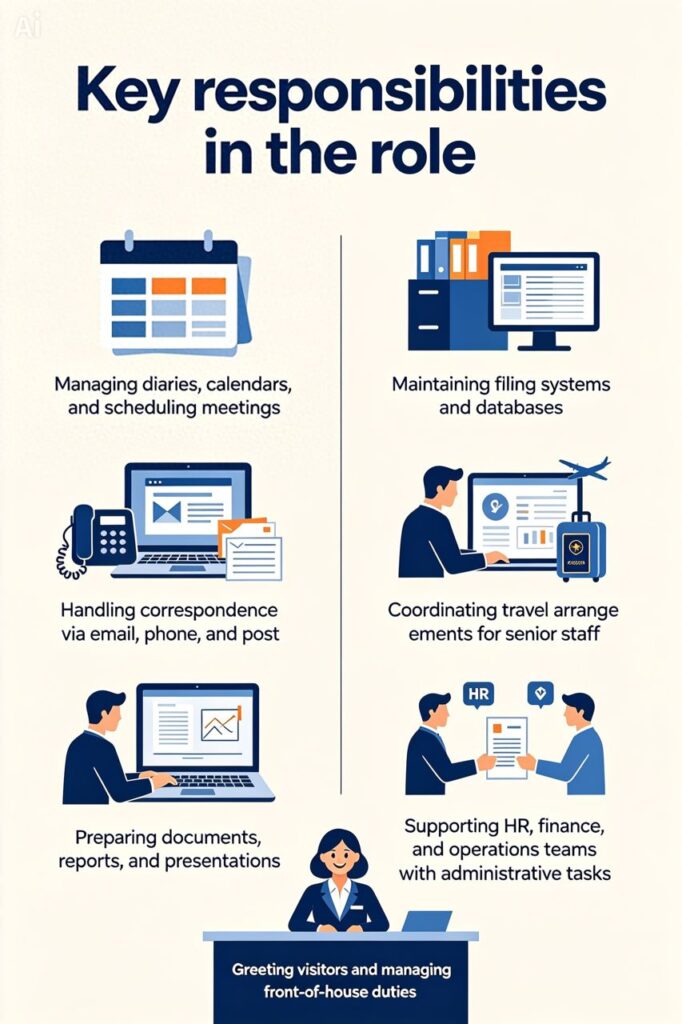
Administrative assistants are the operational backbone of any organisation. Their day-to-day tasks typically include:
- Managing diaries, calendars, and scheduling meetings
- Handling correspondence via email, phone, and post
- Preparing documents, reports, and presentations
- Maintaining filing systems and databases
- Coordinating travel arrangements for senior staff
- Supporting HR, finance, and operations teams with administrative tasks
- Greeting visitors and managing front-of-house duties
The role is fast-paced, people-facing, and highly varied, which is precisely why so many professionals enjoy it.
Types of organisations that hire admin assistants
Here is something reassuring: virtually every sector needs admin support. Organisations that regularly hire include:
- Healthcare: NHS trusts, private clinics, GP surgeries
- Finance and legal: Solicitors, accountancy firms, insurance companies
- Education: Universities, schools, and training providers
- Government and public sector: Local councils, central government departments
- Corporate: Tech firms, consultancies, multinational companies
Administrative assistant jobs UK span every industry imaginable. That breadth of opportunity is one of the role’s greatest strengths.
Entry-level vs senior administrative roles
Not all admin roles are created equal. Here is a quick comparison to help you understand where you might start and where you could go:
| Factor | Entry-Level Admin | Senior Admin / EA |
| Experience | 0–2 years | 5+ years |
| Typical Salary (UK) | £18,000–£24,000 | £30,000–£47,500 |
| Scope of work | General admin, filing, scheduling | Executive support, project co-ordination |
| Direct reports | None | May supervise junior staff |
| Route in | GCSEs / A-Levels sufficient | Degree or extensive experience preferred |
According to Totaljobs, the median salary for administrative roles in the UK hit £27,800 in 2025, a 7.7% rise compared to 2023. London-based roles top out at a median of £34,000.
Read Also:
- Turning Your LinkedIn into a Job Magnet in 2026
- Personal Branding for Job Seekers: What Matters Most in 2026
Why Administrative Assistant Jobs Are a Good Career Choice
Some people dismiss admin as a temporary stepping stone. That is a mistake. Here is why this career path deserves genuine consideration.
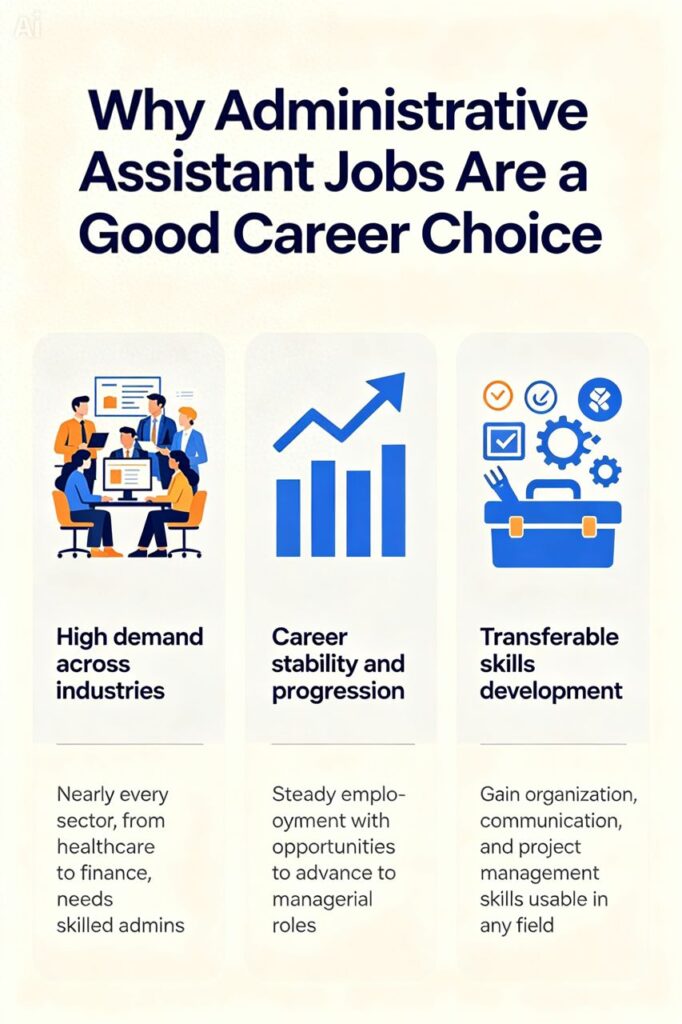
High demand across industries
Administrative roles drove enormous hiring activity globally in 2025. Employers posted more than 772,600 administrative jobs in 2025, up 9% from the previous year, according to Robert Half. Back in the UK, the administrative and support services sector employs approximately 3.1 million workers across nearly 500,000 businesses, and generates £376.4 billion in annual turnover.
Now, consider what that means for you. Every one of those businesses needs someone to keep the wheels turning. That person could be you.
Career stability and progression
Admin roles offer something that many trendy careers cannot: stability. Office administrator jobs exist in sectors that rarely disappear, healthcare, law, finance, education, and government have been hiring admin support for decades and will continue to do so.
Beyond stability, the progression is real. Many professionals start as junior admin assistants and advance to executive assistant roles, office manager positions, and even operations or project management within a few years.
Transferable skills development
This is the hidden power of an admin career. According to Hays, 80% of UK employers would consider hiring a candidate without all required skills if they show strong potential to grow. The skills you build as an admin assistant, communication, organisation, problem-solving, are exactly those that transfer seamlessly across roles and industries.
Skills You Need to Become an Administrative Assistant
Let me explain what employers actually look for. It is less about formal qualifications and more about demonstrable competencies.
| Skill Category | Examples | Why It Matters |
| Communication | Email writing, phone handling, stakeholder liaison | You are the first point of contact for executives and visitors |
| Organisation | Diary management, filing, meeting coordination | Keeps businesses running without chaos |
| Digital & IT | Microsoft Office, Google Workspace, CRM tools | Most roles require proficiency from day one |
| Attention to Detail | Proofreading, data entry, invoice checking | Errors in admin ripple across entire teams |
| Problem-Solving | Scheduling conflicts, last-minute changes | Saves time and prevents escalation |
| Multitasking | Handling phones while managing diaries | Admin roles rarely stay in one lane |
Communication and interpersonal skills
You are the first person a visitor meets and often the last line of quality control before a document leaves the office. Clear written and verbal communication is non-negotiable. Equally important is your ability to adapt your tone, from a friendly greeting for a visitor to a professional email to a C-suite executive.
Organisation and time management
Admin assistant skills centre heavily on organisation. You may be managing three executives’ diaries simultaneously while tracking meeting deadlines and ensuring stationery orders go out on time. Juggling all of that requires a structured mindset and reliable systems.
Microsoft Office and digital skills
Proficiency in Microsoft Word, Excel, Outlook, and PowerPoint is expected at most entry-level positions. Familiarity with tools like Google Workspace, SharePoint, or even basic CRM software will give you a competitive edge. Many online courses can bring you up to speed within a few weeks.
Attention to detail
A single error in a financial report or a double-booked meeting can have consequences that ripple across an entire organisation. Employers need to trust that you catch mistakes before they leave your desk. Demonstrating this in your CV and interview is essential.
Problem-solving and multitasking
No two days in admin look the same. A senior manager may cancel a key meeting at short notice, a supplier may call with an urgent issue, and a visitor may arrive unexpectedly, all at once. Your ability to stay calm, reprioritise, and resolve issues efficiently is what separates good admin assistants from great ones.
Read Also:
Qualifications and Experience Needed
Do you need a degree?
Short answer: no. Most administrative assistant requirements in the UK ask for GCSEs, particularly in English and Maths, at grade C/4 or above.
A degree is rarely a prerequisite, and 45% of UK employers now say it no longer matters whether a job applicant holds one, according to the Hays UK 2024 Salary and Recruiting Trends Report. What matters far more is your ability to do the job.
Useful certifications and short courses
That said, certifications do help, especially when you are competing for popular roles. Consider:
- Microsoft Office Specialist (MOS) certification: widely recognised by UK employers
- City & Guilds Administration qualifications: Level 2 or Level 3
- NVQ in Business Administration: well-regarded at entry level
- ECDL (European Computer Driving Licence): useful for digital competency
- Short online courses via platforms such as LinkedIn Learning, Coursera, or Reed Courses
These are low-cost, often self-paced, and directly relevant to the role.
How to get experience with no background in admin
Here is something we can both agree on: experience is the biggest barrier for new entrants. But it is not an insurmountable one. Volunteering with local organisations, taking on administrative duties in a part-time retail or hospitality role, or completing a short internship can all count as legitimate experience. More on this shortly.
How to Get an Administrative Assistant Job With No Experience
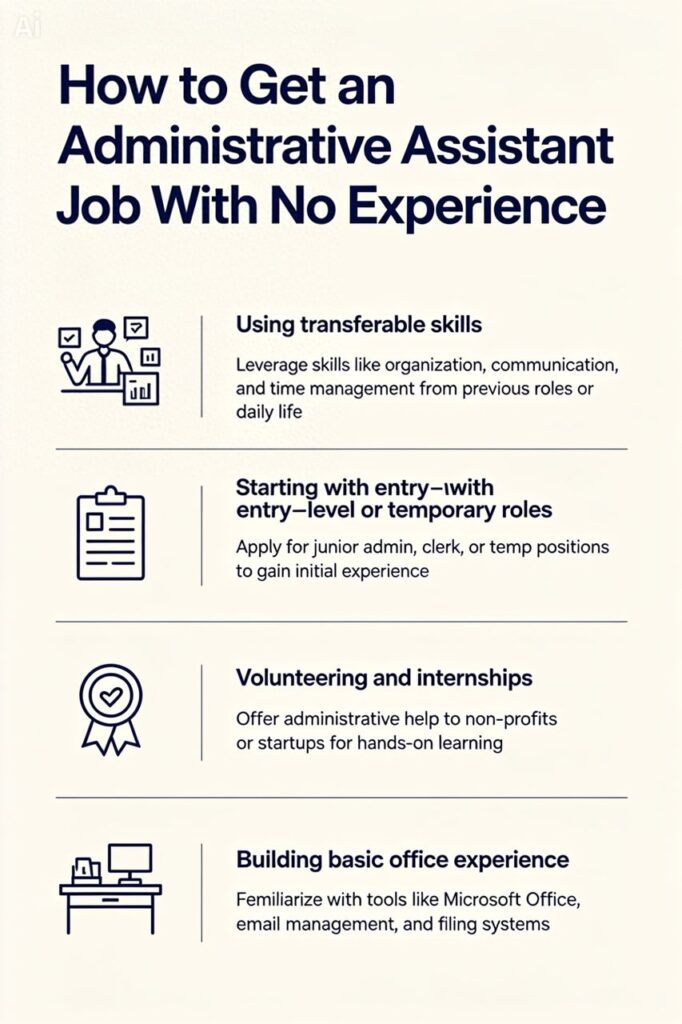
This is the question most people ask first, and for good reason. Learning how to get an administrative assistant job without a track record in the field feels daunting. But it is entirely possible.
Using transferable skills
Have you worked in retail, hospitality, customer service, or education? Then you already have admin assistant skills, you just have not labelled them that way yet. Consider:
- Customer-facing roles develop communication and interpersonal skills
- Team leadership builds multitasking and prioritisation abilities
- Cashier or stock management roles develop numeracy and attention to detail
- Tutoring or mentoring builds written communication and scheduling experience
The key is to reframe your existing experience in terms that speak directly to what admin employers need.
Starting with entry-level or temporary roles
Entry level admin jobs are plentiful, and many are specifically designed for candidates without prior admin experience. Temporary roles are an especially smart strategy. They let you build a real track record quickly, get your foot in the door at reputable organisations, and often convert to permanent positions when you perform well.
No experience admin jobs do exist. Look for titles like ‘Admin Support Assistant’, ‘Office Junior’, ‘Reception and Admin’, or ‘Business Support Assistant’, these are typically designed for people early in their careers.
Volunteering and internships
Volunteering at a charity, a community organisation, or an events company can give you real administrative experience within weeks. Many third-sector organisations rely heavily on volunteer admin support and will gladly provide a reference after your placement.
Building basic office experience
Offer to help with administrative tasks in your current job, even informally. Organising a team meeting, drafting a company newsletter, or building a simple spreadsheet all count. Document everything you do. Tangible examples beat vague claims every time.
How to Write a Strong Administrative Assistant CV
Your administrative assistant CV is your first impression. A weak one gets ignored in seconds. A strong one gets you in front of a hiring manager. Here is how to write the latter.
Writing a professional summary
Open with two to three sentences that immediately communicate your value. For example:
‘Detail-oriented admin professional with three years of experience supporting senior leadership teams in fast-paced environments. Skilled in diary management, stakeholder communication, and Microsoft Office Suite. Committed to delivering efficient, accurate, and professional administrative support.’
Tailor this to every single application. Generic summaries get skipped.
Highlighting key admin skills
Include a dedicated ‘Key Skills’ section near the top of your CV. Keep it focused and use bullet points. Employers scan this section first, make it count:
- Diary and calendar management
- Microsoft Office Suite (Word, Excel, PowerPoint, Outlook)
- Data entry and database management
- Minute-taking and report preparation
- Travel and logistics coordination
- Customer and stakeholder correspondence
Using achievements instead of duties
This is where most CVs fall flat. Instead of listing what you were responsible for, describe what you actually achieved:
Weak: ‘Responsible for managing diaries’
Strong: ‘Managed complex diaries for a team of four directors, reducing scheduling conflicts by 30% through implementing a centralised calendar system’
Quantify wherever you can. Numbers make claims credible.
Tailoring CVs to job descriptions
Read the job description carefully before you apply. Mirror the language they use. If they mention ‘minute-taking’, use that exact phrase in your CV, not ‘meeting notes’. Many employers use Applicant Tracking Systems (ATS) that filter CVs by keyword before a human ever reads them.
How to Write a Cover Letter for Admin Roles
Structuring your cover letter
Keep it to one page and follow a clear structure:
1. Opening paragraph: State the role you are applying for and why you are interested
2. Middle paragraph(s): Link your skills and experience directly to the job requirements
3. Closing paragraph: Confirm your enthusiasm and request an interview
Showing motivation and enthusiasm
Employers want people who genuinely want the role, not just any job. Research the organisation before you write your letter. Reference something specific about their work, culture, or reputation. It signals effort and genuine interest.
Linking experience to job requirements
For each requirement listed in the job posting, prepare a brief example of how you have demonstrated that skill. This is the foundation of a compelling cover letter, and a great way to practise for admin assistant interview questions too.
Where to Find Administrative Assistant Jobs
Job boards and recruitment websites
The most obvious place to start, but use the right ones. The top platforms for admin roles in the UK include:
- Reed.co.uk: extensive admin listings across all regions
- Indeed UK: broad reach with strong filtering tools
- Totaljobs: dedicated admin and business support category
- CV-Library: frequently updated admin vacancies
- LinkedIn Jobs: essential for networking alongside applying
Company career pages
Large employers like NHS Trusts, councils, law firms, and universities often advertise roles exclusively on their own websites before listing them elsewhere. Check the careers pages of organisations you want to work for, and set up job alerts.
Recruitment agencies
Specialist recruitment agencies are particularly useful for admin roles. Agencies such as Adecco, Office Angels, and Pertemps place candidates into both permanent and temporary positions. Registering with two or three gives you access to vacancies that never appear on public job boards.
Networking and referrals
Do not underestimate word of mouth. According to LinkedIn, a significant proportion of roles are filled before they are ever advertised publicly. Let your network know you are looking. Update your LinkedIn profile. Attend industry events. Referrals still count for a great deal.
Local opportunities and internships
Local newspapers, community noticeboards, and council websites often list admin opportunities, especially in smaller towns and boroughs. Do not overlook these. Competition is often lower, and local employers frequently prioritise candidates from the area.
Read Also:
How to Prepare for an Administrative Assistant Interview
Common interview questions
Preparing for admin assistant interview questions in advance is one of the highest-value activities you can do before your interview. Common questions include:
- ‘How do you prioritise tasks when you have multiple deadlines?’
- ‘Describe a time you handled a difficult stakeholder or situation’
- ‘How do you manage confidential information?’
- ‘What software and tools are you proficient in?’
- ‘Tell me about a time you identified and solved a problem before it escalated’
- Prepare a structured answer for each of these before you walk in.
Demonstrating organisational skills
Interviewers will probe your real-world organisation skills, not just ask if you have them. Bring a notepad. Arrive five minutes early. Have your documents organised neatly. These small actions communicate your professional standards without a single word.
Using the STAR method
For any competency-based question, use the STAR framework:
- Situation: Set the scene briefly
- Task: Describe your specific responsibility
- Action: Explain exactly what you did
- Result: Share the measurable or meaningful outcome
This structure keeps your answers focused, compelling, and easy to follow.
Presenting professionalism and confidence
First impressions matter significantly. Dress professionally, make eye contact, and smile. Research the organisation beforehand and prepare two or three smart questions to ask at the end. Interviewers notice candidates who have done their homework, and this is exactly how how to become an administrative assistant becomes a reality rather than just an aspiration.

At RKY Careers, we don’t just teach you skills, we help you land the role. Whether you’re starting from scratch or pivoting your career, our personalised coaching, real-world experience, and expert mentorship have helped over 1,500 professionals secure roles they love. From CV and interview prep to career mapping and bootcamps, we’re with you every step of the way.
Book a Free Career Consultation
Common Mistakes to Avoid
Sending generic applications
A generic CV and cover letter sends a clear signal: you are not serious about this role specifically. Recruiters spot template applications immediately. Take the extra twenty minutes to tailor each application. It is the single highest-return activity in your job search.
Ignoring job descriptions
The job description is a blueprint. It tells you exactly what skills to highlight, what language to use, and what the employer values most. Candidates who fail to mirror that language almost always miss the shortlist.
Weak CV formatting
A cluttered, inconsistently formatted CV is difficult to read and signals poor attention to detail — the exact quality an admin employer is assessing. Use clean fonts, consistent spacing, clear section headers, and concise bullet points. Two pages maximum. Your name on both pages.
Not showcasing transferable skills
This is the biggest missed opportunity for candidates applying to no experience admin jobs. Every job you have held has given you transferable skills. Retail gave you communication and time management. Volunteering gave you initiative and collaboration. Failing to identify and present these skills leaves hiring managers with an incomplete picture of your potential.
Career Progression After Becoming an Administrative Assistant
Here is what people rarely talk about: an admin role is one of the most versatile launchpads in the professional world. Learning how to get an administrative assistant job is just the first step on a much longer journey.
Senior admin assistant roles
With two to three years of solid experience, you can progress to a senior admin assistant position. These roles come with greater responsibility, managing junior admin staff, overseeing office operations, and handling more complex executive support tasks. Salaries at this level typically range between £25,000 and £32,000 across the UK.
Executive assistant roles
The executive assistant (EA) is the pinnacle of the admin career path for many professionals. According to Totaljobs, the highest-paying administrative role in 2025 is the executive assistant, with salaries ranging from £42,600 to £47,500. EAs support C-suite and board-level executives, manage complex schedules, and often represent the executive in communications.
Office manager positions
Office managers oversee entire administrative operations, from facilities and supplier management to team performance and budgets. This is a natural step for admin professionals who have developed leadership instincts alongside their organisational skills.
Project coordination and operations careers
Many admin assistants successfully pivot into project coordination, operations management, or human resources. The skills overlap is significant. Office support careers genuinely serve as a gateway to roles that most people would never associate with an admin starting point, but the evidence is clear.
Read Also:
- How to Prepare for Behavioural Interview Questions: Key Strategies for Success
- How to Craft a Compelling Cover Letter That Shows Your Passion
Frequently Asked Questions
How do I become an administrative assistant with no experience?
Start by identifying your transferable skills from previous jobs, voluntary work, or academic projects. Apply for entry-level or temporary admin roles, complete short IT and admin courses online, and tailor every application carefully to the job description. Persistence and preparation go a long way.
What qualifications do I need for an admin assistant job?
Most positions require GCSEs in English and Maths at grade C/4 or above. A degree is not required. Certifications such as Microsoft Office Specialist, NVQ in Business Administration, or City & Guilds qualifications strengthen your application.
What skills do employers look for in admin assistants?
Employers consistently prioritise strong admin assistant skills: clear written and verbal communication, excellent organisation and time management, proficiency in Microsoft Office, meticulous attention to detail, and the ability to multitask under pressure.
Is administrative assistant a good career?
Yes. particularly for professionals who value variety, stability, and genuine progression opportunities. With nearly 3.1 million workers employed across the UK in admin and secretarial roles, demand is consistent.