Agricultural Development Bank Careers
Have you ever wondered how finance can actually change the world? The truth is: agricultural development bank careers represent one of the most stable and impactful sectors in the modern economy, just like Business Development Manager Careers.
Most people look at banking as a cold game of numbers and spreadsheets. But what if you could merge high-level finance with the very thing that keeps everyone alive?
If you are a mid-career professional or a job seeker in the UK, you might feel like the traditional banking sector is too crowded. You might want something more. You want a role that offers growth, a good salary, and a sense of purpose.
This is where the world of agricultural finance comes in. Whether you are moving from a corporate desk or looking for a fresh start in the UK job market, this guide will show you the way.
What Are Agricultural Development Bank Careers?
Think about it: every piece of food on your plate started with a seed. But before that seed was planted, a farmer likely needed a loan. That loan did not come from a typical high-street bank. It came from an institution dedicated to rural growth.
When you pursue agricultural development bank careers, you are joining a mission-driven sector. These banks do not just chase profit. They chase progress.
In fact, the World Bank estimates that over 80% of the world’s poor live in rural areas and rely on agriculture for their livelihoods, which makes agricultural finance one of the most impactful financial sectors globally.
They provide the money that builds irrigation systems, buys tractors, and helps small farms become big businesses. For a professional like you, this means your daily work has a direct link to global food security.
Overview of Agricultural Development Banks and Their Role
Agricultural development banks (ADBs) are specialised financial institutions. Their main goal is to provide credit to the rural and farming sectors.
The World Bank estimates that nearly one billion people still face food insecurity, highlighting the urgent need for stronger agricultural financing and development programmes
In many parts of the world, including the UK, these banks act as a bridge. They fill the gap where commercial banks see too much risk.
Look: the role of an ADB is complex. They handle everything from micro-loans for individual farmers to multi-million-pound investments in agricultural technology.
Because they often have government or international backing, they can offer lower interest rates and longer repayment terms.
This makes them a vital part of the economic fabric and one of the Careers With Global Demand. If you enjoy solving problems that matter, this is the place to be.
Types of Careers Available in the Agricultural Finance Sector
You might be wondering: Do I need to be a farmer to work here? The short answer is no. The Agri Jobs market is vast and diverse and Navigating this Career Choices is a good decision
While some roles require you to be out in the field, many others are based in corporate offices in cities like London, Manchester, or Edinburgh.
Here is a breakdown of the typical paths:
- Credit and Lending: Managing the flow of money to borrowers.
- Technical Advisory: Providing expertise on crop yields or livestock management.
- Operational Support: Keeping the bank running through HR, legal, and admin roles.
- Impact Investing: Ensuring that the bank’s money is creating real social change.
The variety of Agri Employment options ensures that whether you are a numbers person or a people person, there is a seat at the table for you.
Key Roles and Job Titles in an Agricultural Development Bank
When you start looking for your next role, you need to know what titles to search for. The language in this sector can be specific.
However, if you have a background in general finance or corporate operations, you will find that many of your skills are a perfect match for Agri Jobs.
Loan Officers and Credit Analysts in Agriculture
These are the core roles in any ADB. As a loan officer, you are the face of the bank. You meet with farmers and agribusiness owners to understand their needs.
And you don’t just look at their credit score, you look at their land, their equipment, and their plans for the next harvest.
Credit analysts, on the other hand, do the deep work. You will spend your time looking at data.
You will assess the risks of a specific crop or the likelihood of a drought affecting a loan. It is a blend of financial science and environmental awareness.
Read Also:
Relationship Managers and Business Development Roles
Relationship managers are the “glue” of the bank. This is one of theHigh Demand Careers in UK for International Students.
Your job is to build long-term trust with clients. In the UK, this might involve working with large estates or new tech startups in the farming space.
Better yet: you are not just selling a product. You are providing a solution. You help businesses grow by connecting them with the right financial tools at the right time. If you have strong communication skills and a “can-do” attitude, you will thrive here.
Risk Management and Compliance Positions
Every bank needs a shield. In an agricultural setting, risk management is unique. You aren’t just worried about market crashes. You are worried about climate change, pests, and global trade shifts.
Compliance officers ensure that the bank follows all UK and international regulations. This is especially important for banks that receive government funding.
Your role is to keep the bank safe and ethical. For professionals with a legal or regulatory background, this is a high-demand area within Agri Employment.
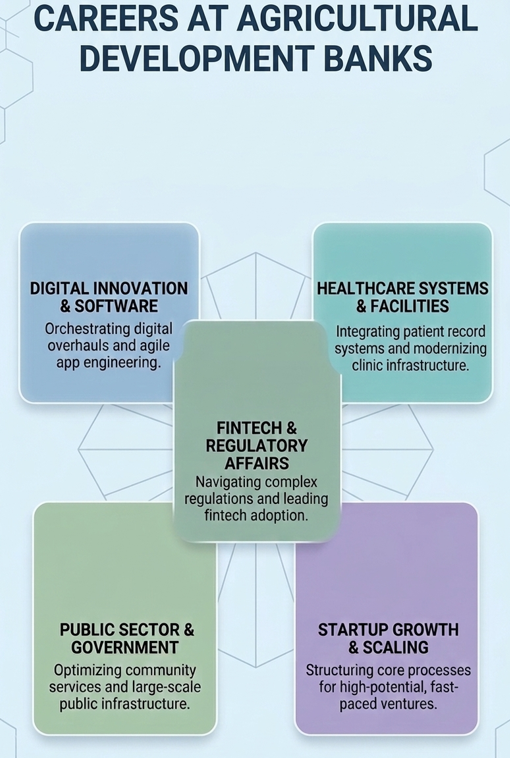
IT, Data and Digital Transformation Roles within ADB
The modern farm is high-tech. From drones to soil sensors, data is everywhere. This has created a surge in agricultural development bank careers for tech experts.
The bank needs people who can:
- Build apps for farmers to manage their loans.
- Use satellite data to predict harvest sizes.
- Secure the bank’s digital infrastructure.
If you are looking for careers in tech and corporate fields, don’t overlook the “Agri” sector. It is one of the fastest-growing areas for digital innovation.
Skills and Qualifications Required for Agricultural Development Bank Careers
To land a job in this field, you need a specific toolkit. The bank wants to know that you understand money, but they also want to see that you understand the sector.
Finance, Agribusiness, and Banking Skills
First, the basics. You need a strong grasp of financial principles. This includes understanding balance sheets, cash flow, and interest rates. But there is a twist. You must also understand “Agribusiness.”
Think about it: a farm’s income is seasonal. They might only get paid once a year. You need to know how to structure a loan that accounts for this.
If you have a degree in finance, economics, or even a specialized agribusiness course, you are already ahead of the pack.
| Skill Area | Importance | Why It Matters |
| Financial Modelling | High | To predict long-term project viability. |
| Risk Assessment | High | To account for weather and market volatility. |
| Ag-Tech Knowledge | Medium | To understand modern farming equipment. |
| ESG Reporting | High | To meet sustainability and social goals. |
Soft Skills That Matter in Agricultural Finance Roles
Here is the thing: robots can crunch numbers, but they can’t build trust with a farmer. Soft skills are what will get you promoted in agricultural development bank careers.
- Empathy: You are dealing with people’s livelihoods. You need to be able to listen and understand their challenges.
- Problem-Solving: When a harvest fails, how do you help the client stay afloat?
- Cultural Competence: Especially in the UK, you will work with a diverse range of people, from local farmers to international investors.
Read Also:
- How to Identify Your Career Goals and Find a Fulfilling Path
- How to Talk About Your Skills in an Interview
How to Apply for Jobs at an Agricultural Development Bank
The application process for an agriculture and rural development bank career requires a strategic approach. You cannot just send a generic CV and hope for the best. You need to show that you are a specialist.
Where to Find ADB Job Openings and Application Portals
You won’t always find these roles on the biggest job boards. You need to look where the experts look.
Start by visiting the career pages of major institutions like:
- The World Bank (Agriculture and Food department)
- The International Fund for Agricultural Development (IFAD)
- The African Development Bank (if you are looking for international roles based in the UK)
- Specialist UK lenders like the Agricultural Mortgage Corporation (AMC)
Search for terms like agricultural development bank job vacancy on LinkedIn. Follow the leaders of these banks. Often, they will post about roles before they go live on a portal.
CV and Application Tips for Agricultural Finance Jobs
Your CV is your first impression. If you are a career changer, you must highlight your “transferable skills.” For example, if you worked in retail banking, focus on your experience with loan processing and client management.
Career Progression and Growth Within Agricultural Development Banks
One of the best parts about Agri Employment is the stability. People will always need to eat. This means the banks that fund food production are rarely hit as hard by economic downturns as other sectors.
Typical Career Paths: From Entry Level to Senior Roles
The journey in agricultural development bank careers often follows a clear path:
- Junior Analyst: You learn the ropes, handle data, and support senior officers.
- Investment Officer: You take charge of your own portfolio of loans or projects.
- Senior Portfolio Manager: You oversee an entire region or a specific sector (like “Green Energy in Farming”).
- Director of Operations: You help set the bank’s strategy and manage large teams.
The best part? You can move horizontally too. You might start in credit and move into digital transformation or ESG (Environmental, Social, and Governance) roles.
Professional Development and Certifications That Help
You should never stop learning. The world of finance is changing fast. If you want to reach the top, consider getting certified in areas that the bank values.
Think about these options:
- CFA (Chartered Financial Analyst): The gold standard for any finance role.
- PRINCE2 or Agile: Great for the IT and project management side of the bank.
- Sustainability Certifications: Anything related to “Green Finance” or “Climate Risk” is pure gold right now.
By staying updated, you ensure that you remain a top candidate for any agricultural development bank job vacancy that comes your way.
Read Also:
FAQs
1. What entry-level jobs are available at agricultural development banks?
Most entry-level roles are in data entry, junior credit analysis, or customer support.
2. Do agricultural development banks require banking experience?
Not always! While it helps, many banks hire people from “Agri-adjacent” backgrounds. If you have worked in logistics, food supply chains, or even environmental science, you have valuable knowledge.
3. What skills make you competitive for careers in agricultural finance?
A mix of “Hard” and “Soft” skills is best. You need to be good with Excel and data. But you also need to be a great communicator.
4. Are there graduate programmes at agricultural development banks?
Yes. Many of the larger development banks have specific intakes for recent graduates.