
Business Development Manager Careers
If you have ever wondered whether business development manager careers are worth pursuing, the answer is a confident yes. These roles sit at the heart of nearly every thriving organisation. It connects strategy with revenue and relationships with results.
Whether you are starting out, pivoting from sales, or looking to level up professionally, this guide covers everything you need to know: responsibilities, career paths, salary expectations, and the skills that matter most.
The UK job market is increasingly prioritising growth-focused professionals. According to the Government’s Occupations in Demand report (2024), sales accounts and business development managers account for 331,000 workers in critical-demand roles, one of the largest occupational groups at skill level 3. That figure alone signals how important this profession has become.
Let’s unpack exactly what this career involves and whether it’s the right move for you.
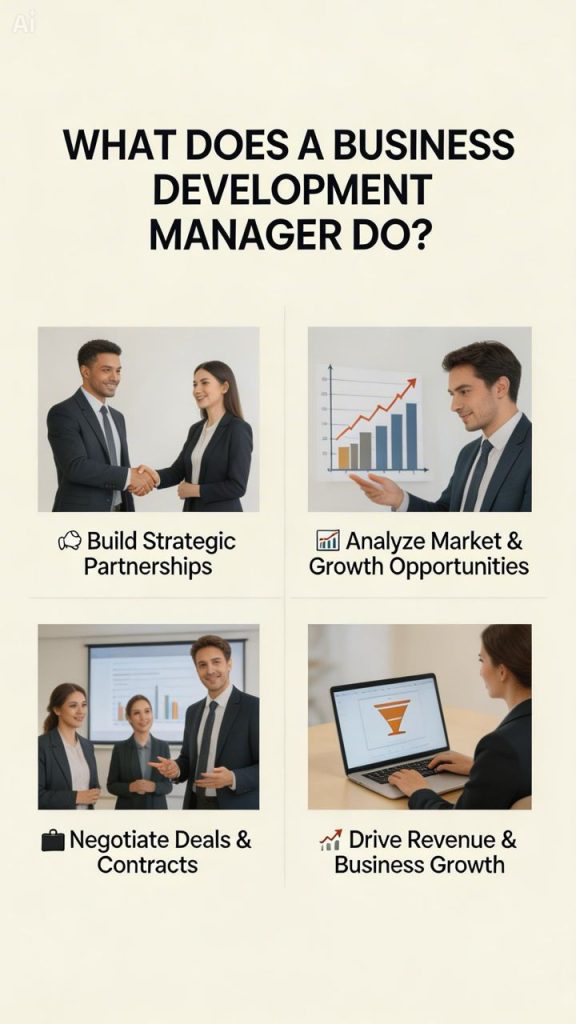
What Does a Business Development Manager Do?
At its core, business development manager careers are about creating growth. BDMs identify new market opportunities, build client relationships, and design strategies that drive revenue. However, the role is far more nuanced than simply selling, it requires commercial awareness, strategic thinking, and the ability to connect dots across departments.
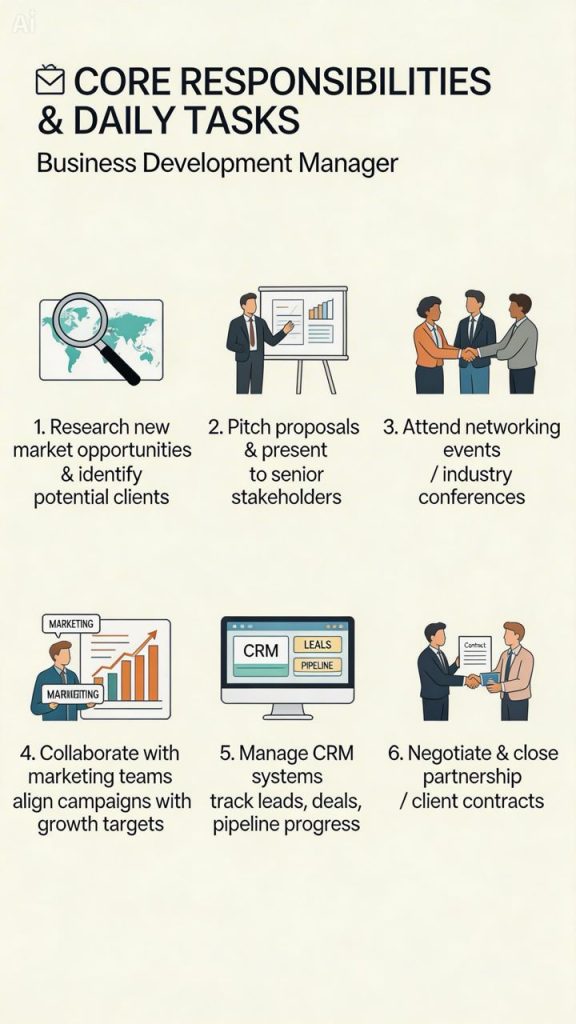
Core Responsibilities and Daily Tasks
Here’s the deal: no two days as a BDM look exactly the same. That variety is part of the appeal. On any given day, a Business Development Manager might be:
- Researching new market opportunities and identifying potential clients
- Pitching proposals and presenting to senior stakeholders
- Attending networking events or industry conferences
- Collaborating with marketing teams to align campaigns with growth targets
- Managing CRM systems to track leads, deals, and pipeline progress
- Negotiating and closing partnership or client contracts
Now, beyond these daily tasks, BDMs also carry longer-term strategic responsibility. They analyse market trends, evaluate competitor activity, and shape the commercial direction of the business. It is a high-visibility, high-impact role which is exactly why business development manager careers attract such competitive salaries.
Industries That Hire Business Development Managers
One of the biggest advantages of this career path is its cross-industry applicability. Virtually every sector needs professionals who can drive growth. Common industries include:
- Technology and SaaS (one of the highest-paying sectors for BDMs)
- Financial services and fintech
- Healthcare and life sciences
- Consulting and professional services
- Construction, engineering, and manufacturing
- Media, marketing, and creative agencies
- Recruitment and HR services
For example, a BDM in a tech scale-up might focus on enterprise partnerships and API integrations. Meanwhile, a BDM in professional services might concentrate on account expansion and thought leadership. The industry shapes the approach, but the core competencies remain the same.
Read Also:
- 2026 Career Paths in Healthcare, Tech, Finance, and Creative Industries
- How Much Project Managers Earn in the UK
Business Development Manager Career Path Explained
Understanding the business development manager career path is crucial before you commit to this direction. The good news? The progression is clear and well-defined, with multiple entry points depending on your background.
You may be wondering: do you need to start in sales? Not necessarily. Many successful BDMs come from marketing, consulting, account management, or even operations. What matters most is developing the right blend of commercial acumen and strategic thinking.
Entry-Level Roles Leading to BDM Positions
Most professionals begin their business development manager career progression through one of these routes:
- Business Development Executive (BDE): the most direct route; focuses on outbound prospecting and lead generation
- Sales Development Representative (SDR): qualification-focused, ideal for building pipeline skills
- Account Executive or Account Manager: relationship-heavy role that builds client management expertise
- Marketing Executive: provides insight into brand positioning, content, and demand generation
- Junior Consultant: builds analytical and problem-solving capabilities
Typically, professionals spend two to four years in one of these roles before transitioning into a BDM position. During this time, building a strong performance track record is essential.
Hitting targets, managing accounts independently, and demonstrating commercial impact will accelerate your progression significantly.
Senior Roles and Leadership Opportunities
Here’s something worth knowing: is business development manager a good career for long-term growth? Absolutely. The business development manager career offers a clear upward trajectory into leadership positions. From a BDM role, progression typically follows one of these paths:
Senior Business Development Manager: managing larger deals and potentially a small team
Head of Business Development: overseeing the entire BD function and setting strategy
Director of Sales or Commercial Director: P&L responsibility and senior stakeholder relationships
VP of Growth or Chief Commercial Officer (CCO): executive-level ownership of all revenue streams
According to Randstad UK, business development managers can progress into marketing director or chief executive officer roles with sufficient experience. The ceiling is genuinely high for driven professionals.
Read Also:
Ready to fast-track your career in business development? RKY Careers offers personalised career development, expert mentorship, and practical bootcamps that have helped 1,500+ professionals land their dream roles. Your next big career move starts here. Book a Free Career Consultation
Skills Required for Business Development Manager Careers
Now, let’s talk about what actually makes a great BDM. Business development manager careers demand a specific blend of hard and soft skills.
The most successful professionals combine emotional intelligence with data-driven thinking, and they do it consistently.
Sales, Negotiation, and Relationship Management
The foundation of any successful BDM is the ability to sell, not in a pushy way, but in a consultative, value-led way. Relationship management is equally critical. Clients and partners need to trust you before they commit to long-term agreements.
Look: according to LinkedIn’s 2024 Most In-Demand Skills report, sales skills remain among the most sought-after by employers globally. Communication, persuasion, and the ability to close deals with integrity are all essential.
Key skills in this area include:
Active listening and consultative questioning
Objection handling and negotiation strategy
CRM proficiency (Salesforce, HubSpot, etc.)
Stakeholder engagement and executive-level communication
Pipeline management and revenue forecasting
Strategic Thinking and Market Analysis
Beyond sales, business development manager careers require a strong strategic mindset. BDMs are expected to identify market gaps before competitors do and translate that insight into actionable plans.
Skills that matter here include:
Market research and competitive analysis
Business case development and financial modelling
Data interpretation and KPI management
Product and service positioning
Cross-functional collaboration with marketing, product, and finance teams
It gets better: BDMs who develop strong analytical skills tend to progress faster and command higher salaries. By 2030, LinkedIn predicts that role-required skills will have changed by at least 65% from 2015 levels, making continuous skill development non-negotiable.
Read Also:
- How to Identify Your Career Goals and Find a Fulfilling Path
- How to Talk About Your Skills in an Interview
Qualifications and Experience Needed
One common question about business development manager careers is: what qualifications do you actually need? The answer is more flexible than many expect. While certain credentials strengthen your application, experience and results often speak louder than degrees alone.
Relevant Degrees and Professional Certifications
Many BDMs hold degrees in one of the following disciplines:
Business Administration or Management
Marketing or Sales
Economics or Finance
Engineering (especially in technical or SaaS-focused organisations)
Psychology or Communications
However, a degree is not always mandatory. Increasingly, employers value certifications and demonstrable skills over formal education alone. Relevant professional qualifications include:
CIM (Chartered Institute of Marketing) qualifications
ISM (Institute of Sales Management) certifications
PRINCE2 or project management credentials (for BDMs managing complex client rollouts)
CRM platform certifications such as Salesforce or HubSpot
The UK Government’s Occupations in Demand (2024) report confirms that BDMs are categorised at skill level 3, meaning vocational qualifications, apprenticeships, and industry experience are all considered valid pathways into the role.
Experience Employers Typically Expect
Most mid-level BDM roles in the UK require between two and five years of relevant commercial experience. Senior positions often demand five to ten years, with a proven track record of hitting targets and managing large accounts.
Here’s an example of what a typical employer might look for
Demonstrated experience in B2B sales or partnership development
A track record of meeting or exceeding revenue targets
Experience using CRM systems to manage and report on a sales pipeline
Evidence of building and maintaining long-term client relationships
Exposure to cross-functional projects involving marketing, product, or finance teams
Importantly, career changers are not excluded. Professionals transitioning from consulting, account management, or marketing regularly secure BDM roles by articulating their transferable skills effectively. RKY Careers has supported thousands of professionals through exactly this kind of career pivot.
Read Also:
Salary Expectations and Job Outlook for Business Development Managers
Let’s get to the numbers. Salary is one of the most frequently asked questions about business development manager careers and for good reason. This is one of the better-compensated roles available to non-technical professionals in the UK.
Salary Ranges by Industry and Location
According to CV-Library’s 2025 BDM Salary Guide, average base salaries for mid-career BDMs in the UK range from £50,000 to £65,000. Experienced professionals regularly earn over £70,000, with total compensation packages, including commission exceeding £100,000 for top performers.
Location plays a significant role in pay. Glassdoor data (2025) shows that the average BDM salary in London sits at £57,422, with top earners reaching £85,000 to £129,000. London roles typically pay 10–25% more than the national average.
Here is a broad salary breakdown by experience level:
Entry-level (0–2 years): £28,000–£38,000
Mid-level (2–5 years): £40,000–£60,000
Senior BDM (5–10 years): £60,000–£80,000
Director-level (10+ years): £80,000–£130,000+
Industries with the highest BDM salaries include technology, fintech, and professional services. Manufacturing and retail tend to offer more modest base salaries but may include attractive bonus structures.
Future Demand and Career Stability
The outlook for business development manager careers is strong. Randstad UK projects a 5% job growth rate for BDMs, with up to 25,500 new roles expected to be created by 2027. Workforce retirements and business expansion are both driving this demand.
Furthermore, the UK Government’s 2024 Occupations in Demand report classifies sales accounts and business development managers among occupations in elevated demand, a designation that reflects strong and sustained hiring activity across sectors.
The bottom line: business development manager careers offer genuine stability, exceptional earning potential, and clear routes to senior leadership. Few non-technical career paths offer this combination at scale.
Business development manager careers represent one of the most dynamic, well-rewarded, and future-proof professional paths available today. Whether you are entering the field for the first time or accelerating your existing trajectory, the opportunities are genuinely significant. RKY Careers has helped over 1,500 professionals navigate exactly these kinds of career transitions, with personalised support, practical experience, and a track record of real results.

Do you want to know the best part? RKY Careers provides end-to-end career support: from career mapping and CV strategy to interview preparation and salary negotiation. If you are serious about breaking into or advancing within business development manager careers, then the next step is a conversation.
Book a Free Career Consultation with RKY Careers Today
Frequently Asked Questions
Is business development a good long-term career?
Yes, business development manager careers offer excellent long-term prospects. The role provides a clear progression into director and C-suite positions, with competitive salaries at every stage.
Can you become a BDM without a sales background?
Absolutely. Many BDMs transition from marketing, consulting, account management, or even operations. What matters most is demonstrating commercial awareness, relationship-building ability, and a results-driven mindset.
What is the difference between sales and business development?
Sales focuses on closing existing opportunities and hitting short-term revenue targets. Business development takes a broader, more strategic view. While both roles overlap, BDMs typically work upstream, generating and qualifying opportunities before ultimately passing them to sales teams.
Are Business Development Managers in high demand?
Yes. The UK Government’s 2024 Occupations in Demand report classifies BDMs as a critically in-demand profession. With 331,000 workers in this occupational category already, and thousands of new roles projected annually, demand shows no signs of slowing. The role’s cross-industry relevance makes it one of the most resilient career choices available.