
Upper Class Salary in the UK
What does it actually take to be considered upper class in the UK? It is a question many ambitious professionals are quietly asking. Understanding the upper class salary in the UK threshold is not just about bragging rights, it is about knowing exactly where you stand and what it takes to get to the top.
Salaries in Britain are rarely transparent. Most people have little idea whether they are on the cusp of the top 10% or still a long way off. This article breaks down the numbers clearly, covering income thresholds, top-paying professions, and actionable strategies to help you move upward.

Build Without Borders. Think Without Limits.
We’re creating a global ecosystem for ambitious Africans and professionals ready to scale beyond geography.
What Defines an Upper Class Salary in the UK
Here’s the deal: the term “upper class” is loaded with history in Britain. It once described aristocratic families and inherited wealth. Today, however, the upper class salary UK conversation is far more about earned income, assets, and economic position.
Economists and sociologists often use income percentiles to define class. While there is no single official definition, data from the Office for National Statistics (ONS) and academic research offer clear benchmarks.
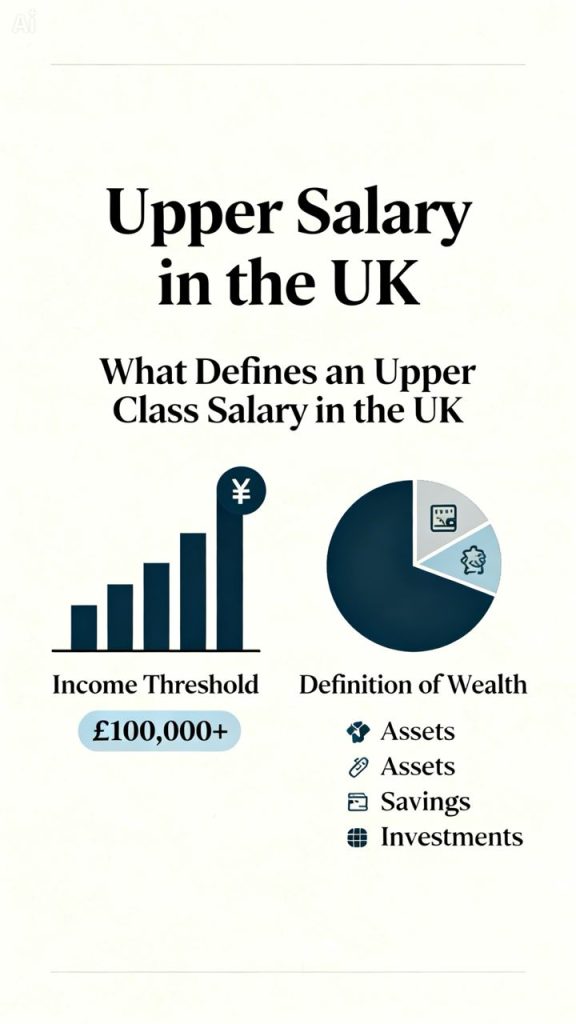
Income Thresholds and Definitions of Wealth
Look: income alone does not tell the full story. Wealth includes savings, investments, property, and passive income. Nevertheless, salary remains the most accessible entry point into upper-class economic circles.
According to the ONS Annual Survey of Hours and Earnings 2024, the median gross annual earnings for full-time UK employees stood at £37,430 in April 2024. This is a 6.9% increase on the previous year.
Individuals earning £75,000 or more broadly fall within the top 5% of earners. Those reaching £125,000 or above begin to touch the true upper class salary UK range.
Wealth in a broader sense often involves net worth of £1 million or more. Yet salary is the most direct lever you can pull and the one you have most control over.
Difference Between Upper Class, Upper Middle Class, and Wealthy
You may be wondering: what exactly separates these categories? The honest answer is that there is no single official UK government definition of these terms by income. Class in Britain has always been shaped by a combination of factors. It is not by how much you earn, but also your wealth, assets, education, profession, and social background.
That said, some broad distinctions are widely understood. The middle class generally describes those earning comfortably above the national average, in stable professional roles, without significant financial strain.
The upper middle class sits a step above typically senior professionals, experienced managers, or specialists whose income allows for considerable savings, property ownership, and lifestyle flexibility.
The upper class, in economic terms, goes beyond a comfortable salary. It typically involves a level of income that generates wealth independently. This could be through investments, property, or business ownership, rather than relying solely on employment earnings.
The distinction matters because many professionals conflate being comfortable with being upper class. A good salary is a strong foundation, but what separates the upper class salary UK bracket from the rest is not just income, it is what that income builds over time.
Read Also:
How Much You Need to Earn to Be Considered Upper Class in the UK
Now, let us get into the actual numbers. Many people discuss class without ever defining the income required to be in the upper class salary UK bracket. Fortunately, income percentile data gives us a clear picture.
Estimates by Income Percentile (Top 10%, 5%, 1%)
The table below is drawn directly from HMRC Table 3.1a: Percentile Points for Total Income Before and After Tax (tax year 2022–23, published March 2025).
These are the official, verified thresholds for each income percentile in the UK:
| Percentile | Income Threshold (Before Tax) | What This Means |
| Top 10% (90th percentile) | Above £64,800 per year | Above-average earners |
| Top 5% (95th percentile) | Above £82,000–£87,000 per year | High earners |
| Top 1% (99th percentile) | Above £201,000 per year | Elite / upper class |
| Top 0.5% | Above ~£280,000 per year | Ultra-high earners |
| Top 0.1% | Above ~£750,000 per year | Exceptional wealth |
| Median (50th percentile) | £37,439 per year | Middle income (ONS ASHE 2024) |
Source: HMRC Table 3.1a. Percentile Points for Total Income Before and After Tax, tax year 2022–23 (published March 2025) | ONS ASHE 2024 (median figure)
This is crazy: according to the TaxPayers’ Alliance (2024), citing HMRC data, the top 1% of income tax payers, around 340,000 individuals paid 28.2% of all income tax collected in 2024–25, despite earning 13.3% of total income. That speaks to just how concentrated earnings are at the very top.
What salary is upper class UK? The official HMRC data places the entry point to the top 1% at £201,000. This is significantly higher than many people assume. Even reaching the top 10% requires individual earnings above £64,800.
London vs Rest of the UK Salary Comparisons
Geography matters enormously in the UK salary conversation. London consistently commands the highest wages across virtually every sector.
For example: a finance analyst earning £85,000 in London might be considered solidly upper middle class in the capital. But that same salary would place them firmly in upper class territory in the North East or Wales.
According to the ONS Annual Survey of Hours and Earnings (ASHE) 2024, median annual earnings in London stood at £47,455, compared to the UK median of £37,430, approximately 27% higher. By contrast, the North East recorded the lowest median annual earnings of any UK region, at £32,960
But here’s the kicker: cost of living in London is also significantly higher. So a £120,000 salary in Manchester may deliver more purchasing power than the same income in Central London.
Read Also:
Professions That Typically Pay Upper Class Salaries
Let me explain something important. Reaching an upper class salary at UK level is not reserved for those who inherited connections. Many of the highest-paying roles in Britain are accessible with the right skills, experience, and strategy.
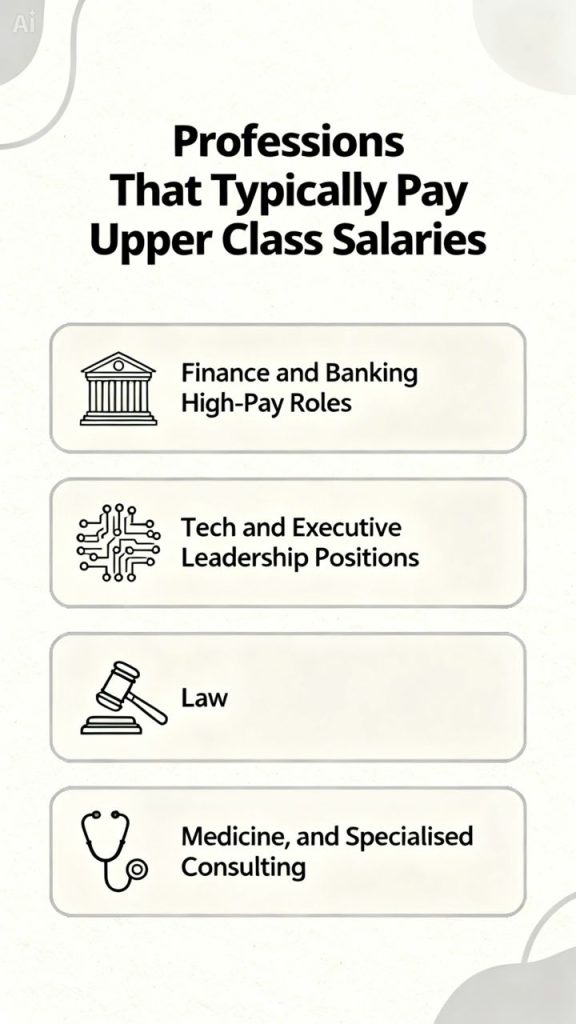
Finance and Banking High-Pay Roles
Finance remains the UK’s most reliable route to top-tier earnings. Investment bankers, hedge fund managers, and private equity professionals regularly earn well above £150,000 per year before bonuses.
According to MBA Crystal ball data for 2026, a Vice President at a major investment bank can expect a base salary of £120,000 to £180,000, with performance bonuses often around that figure.
Here are some of the top-paying finance roles:
- Investment Banker: £100,000 to £300,000+
- Chief Financial Officer (CFO): £150,000 to £500,000+
- Hedge Fund Manager: £200,000 to £1m+
- Actuarial Director: £120,000 to £180,000
Tech and Executive Leadership Positions
Tech has dramatically reshaped the upper class salary UK landscape over the past decade. Software engineering, artificial intelligence, and product leadership roles now compete directly with finance for the highest pay packages.
Do you want to know the best part? Many of these tech roles are accessible through skills-based hiring, meaning your degree matters far less than what you can actually do.
- Principal Software Engineer: £110,000 to £170,000
- Head of Data Science: £120,000 to £160,000
- Chief Technology Officer (CTO): £150,000 to £400,000+
- Product Director: £100,000 to £150,000
Law, Medicine, and Specialised Consulting
Legal and medical professionals remain among the most consistent earners at the top of the UK income distribution. Senior partners at Magic Circle law firms regularly earn between £500,000 and £2 million annually.
Meanwhile, experienced NHS consultant surgeons earn between £93,000 and £126,000 on NHS pay scales, with private practice often more than doubling this figure.
Management consultants at McKinsey, Bain, and BCG operate on a similar trajectory. A Principal or Partner at one of these firms earns well above £200,000, with significant bonus potential on top.
Factors That Affect Upper Class Salaries in the UK
Now: knowing the numbers is one thing. Understanding what drives them is quite another. Several key factors determine whether you access top-tier salaries, or plateau well short of them.
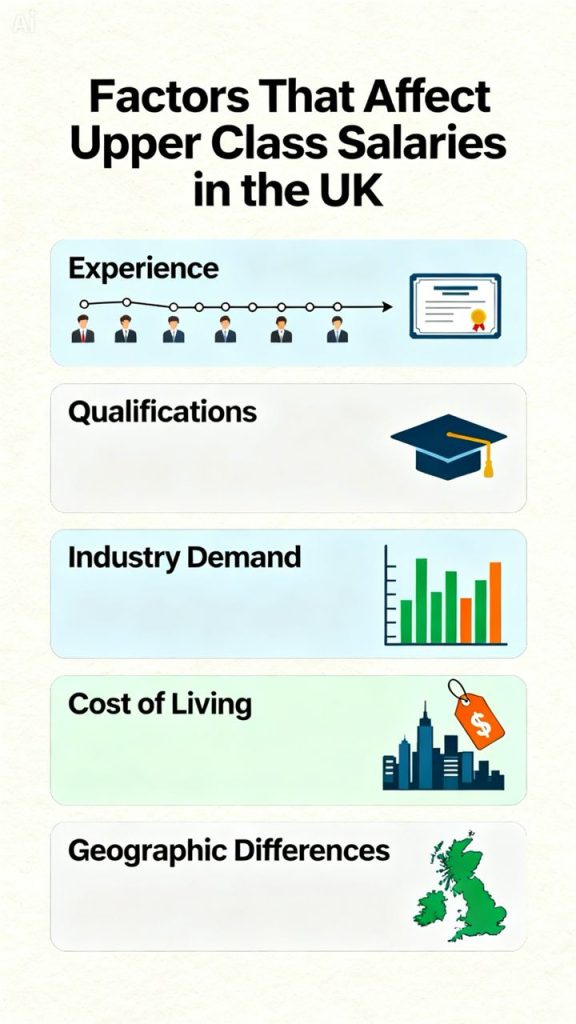
Experience, Qualifications, and Industry Demand
Experience is the single most powerful salary driver at senior levels. Employers in high-paying sectors pay a premium for professionals who have already solved complex problems at scale.
Qualifications act as a signal, particularly in law, medicine, and finance. A Chartered Financial Analyst (CFA) designation, for example, can significantly increase earning potential compared to a generalist finance graduate.
The upper middle class salary UK range of £70,000 to £100,000 is where many skilled professionals plateau. Breaking beyond it typically requires either a sector switch, a deliberate upskilling strategy, or both.
Structural background also plays a role: research from the Social Mobility Foundation Class Pay Gap report (2023) found that professionals from working-class backgrounds earn an average of £6,287 less per year than peers from professional-managerial backgrounds in identical roles.
Bottom line: the upper middle class salary UK range of £55,000 to £100,000 is where most skilled professionals plateau. Breaking beyond requires either a sector switch or a deliberate upskilling strategy.
Cost of Living and Geographic Differences
Here’s something we can both agree on: £100,000 in London is not the same as £100,000 in Liverpool. Cost of living, particularly housing, transport, and everyday expenses, varies significantly across UK regions, meaning the real value of any salary depends heavily on where you live and work.
This means that what salary is upper class UK is not a single fixed answer. A high income in one region may deliver far more financial freedom than the identical figure in another.
Remote work is changing this calculus. Professionals earning London salaries while living in lower-cost regions can accumulate wealth far more rapidly. This is a growing trend reshaping UK earnings mobility.
Ready to Earn at the Top?
RKY Careers is a multi-award-winning EdTech company that has helped 1,500+ professionals break into high-paying tech and finance careers. Our personalised bootcamps deliver real work experience, expert mentorship, and proven job placement support, giving you the career transformation you deserve.
Book a Free Career Consultation Today
How to Move Into an Upper Class Salary Bracket
This is where things get genuinely exciting. Achieving an upper class salary UK level is a structured process, not a matter of luck. Professionals who consistently reach the top follow a clear playbook.

Career Development and High-Impact Skills
First, identify which high-value skills are in demand within your target sector. Then invest deliberately in acquiring them.
The highest-paying skills in the UK right now include:
- Data analysis and data science
- Cloud computing and cybersecurity
- Artificial intelligence and machine learning
- Financial modelling and investment analysis
- Strategic leadership and executive management

According to LinkedIn’s 2025 Jobs on the Rise UK report, AI Engineer and AI Researcher rank among the fastest-growing roles in the UK. Professionals who develop these capabilities are increasingly well-positioned to access upper class salary UK levels, as employer demand for AI skills continues to outpace supply.
Example: Okon came to RKY Careers with no prior tech experience. Within two months of completing the bootcamp, he secured a Commercial Finance Data Analyst role. His trajectory demonstrates that structured upskilling, not just luck, is the accelerant for career and salary growth.
Read Also:
- From No Experience to Commercial Finance Data Analyst: Okon’s UK Success Story
- 2026 Career Paths in Healthcare, Tech, Finance, and Creative Industries
Negotiation, Networking, and Professional Growth
But why do so many skilled professionals leave money on the table? Often, it comes down to a failure to negotiate and a lack of strategic visibility.
Salary negotiation is one of the highest-return activities you can invest in. Research from Harvard Business Review (2024) suggests that professionals who negotiate their salary consistently earn between 7% and 25% more over their career than those who accept first offers.
Here is a simple three-step framework to grow toward a top upper class salary UK:
- Step 1: Audit your value: Identify the specific problems you solve and the measurable outcomes you deliver. Quantify everything.
- Step 2: Build visible expertise: Publish insights on LinkedIn, speak at industry events, and build a reputation as a go-to specialist in your field.
- Step 3: Negotiate strategically: Always negotiate with data. Use salary benchmarking tools, cite your measurable contributions, and target roles above your current bracket.
Networking compounds this effort significantly and building authentic professional relationships opens doors that job boards simply cannot.

Or even better: combine upskilling with personal branding. Professionals who position themselves as thought leaders in high-demand sectors consistently outperform peers at salary negotiation tables.
Read Also:
Frequently Asked Questions
1. What annual income is considered rich in the UK?
In the UK, an individual earning £100,000 or more per year is broadly considered to be in the top 3–5% of earners. Household incomes above £150,000 are widely regarded as “rich.” However, factors like location, lifestyle, and assets all influence whether high income translates to genuine wealth.
2. Do high incomes mean upper class status?
Not necessarily. Upper class status in the UK has traditionally involved inherited wealth, social connections, and cultural capital, not income alone. However, in modern economic terms, consistently earning above £100,000 per year does place individuals firmly within the upper class salary UK income bracket.
3. Which UK cities have the most upper class salaries?
London leads by a significant margin, followed by Edinburgh, Manchester, Bristol, and Birmingham. These cities host the highest concentrations of finance, tech, legal, and consulting roles.
4. How does salary relate to tax in the UK?
Earnings above £100,000 in the UK, trigger the gradual withdrawal of the personal tax-free allowance, creating an effective 60% marginal tax rate on income between £100,000 and £125,140. Beyond that threshold, the additional rate of 45% applies.
The Bottom Line
Reaching an upper class salary at UK level is a realistic goal, but it requires deliberate strategy, the right skills, and consistent professional positioning. The income thresholds are clear. The paths are well-defined. What remains is the decision to invest in yourself and pursue them.
Whether that means upskilling in tech, moving into finance, or mastering the art of salary negotiation, the professionals who succeed are those who act with intention.
RKY Careers exists to help you do exactly that. With 1,500+ success stories and a personalised approach built around real work experience, our bootcamps have helped professionals across the UK and beyond transform their careers and their salaries.