How Do I Land a Remote Job in 2026? Proven Strategies That Work
“How do I land a remote job?” This is one of the most common questions we hear from professionals today. Millions of professionals are now competing for flexible roles across borders. Yet, many still struggle to break through.
Why Remote Jobs Are in High Demand
Remote work didn’t simply survive the return-to-office push, it thrived through it. Millions of professionals across industries now work from home, from co-working spaces in Lagos to home offices in Manchester. Employers, too, have recognised the cost and talent advantages that come with distributed teams.
Growth of Remote Work Globally
According to the World Economic Forum, the number of global digital jobs that can be performed remotely is expected to grow by roughly 25% to over 90 million roles by 2030. Research from 2024 also shows that remote work is now the norm for 28% of the global workforce.
Beyond that, a further 41% of employees prefer a hybrid model, blending home and office time. In fact, 75% of employees engaged in some form of remote work for at least part of 2025, according to Pumble’s remote work report.
Benefits for Employees and Employers
Remote work isn’t just convenient. It creates measurable, documented value on both sides of the hiring table, and understanding those benefits helps you speak the employer’s language during your job search.
For employees, the most obvious gain is flexibility. You reclaim hours lost to commuting, gain control over your work environment, and access roles that were previously out of reach geographically.
Beyond flexibility, remote work directly impacts well-being. Studies consistently show that remote professionals report higher job satisfaction, better mental health, and stronger engagement than their fully in-office counterparts.
For employers, the advantages are just as compelling. Remote hiring opens access to a wider, more diverse talent pool. It reduces overhead costs significantly. It also improves retention, a critical concern for organisations dealing with high turnover in competitive sectors.
Here’s what the data shows across the key metrics:
| Benefit | Employees | Employers |
| Productivity | 13% increase when working from home | More output per worker |
| Retention | Turnover reduced by up to 25% | Lower recruitment costs |
| Happiness | Remote workers are 20% happier | More engaged, loyal teams |
| Cost Savings | Save up to £6,000 yearly on commuting | Save ~£8,500 per part-time remote employee annually |
Now, here’s why this matters for your job search. When you apply for remote roles, you’re not just competing on qualifications. You’re making an implicit case that hiring you remotely is a smart business decision. The more you understand the employer’s perspective, the more effectively you can frame your experience, tools, and working style as direct solutions to their needs.
For employees, it means flexibility, better work-life balance, and access to global job opportunities. For employers, remote work widens the talent pool dramatically.
Vena’s remote work statistics and trends report confirms that remote job postings attract, on average, 2.6 times more applications than in-person roles. That tells you one thing clearly: the competition is real, but so is the opportunity.
Bottom line: the right strategy is what separates the candidates who land remote roles from those who keep scrolling job boards without results.
What Employers Look for in Remote Candidates
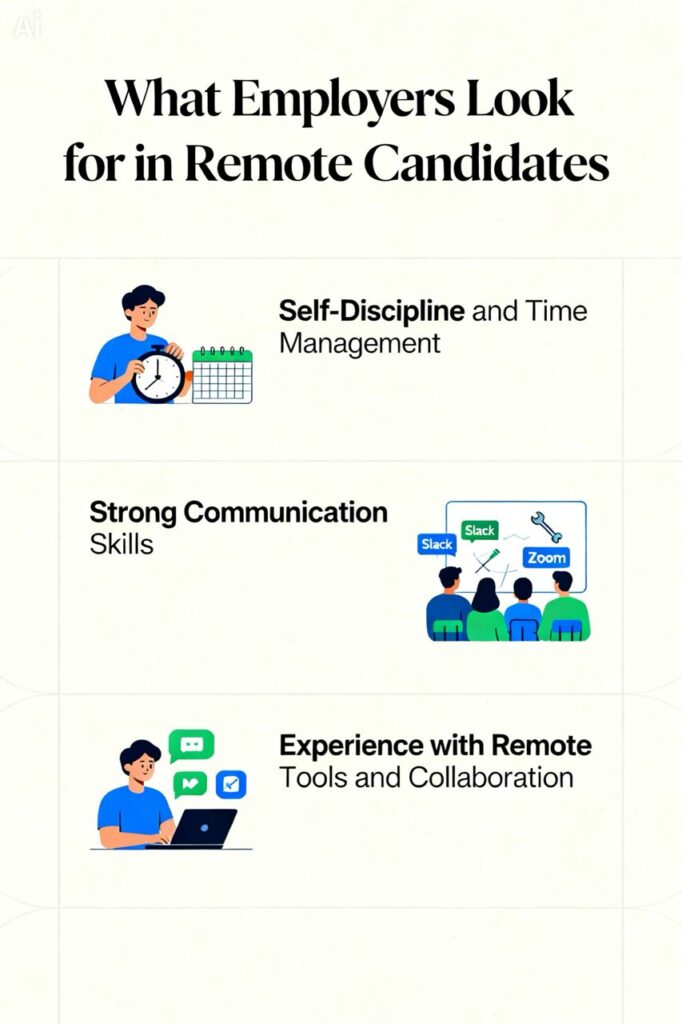
Here’s one of the biggest mistakes professionals make: they assume remote jobs only require the same skills as any office role. They don’t. Hiring managers screening remote candidates are looking for a very specific profile.
Self-Discipline and Time Management
When you work from home, there’s no manager walking past your desk. Employers need evidence that you can manage your own schedule, meet deadlines independently, and stay productive without supervision.
During interviews, they’ll look for examples of self-directed projects, independent deliveries, or situations where you managed competing priorities without oversight.
Now: if you don’t yet have remote experience, think about freelance projects, self-paced learning, or voluntary work you completed on your own. These all count.
Strong Communication Skills
Remote teams depend on clear, timely communication. You need to be able to write concisely in emails and chat tools, speak clearly on video calls, and proactively update colleagues on your progress. Employers look for remote work skills like written clarity, response discipline, and the ability to communicate status updates without being prompted.
For example: candidates who mention how they managed communication in previous hybrid or distributed teams immediately stand out in remote job interviews.
Experience with Remote Tools and Collaboration
Do you know how to use Slack, Zoom, Asana, Trello, Notion, or Google Workspace? These are no longer optional extras. They’re baseline expectations. Listing remote tools confidently in your CV and discussing them naturally in interviews sends a strong signal: you’re already set up to contribute from day one.
Step-by-Step Guide to Landing a Remote Job
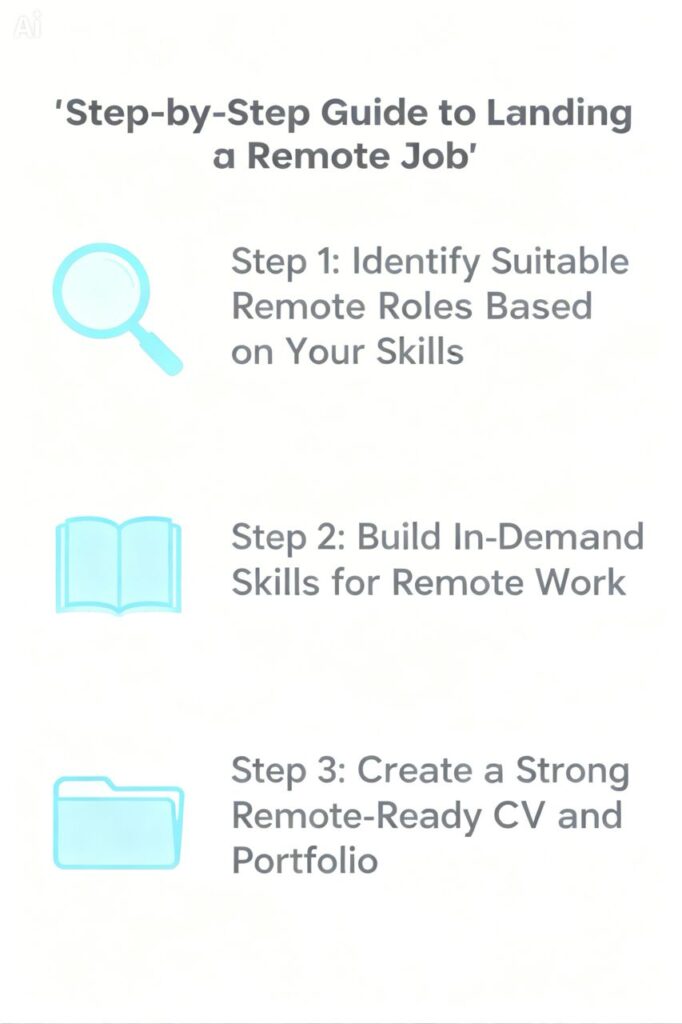
So how do I land a remote job effectively? Here is a proven, practical framework to follow. Use it as your roadmap.
Step 1: Identify Suitable Remote Roles Based on Your Skills
Start with self-assessment. What are you genuinely skilled at? Which of those skills translate well to a remote context? Consider roles where output is measurable, communication is digital, and physical presence is unnecessary. Think digital marketing, data analysis, project management, software development, content writing, or customer success.
Here’s the deal: don’t aim for every remote job posting. Aim for roles where your skills already match 70–80% of the requirements. Targeted applications always outperform mass applications.
Step 2: Build In-Demand Skills for Remote Work
This is where many candidates fall short. Entry-level remote jobs and mid-career remote transitions both benefit from upskilling. Invest in learning tools and skills that employers actively seek:
- Technical skills: Data analysis, digital marketing, project management tools, cloud platforms
- Communication tools: Slack, Microsoft Teams, Zoom, Notion
- Soft skills: Independent problem-solving, written communication, virtual collaboration
- Certifications: Google, HubSpot, Coursera, or industry-specific platforms
Remote job tips 2026 consistently highlight one thing: candidates who can show practical, demonstrable skills get hired faster. A certificate alone rarely moves the needle. Proof of application does.
Step 3: Create a Strong Remote-Ready CV and Portfolio
Your CV needs to do something very specific for remote roles, it must communicate that you work independently, communicate clearly, and deliver results without supervision. Tailor your CV language to reflect remote work skills:
- Mention specific remote tools you’ve used (Asana, Trello, Slack, etc.)
- Replace task-based language with outcome-based language (“reduced project turnaround by 30%”)
- Add a short “Remote Work Profile” or “Work Setup” note if relevant
- Quantify achievements wherever possible
Read Also:
- How to Build a ‘Hire-Me’ Presence Online in 30 Days
- Personal Branding for Job Seekers: What Matters Most in 2026
Step 4: Apply Strategically to Remote Job Platforms
Don’t apply everywhere. Instead, build a focused list of platforms that match your target role and level. Track every application in a spreadsheet. Follow up within five to seven business days if you haven’t heard back.
Work from home job application tips: always apply during peak hiring windows, typically Tuesday to Thursday mornings in the employer’s time zone. Applying on Mondays or Fridays consistently gets lost in the inbox noise.
Step 5: Prepare for Remote Job Interviews
Remote job interview tips start with this: treat a video call with the same professionalism as an in-person interview. Check your lighting, camera angle, and background. Prepare your remote setup in advance.
During the interview, demonstrate self-awareness about remote work challenges. Share examples of how you’ve managed communication, delivered results, or solved problems independently.
Practice answering behavioural questions using the STAR framework:
- Situation: Set the scene
- Task: Explain your responsibility
- Action: Describe what you did
- Result: Share the measurable outcome
Best Platforms to Find Remote Jobs
Not all job platforms are created equal, and when you’re targeting remote roles specifically, where you search matters just as much as how you search. Many general job boards list remote roles, but they’re often buried among thousands of in-office positions.
Using platforms designed specifically for remote hiring gives you better signal, less noise, and faster access to legitimate opportunities. Here’s how to navigate the landscape strategically.
Remote Job Boards and Websites
The right platform matters. Here are the most reliable platforms for remote job opportunities in 2026:
| Platform | Best For |
| Remote.co | Curated remote roles across industries |
| We Work Remotely | Tech, marketing, and creative roles |
| FlexJobs | Premium verified remote listings |
| Remotive.io | Tech-focused remote opportunities |
| Indeed (with “remote” filter) | Volume of listings across sectors |
These are the best platforms for remote jobs, but volume alone doesn’t win. The quality of your application matters far more than the number of roles you apply to.
Freelance Platforms and Gig Opportunities
If you’re new to remote work or building experience, freelance platforms are an excellent starting point. Platforms such as Upwork, Fiverr, Toptal, and PeoplePerHour allow you to build a portfolio of real, paid remote work. Over time, this evidence becomes the strongest part of your CV for future full-time remote applications.
This is especially useful when answering: how to get a remote job with no experience? Start with freelance gigs, build your portfolio, and use client feedback as social proof.
Using LinkedIn for Networking and Job Search
LinkedIn remains the most powerful professional platform for remote job seekers. According to a 2024 report, 68% of Gen Z professionals begin their job search on LinkedIn, and that trend applies equally to mid-career professionals in remote job searches.
Optimise your LinkedIn headline to include remote-friendly keywords. Engage with hiring managers in your target sector. Request informational interviews. Many remote roles are filled before they’re publicly posted, networking is what surfaces those hidden opportunities.
Read Also:
How to Optimise Your CV for Remote Jobs
Your CV is your single most important document in a remote job search and yet most CVs are written with in-office roles in mind. A remote-ready CV is fundamentally different. It must demonstrate not just what you’ve done, but how you’ve done it independently, across digital tools, with measurable results. I
If you’re wondering how do I land a remote job with a CV that actually gets noticed, the answer starts here. A few targeted changes can dramatically improve your shortlisting rate, without exaggerating or inventing experience you don’t have.
Highlighting Remote Work Skills and Experience
Your CV must lead with remote-relevant language. Avoid passive descriptions. Instead, use active, results-focused language that signals remote readiness:
- ✅ “Managed cross-functional team across three time zones using Slack and Asana”
- ✅ “Delivered project two weeks ahead of schedule while working fully remotely”
- ❌ “Responsible for managing tasks and team communication”
Remote work skills to highlight include: asynchronous communication, self-management, project tracking, digital collaboration, and independent decision-making.
Using Relevant Keywords for ATS
Most remote employers use Applicant Tracking Systems (ATS) to filter applications. Research shows that 88% of employers believe they lose highly qualified candidates because those candidates don’t submit ATS-friendly applications. That’s a huge number and entirely avoidable.
Here’s how you can use this technique: copy keywords directly from the job description and mirror them in your CV. If the job advert says “remote collaboration” and “agile project management,” use those exact phrases. Don’t paraphrase them.
Read Also:
Showcasing Achievements and Results
Numbers speak louder than descriptions. Before submitting your CV, review every bullet point and ask: what was the result? Then add it. For example:
- “Reduced reporting time by 35% by implementing automated dashboards using Google Looker Studio”
- “Increased team response rates by 22% through standardising Slack communication protocols”
Results-driven CVs consistently outperform task-based ones in remote job applications. This is one of the most underused remote job search strategy tools available to every candidate and it costs nothing but time.
At RKY Careers, we help professionals like you build the skills, CV, and confidence to compete for remote roles globally. From career branding to practical bootcamps with real work experience, we give you everything you need to stand out. Over 1,500 professionals have already transformed their careers with us.
Book a Free Career Consultation Today and let’s map your route to remote work success.
Common Mistakes to Avoid When Applying for Remote Jobs
Here’s something we can both agree on: most remote job rejections are avoidable. After reviewing hundreds of remote job applications, the same mistakes come up again and again. They’re not about qualifications or experience, they’re about how candidates present themselves.
Fixing these three issues won’t just improve your application. It will change how hiring managers perceive you from the very first glance.
Applying Without Tailoring Your CV
Sending the same CV to every remote role is the fastest way to stay invisible. Employers can spot a generic application within seconds and when they do, it signals a lack of effort and genuine interest.
Tailoring isn’t just about swapping job titles. It means updating your professional summary to reflect the specific role, adjusting your bullet points to mirror the language in the job description, and prioritising the experience most relevant to that employer’s needs.
Yes, it takes more time. But consider this: a tailored application that reaches five employers will almost always outperform fifty generic ones. Remote hiring managers receive a high volume of applications, research shows remote job postings attract 2.6 times more applicants than in-person roles. Standing out starts before the ATS even scans your file.
Ignoring Time Zone and Communication Requirements
Many remote roles, particularly those with UK or US-based companies, explicitly mention required working hours, overlap windows, or preferred time zones. Candidates who overlook this detail waste their own time and the employer’s. Always check the job description carefully for any time zone or availability requirements.
If you’re applying for a UK-based remote role from another country, address this proactively in your cover letter. A simple sentence confirming your available overlap hours removes a key objection before the recruiter even asks.
It shows awareness, professionalism, and genuine consideration for how the team operates. These are qualities remote employers actively look for, and they rarely state it directly.
Not Demonstrating Remote Work Readiness
Employers hiring for remote positions carry a specific concern: will this person actually be able to work effectively from home? They won’t ask you directly in the job description, but they’ll be looking for evidence throughout your application and interview. Your job is to remove that doubt entirely before it forms.
Mention your home office setup briefly in your cover letter. Reference specific remote tools you use daily, Slack, Trello, Zoom, Asana, or Notion. In your CV, describe experiences where you worked independently, managed your own deadlines, or collaborated across digital channels.
Even if your previous roles weren’t formally remote, these signals communicate that you’re already operating like a remote professional. Removing uncertainty is precisely how you move from the maybe pile to the shortlist.
Tips to Stand Out and Get Hired Faster
Knowing how to apply is only half the battle. The other half is knowing how to be remembered. Remote hiring is competitive, and the difference between a shortlisted candidate and one who never hears back often comes down to a few deliberate choices made before, during, and after the application process. These three tactics have a disproportionate impact on how quickly you move through the hiring funnel.
Building a Personal Brand Online
Your online presence is your first impression and it often arrives before your CV does. Before a recruiter calls you in for an interview, they’ve likely searched your name, browsed your LinkedIn, or visited your portfolio. What they find in those first few minutes either builds confidence or raises doubts. A strong personal brand removes that uncertainty entirely.
Start with LinkedIn. Optimise your headline to reflect the remote roles you’re targeting. Write a compelling “About” section that communicates your value clearly. Include results, not just responsibilities, in your experience entries. Beyond LinkedIn, a simple personal website or portfolio even a single clean page adds credibility that most candidates simply don’t have.
Research confirms that remote work is now a permanent, stabilised baseline in the global workforce. That means remote job seekers are competing not just locally, but globally. A strong personal brand is what sets you apart from an equally qualified candidate in another country applying for the same role.
Networking with Remote Professionals
Most professionals underestimate how many jobs are filled before they’re ever publicly posted. Networking within remote work communities dramatically increases your access to these hidden opportunities. The key is to show up consistently and contribute genuinely, not just to ask for referrals.
Join Slack communities in your industry. Participate in LinkedIn groups. Follow and engage with hiring managers and thought leaders in your target sector. Attend virtual events and webinars where remote professionals connect. The relationships you build through these channels compound over time and they frequently lead to introductions that no job board can replicate.
Here’s one real example: a simple, thoughtful comment on a hiring manager’s LinkedIn post can spark a direct conversation. That conversation can lead to a referral. That referral can lead to an offer, all without a single formal application.
Following Up on Applications Professionally
Most candidates never follow up after applying. That habit alone is your competitive advantage. A well-timed, professional follow-up demonstrates initiative, genuine interest, and the kind of proactive communication that remote employers explicitly value.
After five to seven business days with no response, send a brief follow-up message via email or LinkedIn. Keep it to three to four sentences. Reference the specific role, confirm your continued interest, and offer one short reason why you’d be a strong fit. Don’t be apologetic, be confident and direct.
I’ll explain with an example: “Hi [Name], I wanted to follow up on my application for [Role Title]. I remain very interested in the position and would welcome the chance to discuss how my experience in [X] could support your team’s goals.” That’s it. Brief, professional, specific and it consistently generates responses that passive candidates never receive.
Read Also:
Conclusion

If you’ve been asking yourself, “how do I land a remote job?” you now have your answer. Remote work is a real, growing, and competitive market. Success requires more than enthusiasm.
It demands the right skills, a tailored CV, a strategic application approach, and a polished personal brand. The professionals who land remote roles aren’t necessarily the most qualified. They’re the most prepared.
Take this guide and act on it, one step at a time. Whether you’re starting fresh or pivoting from a traditional office role, the remote opportunity is real and it’s waiting for you. At RKY Careers, we’ve helped over 1,500 professionals make exactly this kind of move. You could be next.
BEGIN YOUR REMOTE WORK JOURNEY WITH US
Frequently Asked Questions
How can I get a remote job quickly?
To get a remote job quickly, target roles that match at least 70–80% of your current skills. Tailor every application, use relevant keywords for ATS, and apply on dedicated remote job boards like FlexJobs, We Work Remotely, and Remotive.io. Follow up professionally after five to seven days.
Can I get a remote job with no experience?
Yes, you can get a remote job with no prior remote experience. Start by freelancing on platforms like Upwork or Fiverr to build a portfolio. Complete online certifications to demonstrate relevant skills.
What skills are needed for remote jobs?
Remote jobs require strong self-management, written communication, and proficiency with collaboration tools such as Slack, Zoom, Asana, or Trello. Technical skills vary by role such as data analysis or digital marketing, but soft skills like time management, adaptability, and proactive communication are universally valued.
Where can I find legitimate remote job opportunities?
Legitimate remote jobs are listed on trusted platforms including FlexJobs, Remote.co, We Work Remotely, Remotive.io, and LinkedIn. Always research the employer independently before sharing personal information. Avoid roles that ask for upfront payment or seem vague about responsibilities.
How do I prepare for a remote job interview?
Prepare for a remote job interview by testing your technology in advance, camera, microphone, lighting, and internet connection. Research the company thoroughly and prepare STAR-format answers for behavioural questions. Show awareness of remote working challenges and how you manage them. Dress professionally, minimise distractions, and treat the video call with the same care and preparation as an in-person interview.