What is the RICE Model in Project Management?
Ever heard of the RICE model in project management? So, what is the RICE Model in Project Management? It’s the quiet force behind some of the smartest project decisions you’ve never noticed.
By scoring ideas based on Reach, Impact, Confidence, and Effort, RICE helps teams cut through opinions and focus on what truly moves the needle.
No more endless debates or chasing low-value work, this model shows you exactly where to invest your time for maximum results.
In this guide, we’ll pull back the curtain on how RICE works, why top-performing teams rely on it, and how you can start using it to prioritise like a pro.
Introduction to the RICE Model
In project management, there’s always more work to do than time to do it. That’s why choosing the right things to work on can make all the difference. This is where the RICE model comes in; it’s a powerful way to prioritise tasks based on measurable criteria.
If you’ve ever struggled with choosing between several project ideas or features, this tool provides a structured and logical way to make a decision. And the best part? Anyone can learn how to use it.
Why prioritisation matters in project management
Let’s face it, every project team deals with competing priorities, shifting deadlines, and limited resources. Without a straightforward prioritisation process, it’s easy to get stuck in decision loops or waste time on the wrong things. That’s where project prioritisation models come into play.
They help you make decisions based on real data, not guesswork. By using a structured method like the RICE framework, you can align your choices with business goals and customer value. It’s not about doing more, it’s about doing what matters most.
Who uses the RICE framework and when?
You might be wondering, “Is this just for product managers?” The RICE framework is used by many teams, especially in agile environments. From product owners to project leads, it helps anyone working with a backlog or roadmap.
Read Also:
- Agile Project Management And Scrum Master Certification UK
- How to Become a Project Manager: RKY Career Guide
Studies show that about 85% of successful product teams use models like RICE to steer their decisions. They’re not leaving it up to guesswork; they’re following proven methods that keep everyone aligned, especially when the stakes are high.
Think of it as one of the most practical product management frameworks available today. Whether you lead a startup or work in a big organisation, it’s a decision-making tool in project management that brings clarity to chaos.
Breaking Down the RICE Acronym
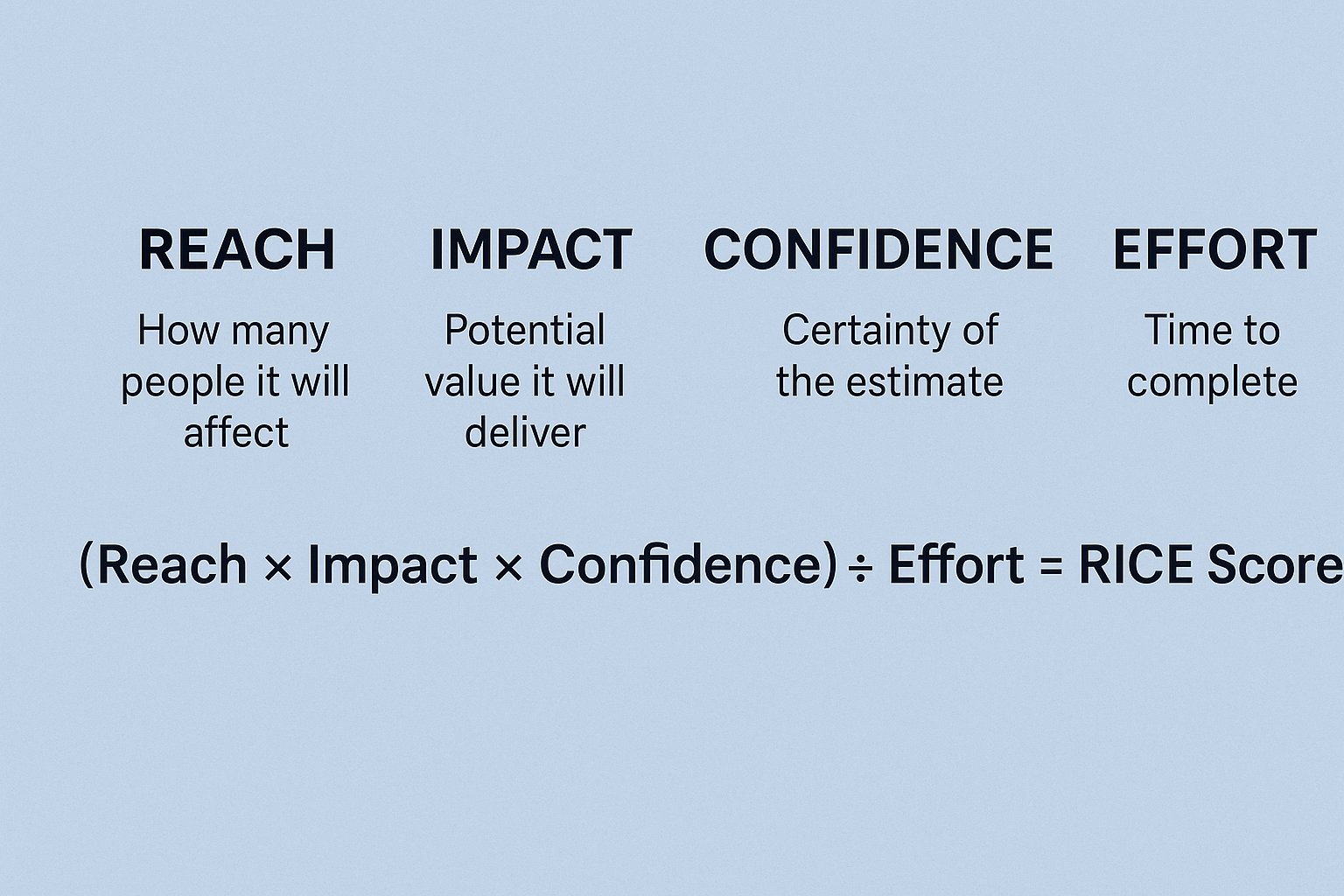
The RICE model gets its name from four components: Reach, Impact, Confidence, and Effort. These factors help you measure the value of an idea more objectively. This helps us to answer “What is the RICE Model in Project Management?”
When you use this method, you’re not just guessing; you’re making informed decisions with supporting logic. If you’ve ever found yourself choosing between two good ideas with no clue which one to pursue, this model steps in to make the process fair and data-driven.
Read Also:
Reach – How many people will this Impact?
Let’s start with Reach, the first variable in the RICE model, and for good reason. Reach helps you estimate the number of people who your project or feature will impact within a specific timeframe.
This could be measured in new sign-ups per month, active users per week, leads generated per campaign, or any relevant metric tied to your goals. The timeframe you choose matters too. Are you thinking in terms of a short-term goal, such as 30 days, or a long-term goal, like a full quarter?
When scoring Reach, think in numbers. For example, if a feature is expected to attract 400 new users per month, then the Reach score is 400. This part of the RICE framework translates abstract ideas into something that can be measured. It’s not just about throwing a feature out there; it’s about understanding how many people it’ll touch and how frequently.
Now here’s the kicker: even a simple change can lead to massive returns if the Reach is high. Say you’re fixing a button that doesn’t work on mobile.
That’s a minor fix, but if 20,000 people are trying to click it every month, the Impact is enormous. So, when deciding how to score projects, begin by asking: how many users will this genuinely reach?
Impact – What’s the potential benefit?
Impact takes you a layer deeper than just who sees your project; it’s about what happens when they do. While Reach measures volume, Impact measures value.
It asks, “How meaningful is this change for the people it touches?” Will it reduce churn? Increase retention? Improve conversion rates? Or make your user experience 10x better? You’re looking at the difference your idea can make in real-world terms.
In the RICE model, we typically use a scoring scale to maintain consistency. A score of 3 means massive Impact, a game-changer. A 2 signals high impact. A 1 is medium, 0.5 is low, and 0.25 means minimal. This way, you can compare ideas that might otherwise feel subjective.
Here’s where things get interesting: you might have two projects with similar Reach, but one offers much higher Impact. That’s how you start separating the good ideas from the great ones. In agile prioritisation methods, where teams often have to make quick decisions, being able to judge impact quickly is essential.
- Read Also:
- Can a Civil Engineer Become a Project Manager?
- Can a Civil Engineer Become a Project Manager?
Confidence – How sure are you about your data?
Let’s be honest, most of us don’t always have perfect information. And that’s where Confidence steps in. This metric keeps your assumptions in check by asking: How certain are you that your Reach and Impact numbers are accurate? Are you working from data or gut feelings?
Confidence uses a percentage-based score. A score of 100% indicates that you have solid evidence, such as past performance data or verified research. 80% suggests you’re reasonably confident, but still have a few unknowns. And 50%? That’s more of a guess than anything else. However, it’s still better to acknowledge uncertainty than to pretend it doesn’t exist.
This part of the RICE framework explained why many product teams love it: it forces transparency. If your Reach and Impact seem impressive, but your Confidence is low, it signals a risky bet in decision-making tools for project management, risk matters. Confidence gives you a way to score that risk clearly and avoid placing big bets on fragile assumptions.
In short, Confidence helps you take your optimism and run it through a reality check.
Effort – How much work is involved?
Finally, let’s talk about Effort, the only RICE factor where a higher number is a bad thing. While Reach, Impact, and Confidence are all about potential gains, Effort is about cost. Specifically, how much time does your team need to complete the task? It’s usually measured in person-days, person-weeks, or even months, depending on the scope.
This is crucial because no team has unlimited resources. So even if an idea scores high in every other area, a massive workload might make it a poor short-term choice. For example, a feature that takes three developers a whole month is a much bigger ask than one that takes two days.
And here’s where it gets strategic: Effort acts as the denominator in the RICE formula. That means high-effort ideas need to work extra hard to earn their spot. You’ll often find that a small change with a high Reach and substantial Impact, but minimal Effort, can shoot to the top of your project prioritisation models.
How to Calculate the RICE Score
Now that you understand the four pillars, Reach, Impact, Confidence, and Effort, let’s put them to work. It is not only on answering “What is the RICE Model in Project Management?” The real magic of the RICE model lies in the formula that ties everything together. It’s not just about ideas, it’s about putting numbers to those ideas.
Want proof that scoring works? McKinsey found that projects selected using structured methods like the RICE model are 40% more likely to deliver real, measurable value. That’s not just theory, it’s performance backed by data
You’ll learn how the scoring system reveals high-value, low-effort opportunities you might have missed. If you’ve ever wanted a more scientific way to choose between tasks, this formula is your new best friend.
The RICE Formula Explained
Here’s how it works in practice: you take your Reach number, multiply it by the Impact score, then multiply that result by your Confidence percentage. After that, divide the whole thing by the Effort required to complete the project. In plain terms, it looks like this:
RICE Score = (Reach × Impact × Confidence) ÷ Effort
This simple formula packs a powerful punch. It helps teams move beyond hunches and into data-backed prioritisation. Each part of the equation balances out the others: high Reach means more users, substantial Impact means deeper value, and a high Confidence score means you’re not just guessing. But all of that can still be outweighed if the Effort is too high.
The result? To get the impact vs effort decision, you get a single number that helps you compare multiple ideas, regardless of how different they seem. It’s one of the most dependable decision-making tools in modern project management.
Practical example of RICE calculation
Let’s try an example. Say you’re considering adding a new feature. You estimate it’ll reach 500 users in a month, have an Impact of 2 (high), and you’re 80% Confident in your data. The Effort? About 5 person-days. So your RICE score becomes: (500 × 2 × 0.8) ÷ 5 = 160.
That’s a pretty solid score. Another feature might look exciting, but it scores only 30. Now you’ve got data-backed insight instead of gut feelings. This is what agile prioritisation methods are all about.
Read Also:
- How to Land a Project Manager Role in London
- How to Prioritise Tasks and Manage Time Effectively for Increased Productivity
When to Use the RICE Model
The RICE model isn’t something you use once and forget. It works best when your team needs to compare ideas with limited resources. Whether you’re running a product team or managing a startup, it gives you structure.
When teams use clear frameworks like RICE, they save up to 25% of planning time, according to Atlassian. That means fewer meetings, faster decisions, and more time building what matters.
Use it in regular planning meetings or backlog grooming sessions. The model shines when you’ve got too many ideas and not enough capacity. Want to know when it pays for itself? When deadlines are tight and the stakes are high. That’s when intelligent prioritisation wins.
Comparing multiple project ideas
Ever been stuck between three or four great ideas? That’s precisely when the RICE model helps. You can plug each idea into the formula and get clear, quantifiable rankings. That’s how product teams use agile prioritisation methods to move fast without breaking things.
This system strips away guesswork and helps you stay focused on high-impact moves. It’s not just about comparing tasks, it’s about building the habit of evidence-based thinking. With time, it becomes second nature in any product management framework.
Prioritising features in product roadmaps
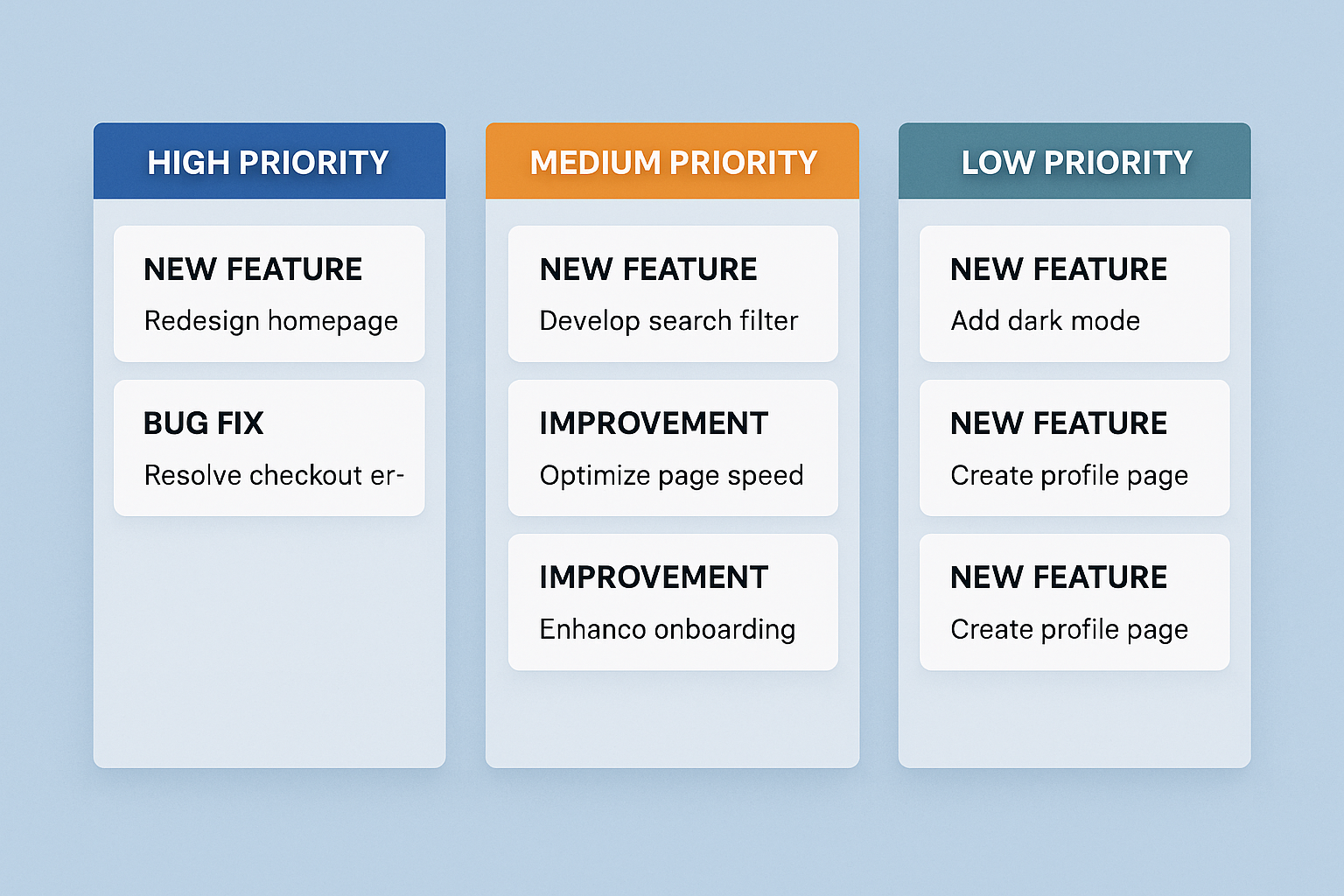
When your team’s roadmap is complete with features, bugs, and “nice-to-haves,” the RICE model offers clarity. It lets you focus on what matters now, what brings the most value with the least Effort.
This approach is ideal for striking a balance between long-term goals and short-term wins. By consistently using this model, your team will learn how to score projects and align them better with company objectives.
It also helps explain decisions to stakeholders who may question why one feature was selected and another wasn’t.
Pros and Cons of the RICE Model
No model is perfect, not even one as smart as RICE. That said, it’s one of the most reliable frameworks available when used effectively. In this final section, I’ll walk you through what it does best and where it falls short. The goal isn’t to replace your judgment but to support it.
Before applying this model without careful consideration, let’s examine its advantages and limitations. That way, you know exactly what to expect and how to get the most from it.
Advantages of using RICE for decision-making
One of the top reasons digital projects fail is bad prioritisation. In fact, 60% of product failures can be traced back to teams building the wrong things at the wrong time. That’s where the RICE model steps in to cut through the noise and help you pick winners. This helps in answering the question “What is the RICE Model in Project Management?”
RICE helps remove emotion and bias from your planning. It provides your team with a shared language for making tough decisions. It works beautifully with other decision-making tools in project management.
You’ll also find it plays nicely with most product management frameworks. Whether you’re looking at internal projects or customer-facing features, RICE turns debate into dialogue. It’s fast, flexible, and surprisingly fun to use once you get the hang of it. That’s why it remains popular in 2025.
Read Also:
Limitations to consider
Of course, RICE isn’t magic. Sometimes your inputs aren’t accurate. Or a project might score low but still be required for legal or technical reasons. That’s why human oversight still matters.
Also, assigning scores can be subjective; what you call high Impact, someone else might call average. However, if you treat the RICE model as a guide, rather than a gospel, it becomes one of the best project prioritisation models you’ll ever use. Just remember: it’s a tool, not a decision-maker. Use it wisely.
Conclusion
By now, I believe you can answer the question “What is the RICE Model in Project Management?” You’ve seen just how useful the RICE model can be when you’re drowning in ideas and need to make smart, timely decisions.
It takes the guesswork out of project prioritisation by breaking things down into Reach, Impact, Confidence, and Effort, four pillars that keep your choices grounded in logic instead of gut feelings.
So the next time you’re faced with tough choices and tight resources, ask yourself: how does it score on RICE? It might just help you spot the next great idea hiding in plain sight.
And if you’re ready to go from theory to real-world execution, RKY Careers’ Project Management and Product Management Bootcamp is where your journey begins.
Designed for aspiring professionals, especially those transitioning into tech roles in the UK, this bootcamp equips you with the frameworks, tools, and Confidence to lead projects and products that deliver real value.
Ready to stop guessing and start leading with strategy?
Join the RKY Careers Bootcamp today, where smart decisions start with innovative training.

FAQ for What is the RICE Model in Project Management?
How is the RICE model different from other prioritisation frameworks?
The RICE model stands out because it blends both qualitative and quantitative inputs. Unlike some frameworks that rely purely on opinion or Effort, RICE lets you weigh potential Impact, reach, Confidence, and Effort in one formula.
It’s beneficial when you need a balanced, data-informed way to compare numerous ideas without letting personal bias influence the outcome.
Can the RICE model be used outside of product management?
Absolutely. While it’s popular in product teams, the RICE model is also applicable to marketing, operations, UX, and even nonprofit planning. Anywhere you need to prioritise tasks with limited time or resources, RICE helps bring clarity.
What tools support RICE scoring in agile project management?
Plenty of agile-friendly tools support RICE scoring, including Airtable, Trello (with Power-Ups), Productboard, and even spreadsheets like Google Sheets. Some platforms let you create custom scoring columns, while others have RICE templates built in.
How accurate is the RICE model in predicting project success?
RICE isn’t about guarantees, it’s about smarter bets. Its accuracy depends on how well you estimate each factor, especially Reach and Impact. When combined with good data and honest inputs, RICE dramatically reduces bias and guesswork.