
Agile Delivery Manager Responsibilities
An Agile Delivery Manager responsibility is more than you think helps teams turn ideas into real work, week by week. They clear roadblocks, keep meetings productive, and ensure the team can deliver small, steady wins
This article explains agile delivery manager responsibilities in simple, practical terms. You’ll learn what the role entails, how it connects teams and business, and which skills are most important.
Everything here is written plain and short, so it is easy to read. If you want a clear view of the job, not a sea of jargon, this guide will help.
What Is an Agile Delivery Manager?
An Agile Delivery Manager helps teams deliver work that matters. They clear roadblocks and keep teams focused on the right goals while balancing speed with care. Also help the team ship often, get feedback fast, and learn from that feedback.
Practical things are what they do every day to keep delivery steady. They coach teams in habits that keep quality high and stress low. And also make sure the team’s work links to business goals and real user needs.
Not only do they look after flow, people, and outcomes but also do not micro-manage tasks. Instead, they remove noise so the team can do great work. In many organisations, they are the glue between product, design, engineering, and operations. It is worth considering when Setting Career Development Goals
Definition of the role
SOURCE: ITJobs
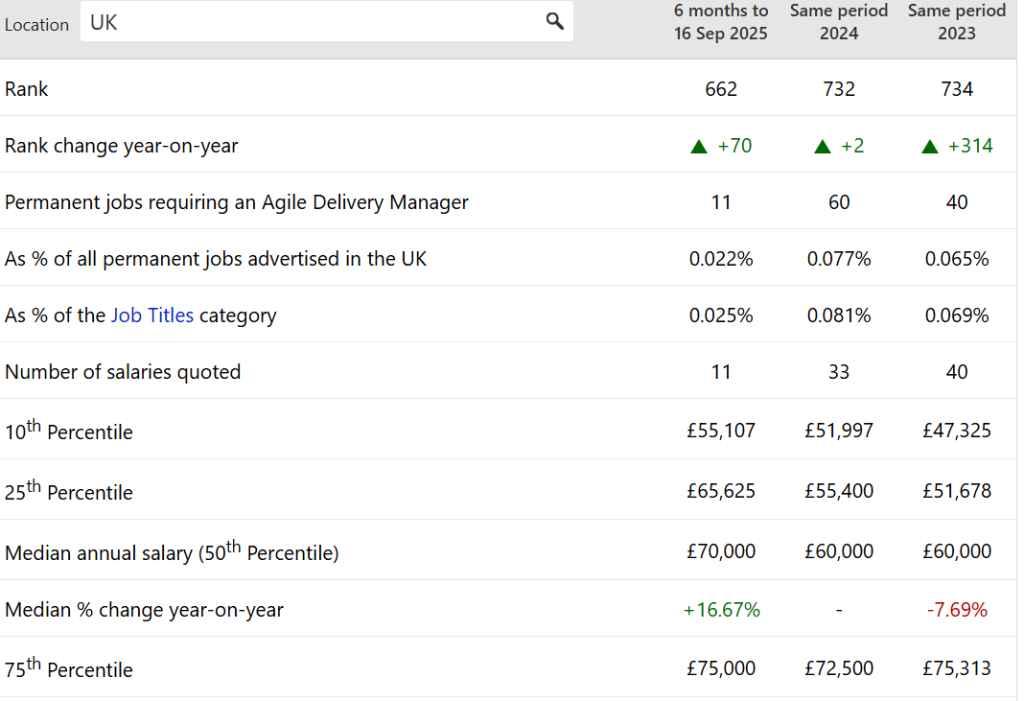
An Agile Delivery Manager makes delivery work smoothly with a salary of an average of £70,000 per year in the UK. Agile delivery manager also helps teams move from idea to release by turning big goals into small, clear steps.
Breaking big projects into bite-sized work keeps the team focused on the most valuable tasks. As a result, the team spends less time guessing and more time shipping.
Small problems are fixed early so they do not grow into big delays. Asking short, useful questions helps people make decisions faster.
The manager also sets up simple ways to measure progress and learns from the results. Coaching is part of the job too: teams are encouraged to try small changes, test them, and keep what works.
Waste that repeats is cut away so teams get faster over time. Keeping the team’s routine healthy is another top priority.
The delivery manager helps teams share work, run demos, and gather real feedback from users. Often hands-on, this person clears the path so the product can reach users sooner.
This agile delivery manager job description captures planning, removing blockers, coaching, and making delivery predictable.
How it fits into Agile organisations in the UK
In the UK, the agile delivery manager role UK appears in many sectors. Many tech companies choose Agile project management methods. You will find it in finance, consultancies, and public sector digital teams. The manager links teams across departments and regions.
The manager connects teams across departments and regions so work flows well between groups. By shaping roadmaps with product owners and business leaders, they help teams ship together at scale..
In government and regulated finance teams, this role often helps keep delivery safe and steady. The role is practical, people-focused, and tuned to local business realities.
Difference from Scrum Master, Product Owner, and Project Manager
These roles can sound alike, but each has a different focus. A Scrum Master coaches one team on ceremonies and team health. A Product Owner is the voice of the user and decides product priorities.
A Project Manager often plans fixed budgets and milestones for a project. An Agile Delivery Manager, by contrast, looks across several teams and delivery streams.
Coordination is a core task: aligning roadmaps, removing cross-team blockers, and keeping senior stakeholders informed.
Where one person might wear two hats in a small team, larger organisations keep these roles separate so each can focus on its area of strength. The Delivery Manager’s priority is flow and predictability across the delivery area.
See Also:
- Success Story: How Temitope Secured a Visa Sponsorship Job as an Agile Delivery Manager
- How to Use LinkedIn Effectively for Your UK Job Search
Core Responsibilities of an Agile Delivery Manager
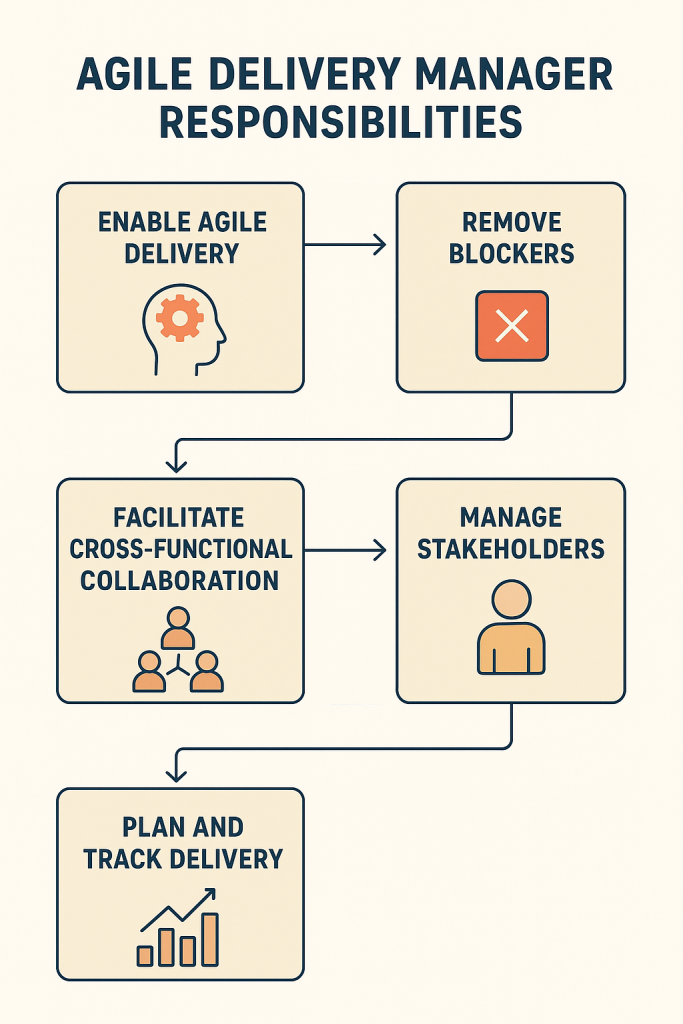
The set of agile delivery manager responsibilities is practical and people-centred. The role helps teams adopt agile habits and deliver value in short cycles. This keeps the flow of work smooth and visible and removes blockers quickly.
It keeps stakeholders informed and aligned and helps teams learn and improve with each release.
The role is both tactical and strategic: tactical in daily unblock work, strategic in aligning work with business outcomes.
It helps scale delivery and keep teams healthy, and they are not limited to software product alone; they can also be used for non-software products.
Enabling Agile Delivery
Enabling agile delivery means making Agile useful, not just formal. The manager helps teams adopt short cycles, small stories, early tests, and frequent demos.
They coach on how to split big features into small, testable pieces while encouraging testing early in the flow so bugs are cheaper to fix.
Removing blockers for the team
When work stops, the manager steps in; spot blocks like unclear decisions, broken builds, waiting for approvals, or missing environments.
Like a super hero, they find the right person to fix the problem and push the fix forward. They keep the team focused while the issue is resolved.
Facilitating cross-functional collaboration
Delivery needs many skills: product, design, engineering, testing, security, and operations.
This cross-functional work reduces wait time and improves release reliability. When teams talk and plan together, delivery becomes smoother and faster.
Stakeholder Management
Stakeholder management is about clear, honest, and timely communication. The Agile Delivery Manager shares progress in plain words, highlights real risks early, and explains trade-offs simply.
Agile managers are in charge of runing demos and short reports so stakeholders can see value quickly.
They balance urgent asks with what the team can realistically do, protecting team focus. This builds trust. When stakeholders trust the team, they support steady delivery and avoid last-minute changes that create chaos.
Communicating progress, risks, and dependencies
Clear updates prevent surprise. The manager shares what has been done, what is next, and what may block progress.
They adapt their style; some want a single-line update, others want a short chart.The manager learns these preferences and gives the right information. This keeps plans realistic and keeps leaders confident in the team’s delivery.
Building trust between teams and business stakeholders
Trust grows when teams are honest and predictable. The manager helps set realistic expectations and then helps the team meet them.
Stakeholders who trust the team allow room for learning, which leads to better outcomes over time.
Delivery Planning and Tracking
Good planning breaks big goals into small, testable steps. The Agile Delivery Manager helps create roadmaps that are realistic and adaptive. They help teams plan short cycles and set milestones that make sense.
They help the team forecast with care, so promises to customers and leaders are safe. The aim is steady, predictable delivery without over-planning.
Coordinating delivery roadmaps and timelines
The manager works with the product to split big features into a sequence of small deliverables. Timelines are important because that allows time for testing and rollout.
This coordination makes multi-team releases less risky and more predictable. The manager focuses on clarity and on keeping the roadmap realistic.
Monitoring team performance and delivery metrics
A few simple measures reveal the flow of work. The manager watches lead time and cycle time to spot delays. They watch how often the team ships and how often goals are met. If metrics change, the manager asks why and helps the team find fixes.
Coaching and Mentoring
Coaching and mentoring grow the team’s skills and confidence. The manager runs short workshops and helps with retrospectives that lead to real experiments. They pair with team leads to share best practices.
They encourage small trials of new ideas and measure results. Mentoring is personal: the manager gives clear feedback and suggests learning paths. They help people deepen technical craft and collaboration skills.
Over time, the team becomes stronger and needs less daily help. A key measure of success is a team that runs its own improvement work and keeps delivering.
Supporting continuous improvement
Continuous improvement is steady and small. The manager helps the team turn one or two ideas from a retro into short experiments.
These small steps compound into major gains in reliability and speed. The manager’s role is to keep the improvement habit alive without overloading the team.
Guiding teams through Agile maturity
Teams grow at different paces. The manager meets teams where they are. For a new team, they teach basic habits like short cycles and clear stories. For mature teams, they help scale practices across multiple teams.
They add governance without killing speed. They coach new leaders and help the organisation adopt consistent ways of working. Over time, the team should need less hands-on help. The manager’s job is to guide that path so teams gain confidence and autonomy.
Risk and Issue Management
Good delivery needs good risk thinking. The manager helps teams list what might go wrong early. They focus on the top few risks and assign owners. They design clear, simple mitigation steps that match business priorities.
Identifying delivery risks early
Early risk spotting stops many late crises. The manager asks about third-party dependencies, known technical debt, and timeline tightness. Always checking for missing decisions or change requests that could derail delivery.
When a risk becomes an issue, the manager makes sure the team and leaders know the plan and who acts next.
Aligning mitigation strategies with business priorities
Not every risk must be fixed the same way. The manager helps the team choose actions that match the business value at stake.Before fixing, the manager weighs the cost against how important the feature is.
See Also:
Skills Required for an Agile Delivery Manager
An Agile Delivery Manager needs both head and heart and should also match your personality. Strong agile delivery manager skills rest on a clear grasp of Agile and Lean principles plus top-notch communication and facilitation.
Strategic thinking and quick problem-solving let them make smart trade-offs when plans change. They lead by enabling, not by micromanaging, and listen with real empathy so the team feels heard and supported.
Tool literacy, like boards, CI, deployment pipelines, and simple dashboards, helps them spot trends.
They need a calm presence under pressure and the ability to push for decisions without causing conflict. The blend of data, facilitation, and people skills makes the role effective. These are also transferable skills that look good for career change.
Agile Delivery Manager in the UK Job Market
The agile delivery manager salary UK varies by city and by sector. One reliable snapshot shows an average Agile Delivery Manager salary in the UK of around £63,002 per year.
This role is common in tech, finance, consultancy, and the public sector. Career progression often goes from Delivery Manager to Senior Delivery Lead, Head of Delivery, and then to Director roles.
Helpful certifications include SAFe, AgilePM, ICAgile, and CSM. Taking courses, especially the entry-level AgilePM course UK for beginners, is important, but real delivery outcomes often matter more than paper.
Employers look for candidates who can show concrete improvements to flow, reduced wait times, and better release reliability.
See Also:
Agile Delivery Manager vs Other Agile Roles
When people search agile delivery manager vs scrum master or agile delivery manager vs project manager, the key question is scope. A Scrum Master helps one team with daily practice.
A Project Manager often plans a fixed scope and tracks budgets. An Agile Delivery Manager coordinates across teams and aligns delivery to business goals. They help keep large releases aligned and predictable. Organisations often need all these roles.
As delivery scales, the Delivery Manager role helps avoid teams working in isolation and keeps the whole product delivery coherent.
Agile Delivery Manager vs Scrum Master
A Scrum Master coaches one team’s ceremonies and helps the team remove local blockers. An Agile Delivery Manager looks across multiple teams or a delivery stream and focuses on roadmap alignment, cross-team dependencies, and stakeholder communication.
In small companies, one person may cover both roles. In larger setups, they are separate to let each role add more value.
Agile Delivery Manager vs Project Manager
Project Managers often work with detailed plans, budgets, and fixed scopes. Agile Delivery Managers favour short feedback loops, iterative planning, and adapting as teams learn. Both approaches have value.
For work with strict contracts and compliance, Agile methodology in project management helps. For changeable product work, delivery managers help teams adjust fast and deliver value more continuously.
Why organisations need this role
Companies need an Agile Delivery Manager when many teams must work together. Without this role, teams can become islands. They may deliver parts that do not fit. The manager keeps the pieces working as one.
This role helps scale Agile and keeps releases steady and teams healthy. Also helps in building trust with leaders and the companies move fast while keeping people well.
The responsibilities of an agile delivery manager help the whole group move as one. Thinking of switching career into tech UK with no experience, you can give it a go.
See Also:
- A Comprehensive Guide Into Agile Project Management
- How to Spot Ghost Job Postings UK Before Applying
Final Thoughts
The responsibilities of an agile delivery manager focus on people, flow, and steady delivery. They enable teams, manage stakeholders, plan and track work, coach teams, and handle risks.
Agile is now used widely. Just over 70% of organisations report using Agile in their SDLC. Also, 42% say they use a hybrid model that mixes Agile with other ways. These facts show why delivery roles are in demand.
If you’re serious about standing out in today’s job market, the next step is building solid expertise as a project manager

That’s where the RKY Careers project manager Boot Camp comes in.
Designed for professionals in the UK and beyond, this program gives you hands-on training, industry-recognised certification prep, and practical insights from seasoned Agile experts.
Don’t just read about Agile, live it, practice it, and lead with confidence.
Enrol today with RKY Careers and take the first bold step towards becoming the Agile leader companies are searching for.
FAQs
- What does an Agile Delivery Manager do?
They make sure teams deliver value often and safely. They remove blockers, coach teams, and talk to stakeholders. - Is an Agile Delivery Manager the same as a Scrum Master?
No. The Scrum Master often helps one team. The Agile Delivery Manager helps many teams and handles roadmaps. - What skills are needed to be a successful Agile Delivery Manager?
Key agile delivery manager skills include Agile and Lean knowledge, clear communication, facilitation, strategic thinking, problem-solving, and leadership that trusts the team. - How much does an Agile Delivery Manager earn in the UK?
Market data shows an average agile delivery manager salary UK of roughly £63,002 per year, though exact pay varies by city and sector. - What is the difference between an Agile Delivery Manager and a Project Manager?
A Project Manager traditionally designs a fixed plan and tracks it. An Agile Delivery Manager helps teams iterate, learn, and adapt while keeping delivery steady.