
How to Become a Business Analyst UK: A Practical Roadmap
Many career changers ask how to become a business analyst UK companies will take seriously. The good news is that the role welcomes people from many backgrounds.
Business analysts sit between business teams and technology teams. They turn messy problems into clear requirements that developers can build. As a result, the role suits people who enjoy both problem solving and people.
Here’s the deal: you do not need a computer science degree to start. Many analysts come from operations, finance, admin, teaching or customer service. Below, you will see how to make that shift with confidence.
What Does a Business Analyst Do Day to Day?
A business analyst studies how an organisation works and finds ways to improve it. In practice, that means running workshops, mapping processes and writing requirements. You also test solutions and explain results to senior leaders.
Here’s an example: a bank wants faster loan approvals. The analyst maps every step and spots the delays. Then the delivery team builds the fix.
Read also:
- Data Analyst Responsibilities: What Does a Data Analyst Do?
- Step-by-Step Guide on How to Become a Data Analyst in the UK
Why Now Is a Smart Time to Enter the Field
Look at the demand. Adzuna data shows over 5,000 active business analyst postings in December 2024. The same data puts the average business analyst salary UK wide at £59,013, with London averaging higher.
Another analysis of job adverts found a median advertised salary of £62,500 in the six months to May 2025. Pay still varies by location and experience. Treat these figures as guides rather than promises.
But why does demand keep growing? Organisations change constantly, and someone must connect ideas to delivery. The World Economic Forum found that employers expect 39% of key skills to change by 2030. Its report also projects 170 million new jobs worldwide by 2030.
Technology skills add another boost. A 2025 study found that jobs requiring AI skills carry a 56% wage premium. It also found that skills are changing 66% faster in the jobs most exposed to AI. Analysts who understand data and automation therefore stand out.
Which Route Suits You Best?
There is no single answer to how to become a business analyst UK employers accept, so compare routes first. Each path suits a different starting point. The table below shows the main options.
| Route | Best for | Typical timeline | Main advantage |
| Level 4 Business Analyst apprenticeship | Current employees and school leavers | About 18 months | Paid learning with BCS recognition |
| University degree or MSc | Recent graduates | One to three years | Academic credibility |
| Career-change bootcamp | Mid-career professionals | Weeks to months | Practical, project-based learning |
| Internal move | People already in a business team | Varies | Fastest route to real experience |
It gets better: a degree is no longer the only gatekeeper. PwC’s analysis shows the share of AI-augmented jobs requiring a degree fell from 66% to 59% between 2019 and 2024. In fact, employers increasingly hire for skills and proof of ability.
How to Become a Business Analyst UK: Step by Step
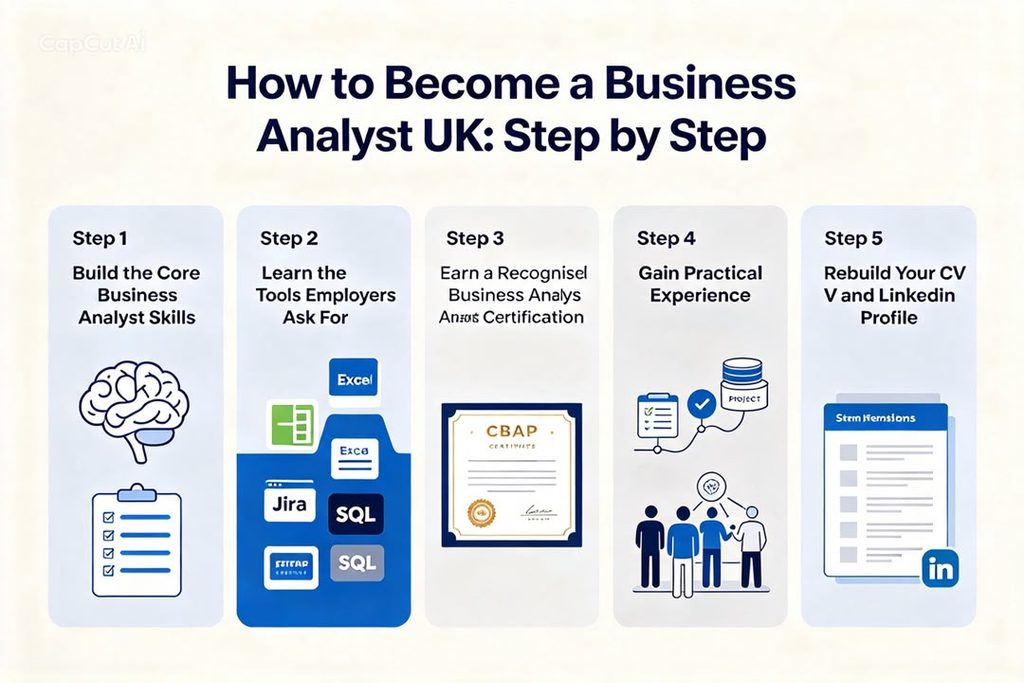
Now: let’s turn the routes into an action plan. Follow these six steps in order and adjust them to your background.
Step 1: Build the Core Business Analyst Skills
Start with requirements gathering, process mapping and stakeholder management. These abilities sit at the heart of the job. You can practise them today by documenting a process at work and interviewing colleagues about pain points.
Step 2: Learn the Tools Employers Ask For
Job adverts commonly list Excel, SQL, Jira and a diagramming tool such as Visio or Lucidchart. Power BI and Tableau also appear often. You do not need to master everything at once. Pick two tools and build a small project with each.
Step 3: Earn a Recognised Business Analyst Certification
Credentials show recruiters what you know before they meet you. The BCS Foundation Certificate in Business Analysis and the IIBA’s ECBA are widely recognised starting points. Choose one and book the exam, because a deadline keeps you moving.
Step 4: Gain Practical Experience
Experience is the biggest hurdle for anyone working out how to become a business analyst UK companies will hire. But stay with me, because you can build it in several ways. Live projects, volunteering, internal secondments and structured work experience all count.
Document each project with the problem, your actions and the result. Those three parts become CV bullet points and interview stories. Pair your business analyst certification with at least one documented project, and your profile becomes far more convincing.
Step 5: Rebuild Your CV and LinkedIn Profile
Recruiters scan for outcomes, so lead with results. Translate your past work into the language of business analysis. For example, replace “handled orders” with “redesigned the order process and reduced errors”. Finally, update your LinkedIn headline to match.
Read also:
Step 6: Prepare for Interviews and Apply
Search for entry level business analyst, junior analyst and business systems analyst roles. Expect scenario questions, such as handling two stakeholders who want opposite things. Practise with the STAR method, which covers situation, task, action and result.
The bottom line: employers hire analysts who can show how they think, so rehearse your reasoning out loud.
Read also:
- Business Analyst Scenario-Based Interview Questions and Answers
- Business Analysis Interview Questions
How to Become a Business Analyst UK With No Experience
Picture Amara, an operations coordinator who spends her days fixing repeated delivery delays. She maps the process, finds the bottleneck and presents a fix to her manager. Without realising it, she already uses business analyst skills. (This is an illustrative scenario.)
Her next moves are simple. She adds a certification and documents two projects from her current job. Amara’s story shows how to become a business analyst UK recruiters notice, by starting with what you already do.
What Does the Business Analyst Career Path Look Like?
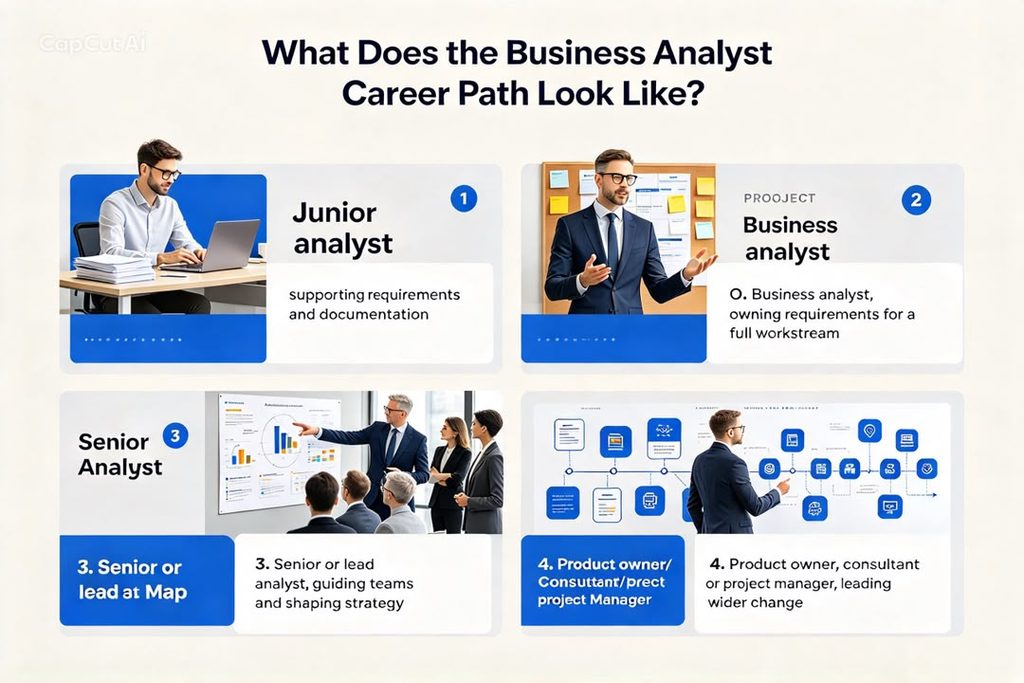
Once you know how to become a business analyst UK, progression becomes the next question. A typical business analyst career path starts at junior level and moves through analyst and senior roles.
- Junior analyst, supporting requirements and documentation
- Business analyst, owning requirements for a full workstream
- Senior or lead analyst, guiding teams and shaping strategy
- Product owner, consultant or project manager, leading wider change
Each step lifts your earning power, and the business analyst salary UK employers offer grows with responsibility. But here’s the kicker: project management skills open doors at every level. Understanding scope, budgets and delivery makes you far more valuable.
Read also:
- Career Guide on How to Become a Project Manager in the UK
- How to Highlight Transferable Skills in Job Applications to Impress Employers
The bottom line: how to become a business analyst UK employers respect comes down to skills, proof and support.
Ready to move from curiosity to a confirmed offer? RKY Careers builds personalised career plans for professionals changing direction. Our Project Management course pairs practical work experience with mentorship during and after your bootcamp. Join 1,500+ success stories and turn your transferable skills into a confident UK career starting today.
Explore Our Project Management Bootcamp
Frequently Asked Questions
How long does it take to become a business analyst in the UK?
Most career changers need several months to build skills, earn a certification and gain practical experience. Apprenticeships typically take about 18 months, while degrees take longer. Your timeline depends on your background and study hours. It depends on how quickly you secure hands-on project experience through work placements or volunteering.
Do you need a degree to become a business analyst in the UK?
No, a degree is not compulsory. Employers care most about analytical thinking, communication and proof of practical skills. Many analysts move across from operations, finance or admin roles. A certification, a documented project and a strong CV can often carry as much weight as formal study in many hiring processes.
Which tools should a new business analyst learn?
Start by learning Excel, SQL and a process mapping tool such as Visio or Lucidchart. Add Jira for managing requirements and Power BI or Tableau for reporting. Employers value the ability to explain findings clearly, so practise presenting your analysis to non-technical colleagues. Comfort with data helps you stand out.
Is business analysis a good career for career changers?
Yes, because the role rewards transferable skills such as communication, problem solving and stakeholder management. Many people begin as an entry level business analyst after working in operations, finance or customer service. With a certification and documented projects, career changers can compete well against more traditional candidates for many roles.