Business Analyst vs Data Analyst
You know analytics is the future but here’s the big question; ‘Where should I delve into – Business analyst vs data analyst?
This is a crossroad every job seeker faces when choosing a clear career path. Think about it: one role trains you to shape business outcomes and guide teams, while the other trains you to dig into numbers and prove what works.
Here’s the thing: employers hire for impact, not jargon. Want quick wins? Learn core tools, craft project stories, and show measurable results. business analyst role explained and data analyst role explained in this article.
Understanding the Roles
Knowing the roles helps you know which one is best suited for you. If you are looking into transitioning into any of these roles, you should know what each role focuses on and why it matters for your business.
You should understand the clear contrasts and useful overlap so you can decide which to apply for or not. From day-to-day tasks, goals, to the skills each role brings. Data analyst vs business analyst is one tricky comparison so, stay with me. Let’s begin.
What Does a Business Analyst Do?
What exactly does a business analyst do? A business analyst turns business needs into clear plans. They look at processes, goals, and pain points, then work with stakeholders to map solutions.
Peregrine Intelligence estimates approximately 47,980 professionals are currently working specifically in Business Analyst roles in the UK, rising to over 88,250 when including adjacent data/insights roles
You’ll often find a business analyst managing requirements, running workshops, and writing clear specifications. They bridge strategy and execution so can teams deliver value but not only that, they also ask the hard questions, prioritise features, and test outcomes.
Here’s the thing: business analysts blend communication, process design, and market sense. If you want a short label, think business analyst role as a strategist-translator who helps teams act on business goals. This is simply a business analyst role explained.
What Does a Data Analyst Do?
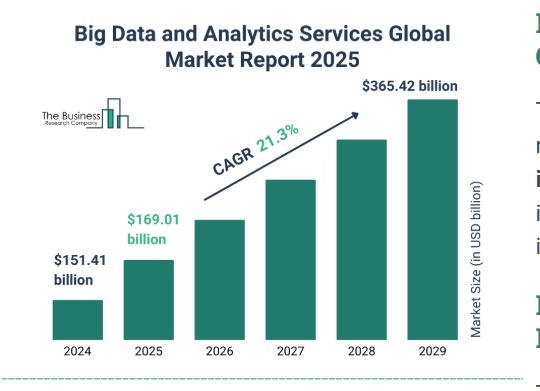
Source: The business research company
Now, what does a data analyst do? Data analyst turns raw numbers into useful insight. Sound simple, right? Well not really. You’ll see them cleaning data, building charts, and running queries to answer questions
The job opportunities is on the high is probability of about 23% increase in demand by 2028
A data analyst uses tools to slice datasets, test hypotheses, and spot trends that guide choices. In practice a data analyst builds reports, dashboards, and models to help teams act faster.They focus on accuracy, repeatable analysis, and telling the story behind numbers.
Think of a data analyst as the detective work behind decisions. They often write SQL, use spreadsheets, and work with BI tools to automate insights and also help you prove what works and stop wasting time.
If you are looking to Transition to a New Industry in the UK, you might want to get started as a data analyst.
Where the Two Roles Overlap
Both roles turn information into action. You’ll find both people asking questions, testing assumptions, and helping teams choose priorities. They work hand in hand as a business analyst frames what needs to change and a data analyst shows whether it worked.
In many organisations the roles share skills like communication, problem solving, and a focus on outcomes. The overlap is collaboration: you get to strategise with evidence.
In short, Business Analysis vs Data Analysis is not always a strict split; it’s often a team effort to make better choices and measure results. You can start small in any of the role, measure impact, and scale what works quickly.
Read Also:
Key Differences Between Business Analysts and Data Analysts
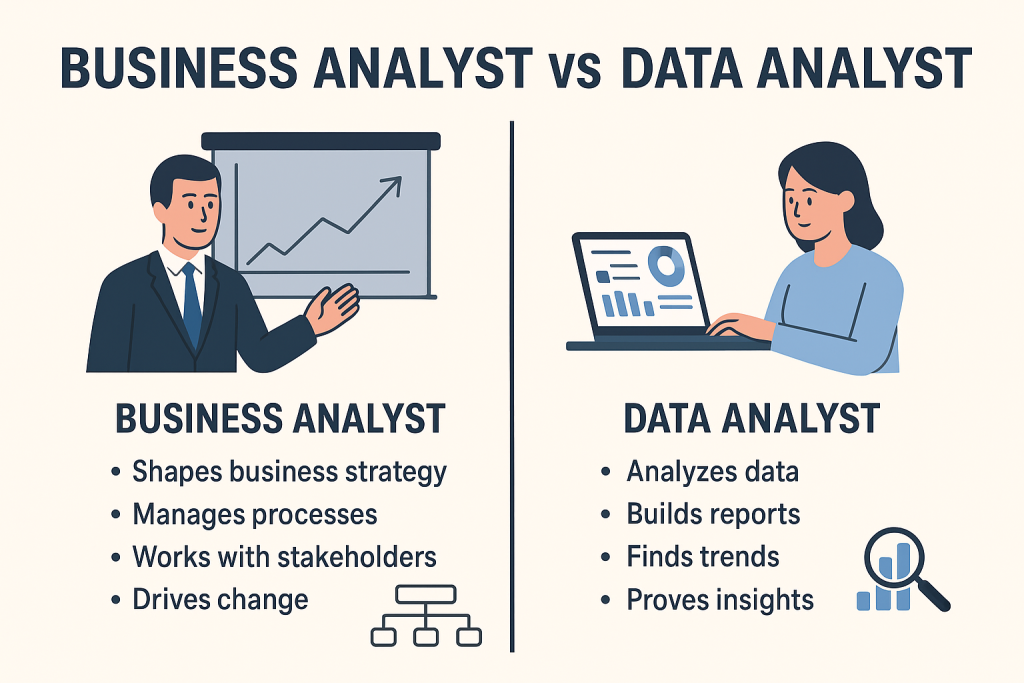
Even though they carry the analyst last name, they also key differences. Business analysts study processes, stakeholders, and outcomes while data analysts focus on datasets, cleaning, and modelling.
As a Business Analyst you get to shape strategy and a data analyst to test hypotheses. But the lines blur in small teams. Here’s why: the BA speaks business language and drives change; the data analyst speaks data language and proves impact.
Together they speed decisions and reduce risk. Think clarity, proof, and action.
Focus Areas: Strategy vs Data Insights
Business analysts concentrate on strategy, process design, and stakeholder alignment. They look at goals, value, and how projects will change the business.
On the other hand, data analysts concentrate on insight generation, data quality, and measurement. They answer specific questions with numbers.
For you, this means as a BA you frame the question and as a data analyst, you find the evidence. In practice, teams combine both: strategy needs proof, and proof needs context.
So, when you weigh Business Analysis vs Data Analysis, ask what stage you are at in idea, testing, or scaling and check which one resonate with you best.
Tools and Software Used by Each Role
Data analysts use SQL, Python, R, Excel, and BI tools to wrangle and visualise data. Business analysts use process mapping, requirements tools, stakeholder matrices, and collaborative platforms to capture needs.
Yet both often share dashboards and communication tools. For clarity, data analyst vs business analyst tools can differ sometimes, depending on what is being worked on.
Data analyst handle code and queries and Business Analyst handle workshops and specifications.
If you are good with quick insight, prioritise BI and SQL. Examples: Tableau, Power BI, Jira, Confluence, Miro and Visio. You can learn various tools to keep your skills flexible.
Types of Problems They Solve
Business analysts solve problems about processes, customer journeys, and value delivery. They ask what the business should build and why.
Data analysts solve problems about patterns, performance, and measurement. They ask whether an idea worked and why. The difference between business analyst and data analyst shows that BAs interpret business context and recommend change; data analysts provide the evidence to act.
This means BAs write the narrative and plan the change while data analysts test, measure, and refine. Both roles reduce uncertainty, but they attack different parts of the problem.
Required Skills and Competencies
Skills matters if you looking to get into any of the analyst roles. Business analysts need stakeholder management, process thinking, and clear writing. Data analysts need SQL, statistics, and data visualisation skills.
Both need curiosity, problem solving, and communication. Transferable skills like storytelling and critical thinking make transitions possible. In short, prioritise attitude and teachable skills to help you make better decision and Tailor Your Job Search To Your Ideal Career Path.
Core Skills of a Business Analyst
Core business analyst skills combine analysis and people work. The major Functions of a Business Analyst are;
- Requirements gathering
- Process mapping
- Stakeholder interviews
- Business case writing.
- A BA uses modelling, cost-benefit thinking, and prioritisation.
They must translate technical detail into plain language so teams move fast. I think the single biggest BA skill is influencing without authority like getting agreement across teams. Here’s another way to think about it: a BA turns vague goals into clear, testable steps.
Core Skills of a Data Analyst
Core data analyst skills centre on numbers and curiosity. You’ll get to use SQL, Excel, Python or R, statistics knowledge, and dashboarding skills.
You clean data, reliable queries, and repeatable reports matter more than clever models. No wonder it is one of the Highest Paying Tech Jobs UK 2025.
A great data analyst frames questions, chooses the right test, and shows limits of the data. By the way, communication is key: they must explain methods in clear terms so stakeholders trust results.
If you looking into How To Become A Data Analyst, you must be able balance statistical rigour with simple visuals and clear recommendations, this might be a great pick.
Examples include A/B tests, churn models, and automated pipelines.
Transferable Skills Between the Two Careers
Can you transition between these two roles? Yes. data analyst transferable skills include communication, critical thinking, and problem framing. Data analysts who explain results clearly can step into BA work.
Business analysts who understand metrics and basic SQL can test ideas faster. For you, the key is practice: You can work across tasks, run short projects, and learn the missing skills.
Storytelling, stakeholder management, and analysis skills are the highest-value transferable skills. Want to know more? Start with simple tasks and document measurable results.
See Also:
- Building a Job-Ready Portfolio for Data Analyst Roles
- How to Use Keywords to Optimise Your CV for Specific Job Postings
Career Paths and Growth Opportunities
Data analysts often move into senior analytics, data science, or engineering and business analysts can progress to product, programme, or strategy roles.
Here’s the thing: titles differ across companies, so focus on skills and job decription.. In short, plan any of the roles with clear steps, benchmarks and review progress .
Business Analyst Career Progression
A common BA path starts as a junior analyst, moves to business analyst, senior BA, and then to product owner, programme manager, or head of strategy. Along the way you build stakeholder influence, domain knowledge, and delivery muscle.
The advise is to plot clear milestones to see your progress: impact metrics, stakeholder endorsements, and leadership tasks. That means designing projects that show measurable value and create promotion evidence.
Steps: own a project, measure before and after, collect feedback, mentor juniors, and present results to leaders. Keep learning, network, and seek cross-functional roles to broaden experience quickly.
Data Analyst Career Progression
A Data Analyst Career Progression often begins as a junior analyst, then moves to senior analyst, analytics lead, and potentially to data scientist, analytics manager, or data engineering roles. The path leans on technical depth, modelling skills, and domain knowledge.
You’ll need to show reproducible projects, clean pipelines, and clear dashboards. If you are aiming to move into product or strategy, pair analytics work with stakeholder communication.
Examples of evidence are A/B tests, retention improvements, and automated reports. Mentorship and communication speed progress. You can also publish three reproducible projects to accelerate promotion.
Which Role Pays More in the UK?
Salary depends on experience, industry, and location. In the UK, business analysts commonly earn from entry-level to senior bands that increase with responsibility. Data analysts also show a wide spread depending on skill and city.
According to the National Careers Service, business analysts typically earn £23,000 to £55,000 per year while data analysts at £23,000 up to £62,000 per year, a wider top range than many BA roles.
Typically, experienced BAs in London and financial sectors command higher packages, while data analysts with machine-learning skills earn premiums too. When comparing business analyst vs data analyst salary UK, remember total compensation includes bonuses and benefits.
Benchmark roles with reliable guides, plan progression, and review pay annually as skills and impact grow. Here’s the thing: use salary guides, job boards, and recruiter input to set fair ranges.
Factor in remote work, training budgets, and career routes to avoid mismatches and review annually for changing market rates.
Read:
Choosing the Right Path for Your Career
So you want to choose a path. Start by listing your strengths: people, process, or numbers. If you enjoy stakeholder work and change, lean to business analysis; if you like coding and evidence, lean to data analysis.
Remember, titles vary and many roles blend skills. Here’s the point: try short projects in both areas, track results, and choose the path that energises you
Deciding Based on Background and Interests
Deciding depends on your background and what excites you. If you have domain experience, product sense, or strong communication, business analysis may fit. If you enjoy scripting, statistics, and working directly with datasets, data analysis will suit you.
Experience matters than learning ability. For you, test both paths with short projects or online courses. I recommend documenting small wins and feedback. Want to know how to try both?
Start a mini project: define a business question, gather data, and present both a process change and a data-backed insight. Reflect, get feedback, and iterate your choice regularly.
Switching Between Business Analysis and Data Analysis
Switching is common and doable. If you’re a data analyst aiming to move into BA work, start by improving stakeholder communication, facilitation, and business case writing.
If you’re a BA moving to data work, learn SQL, basic statistics, and BI tools. For a business analyst career change from data analysis, highlight projects where you influenced outcomes with data and show facilitation experience.
Here’s the thing: if you want to Switch Career into Tech UK, short courses, mentorship, and stretch projects accelerate transitions. One practical step: volunteer for cross-functional sprints, pair with the other role, and document measurable before-and-after metrics. Then follow up.
Industry Demand in 2025 and Beyond
Data analyst in the UK is a high demand role in different sectors. The industry demand for both business analysts and data analysts is expected to remain strong in 2025, but in slightly different ways.
Business analyst roles are projected to grow as companies continue to seek professionals who can link strategy with operations.
Data analysts, on the other hand, are in higher demand as organizations rely more on real-time insights. According to the UK’s Office for National Statistics, data-related roles grew by 6% in 2024 despite wider tech sector challenges
If you want security, both careers are viable, but data analytics may see slightly faster growth due to the surge in AI and big data use.
Check Out:
Conclusion
Choosing between a business analyst and a data analyst career isn’t about which one is “better.” It’s about which path fits your skills, goals, and vision for the future. Both roles remain highly relevant in 2025 and beyond, with demand spreading across industries like finance, healthcare, and technology.
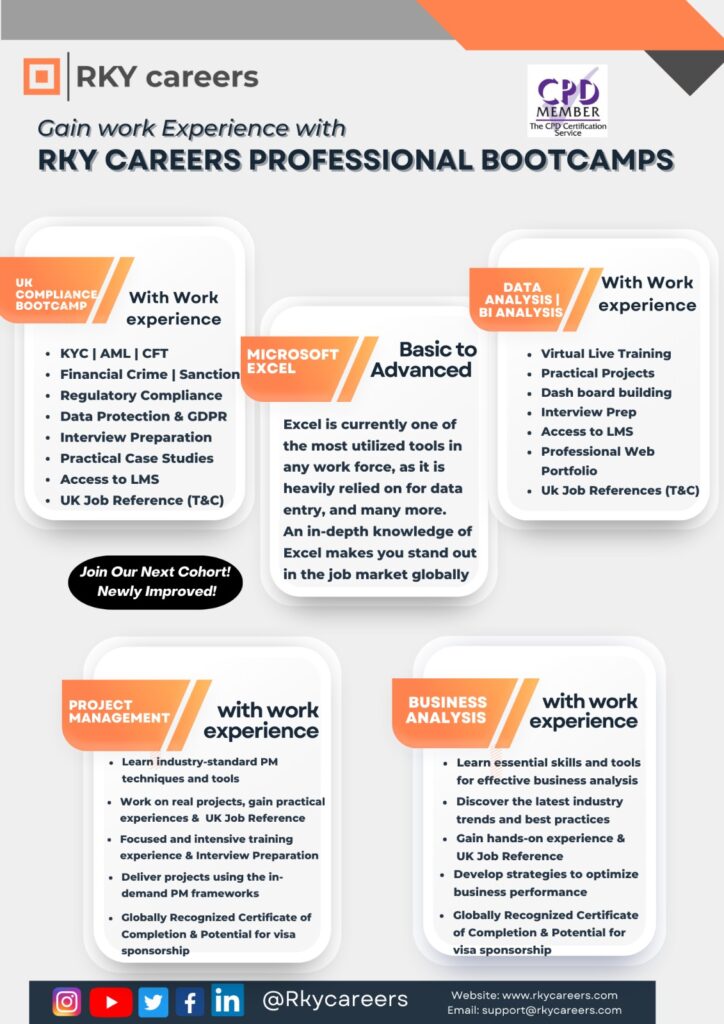
And here’s the good news: you don’t have to figure it out alone. At RKYCareers, our PMBA and DABI Bootcamp is designed to equip you with practical skills, hands-on projects, and the confidence to stand out in today’s competitive job market.
Whether you’re aiming to become a skilled business analyst or pivot into data analytics, this program gives you the tools and mentorship to succeed.
So if you’re serious about taking control of your career growth, the next step is simple join the Bootcamp and start building your future today.
FAQs: Business Analyst vs Data Analyst
- Which is harder: business analyst or data analyst
Both have challenges. Business analyst vs data analyst difficulty depends on your strengths: BAs need people and process skills; data analysts need technical and statistical skills. Pick what energises you.
- Do business analysts need coding like data analysts?
Not typically. BAs focus on requirements and stakeholder work. If you want to switch, learn basics like SQL. Business Analysis vs Data Analysis often means different technical depth.
- Which role has more demand in the UK job market?
Demand varies by sector and city. business analyst vs data analyst UK demand can favour data roles in tech and fintech, while BAs remain vital in product and operations. Check sector reports and recruiter alerts.
- Can a data analyst transition into a business analyst role?
Yes. A business analyst career change from data analysis is common. Demonstrate stakeholder work, business cases, and outcome-focused projects. Business Analysis vs Data Analysis skills mix helps.