Building the Perfect Data Analyst Project Portfolio in 2023
The importance of having a project portfolio to showcase one’s abilities as a data analyst is now more evident than ever. Data analysts must demonstrate how they use data to solve complex problems, similar to how web developers show their code and designers present visual representations of their process. Consequently, just like developers and designers, you can accomplish this by creating your data analyst portfolio. However, the process of constructing a robust project portfolio still lacks clarity.
But what exactly does a data analyst portfolio consist of? How can your work be effectively captured in pictures and words? Additionally, how can a novice in the field find projects to include in their portfolio? There’s no need to worry if the idea of a data analyst portfolio seems strange and a little abstract. The goal is to work with you to create excellent projects that impress potential employers and put you one step closer to landing your dream job.
The Importance of a Data Analyst Project Portfolio

The importance of a data analyst project portfolio cannot be overstated in today’s competitive job market. As organisations continue recognising the value of data-driven decision-making, the demand for skilled data analysts has steadily increased. In such a scenario, a well-crafted project portfolio becomes a powerful tool for data analysts to showcase their expertise, skills, and accomplishments.
Here are several key reasons why a data analyst project portfolio is essential:
- Demonstrating Technical Skills
- Displaying Industry Knowledge
- Standing Out in the Job Market
- Showcasing Problem-Solving Skills
- Establishing a Track Record of Success
- Highlighting Collaboration and Communication Skills
Developing your Data Analyst Project Portfolio
The first and most crucial step in creating a portfolio is choosing the ideal web location for hosting your portfolio. Finding the perfect answer to this problem in the past proved difficult and uncertain. People would frequently combine platforms like LinkedIn, personal websites, and niche websites like Tableau Public, each producing varying degrees of success.
A personalised professional web portfolio is one of the perks of enrolling in RKY Careers’ Data Analysis and Business Intelligence Bootcamp. At RKY Careers, our developers collaborate with the students to create a portfolio highlighting the tasks accomplished throughout the BootCamp. This makes the candidates stand out in the crowded job market, as evidenced by the numerous success stories of our students landing jobs after the bootcamp.
One feature that sets our platform apart is its ability to seamlessly embed Power BI, Tableau dashboards, Excel workbooks, and videos. After finishing the course, this portfolio is typically produced for each student in our Data Analysis | Business Intelligence Analysis Bootcamp. It is evidence of the expertise and abilities learned during the training course. I highly recommend this bootcamp because it outperforms all competition and provides extra advantages like free interview coaching, CV and LinkedIn optimisation and access to training materials on our LMS for up to 12 months after completion of the Bootcamp. However, don’t just take my word for it; let Olivia’s success story testify to our program’s effectiveness in the UK labour market.
What you should include in your Data Analyst Project Portfolio
At RKY Careers, we offer top-notch delivery regarding our trainees’ data analysis project portfolios, and we adopt only the latest trends when it comes to putting together project portfolios. To this end, let’s delve into the components that make up that perfect Portfolio that will land you your dream job in Data Analysis.
Portfolio Homepage

The fact that your portfolio website serves as your initial landing point potential when employers visit it emphasises the value of making a good first impression. Make an effort to communicate important information succinctly and effectively so that readers can quickly understand your identity and career goals. We suggest placing a picture of yourself on the homepage, followed by a strong introduction that leaves an impression. Add a synopsis of your professional background to it.
For instance, your opening statement could be along the lines of: “Greetings! I’m Tolani, a data analytics graduate from Bournemouth. My unwavering belief in utilising data to tackle humanitarian issues drives me to contribute towards a better world.”
The example represents a fundamental template for your portfolio homepage, generated using Squarespace. Nevertheless, it serves merely as a starting point; we encourage you to enhance it by adding an image and selecting a design that reflects your unique personal brand.
“About Me” Section
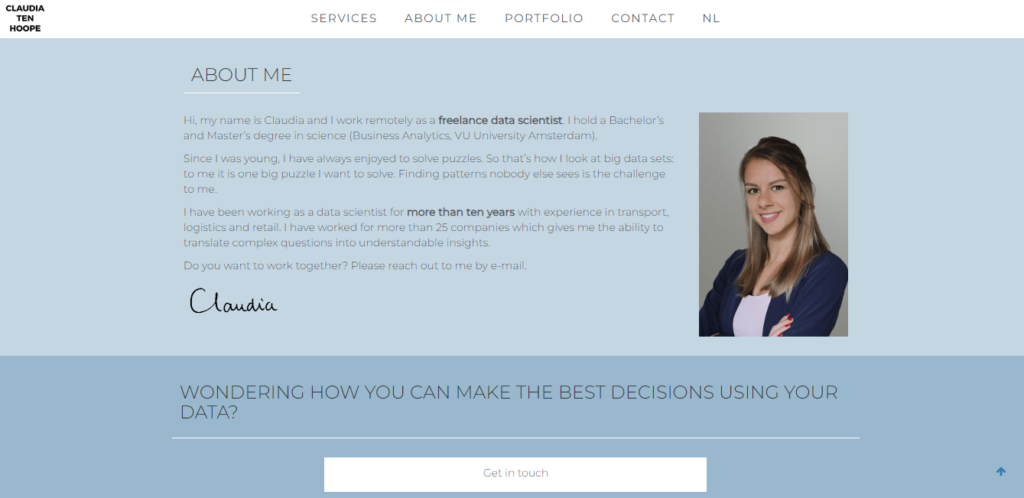
The “About Me” section allows you to highlight your educational background, professional background, and personality. Professional experience, skills & expertise, and passion & motivation are all included. Visitors should have easy access to your “About Me” page on the homepage, including prospective employers and curious browsers. In this section, you can go into greater detail about your background, areas of expertise, and interests. To learn how to format your “About” section, refer to the sample portfolio mentioned above.
To enhance your “About Me” section, include your contact details and links to your various online profiles, such as Twitter, LinkedIn, and GitHub. Claudia Ten Hoope is an excellent example of how this section should be developed.
Projects

When building your data analyst portfolio, it is essential to incorporate a specific section dedicated to showcasing your projects. This section will highlight the various projects you have worked on. There are multiple options for presenting your work. You can host your portfolio projects directly on your website or include a summary of your work with external links to the projects hosted elsewhere, such as on GitHub.
The choice between these approaches depends on the project’s nature, technical aspects, and personal preference. It’s worth noting that many data analysts combine both techniques in their portfolios. The projects section is the core of your data analyst portfolio. It should showcase a selection of your best work and demonstrate your ability to handle real-world data analysis challenges. This section usually includes Project Descriptions, Data Visualization, Impact and Results, and Technical Details.
Blog Section
You’ll frequently come across blogs when exploring the portfolios of data analysts and data scientists. This may appear contradictory in the realm of data, but blogging is an invaluable tool for showcasing one’s skills as a data analyst. Among the essential abilities employers seek when hiring a data analyst is the capacity to elucidate detailed insights in a clear, concise, and easily understandable manner—and this is precisely what you can exhibit through a blog post.
Consider crafting concise articles explaining specific concepts when you embark on your journey. This demonstrates your aptitude for communicating and clarifying your work in a user-friendly manner and signifies your genuine passion for what you do, as evidenced by the considerable thought and effort invested in your portfolio.
Remember to regularly update and maintain your portfolio as you complete new projects and gain more experience. A well-crafted data analyst project portfolio will showcase your skills and demonstrate your ability to solve real-world problems and provide value through data analysis.