Step-by-Step Guide on How to Become a Data Analyst in the UK
Wondering how to become a data analyst in the UK without wasting months on random courses? Perhaps you are changing careers, lacking experience, or unsure which data analyst qualifications employers value. We built this guide to turn that uncertainty into a clear, practical route forward.
You will learn the data analyst skills employers expect and which tools deserve your attention. We will map entry-level data analyst jobs in the UK and smarter application strategies. Finally, I will show how structured training can strengthen your data analyst career path with confidence.
Understand What a Data Analyst Actually Does in the UK
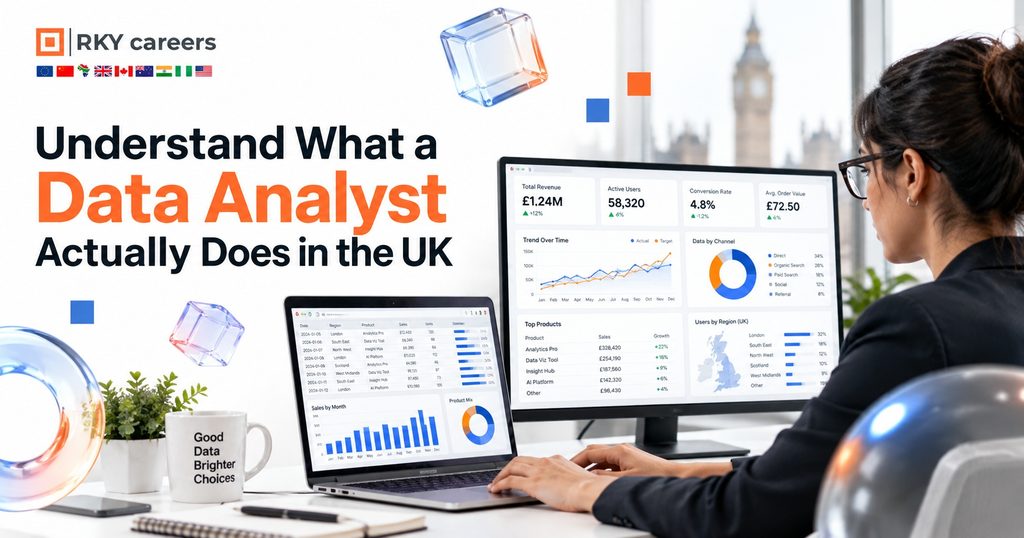
If you want to understand how to become a data analyst in the UK, start with the work. Job titles vary, but purpose stays simple.
You turn raw information into answers that guide decisions. This foundation helps you judge whether a data analyst career in the UK matches your strengths.
Understand the Day-to-Day Role Before Chasing Certificates
A data analyst gathers, cleans, studies, and explains information so organisations can make better decisions. You might analyse customer behaviour, financial performance, service quality, marketing results, or operational problems.
Now: the job is not simply about producing colourful dashboards. You must ask useful questions, spot patterns, check accuracy, and explain what the evidence means.
The UK Government’s updated Digital and Data framework describes analysts as professionals who collect, manage, explore, and communicate data for business impact.
Therefore, learning how to become a data analyst in the UK starts with understanding business problems before mastering software.
Know Why UK Employers Need Data Analysts
Your data analyst career in the UK can take you far beyond technology companies. Banks, retailers, NHS organisations, government departments, consultancies, charities, and logistics firms all use analytical talent.
The opportunity exists because data now touches almost every commercial activity. In the UK Business Data Survey 2026, 86% of UK businesses reported handling digitised data.
Consequently, your knowledge can travel between sectors. A marketing analyst may later become a business intelligence analyst, while a healthcare professional could move into NHS analytics. That flexibility makes the data analyst career path attractive for career changers.
Map Your Existing Experience to Data Work
You may already possess useful data analyst skills without carrying an analyst title. Finance professionals handle figures, administrators manage records, marketers measure campaigns, and operations teams monitor performance.
Here’s the deal: transferable experience matters when you explain it properly. Ask yourself:
- Have you produced reports or tracked performance?
- Have you used Excel to organise information?
- Have you solved problems using evidence?
- Have you presented findings to colleagues?
- Have you improved a process after reviewing results?
These experiences can support how to start a data analyst career. They also help you position your previous career as an asset rather than baggage.
Understanding this connection makes how to become a data analyst in the UK feel far more achievable.
Also Read:
Build the Data Analyst Skills UK Employers Expect

Once the role makes sense, your next task is building the technical foundation. Employers want practical data analyst skills, not a crowded certificate folder.
For a strong data analyst career in the UK, learn tools in a sensible order. Then practise them on realistic questions until your work becomes clear.
Start With Excel and SQL
Excel remains a sensible starting point because organisations use spreadsheets for reporting, cleaning, calculations, and quick analysis. Learn formulas, PivotTables, lookup functions, charts, data cleaning, and basic dashboard building.
Next, learn SQL because business information often sits inside databases. Focus on:
- SELECT and WHERE statements
- GROUP BY and aggregations
- JOIN operations
- Sorting and filtering
- Subqueries and common table expressions
But why? These data analyst skills help you retrieve the exact information needed for a business question.
If you are researching how to become a data analyst in the UK, Excel and SQL should sit near the beginning of your learning plan, not the end.
Learn Power BI or Tableau for Data Visualisation
Data becomes valuable when another person can understand it quickly. Therefore, visualisation should become a core part of your data analyst career path.
Power BI works particularly well for organisations already using Microsoft products. Tableau also offers strong visual exploration and interactive reporting capabilities.
Do you want to know the best part? You do not need to master both immediately. Pick one, build several dashboards, then expand later.
Skills England reported in 2026 that 68% of priority digital and technology occupations were experiencing elevated or critical demand.
Strong visualisation skills can therefore strengthen a data analyst career for UK employers.
Add Python, Statistics, and Communication Gradually
Python becomes useful when datasets grow larger or repetitive tasks need automation. Start with Pandas for analysis, then learn simple charts and basic statistical techniques.
However, technical knowledge alone does not complete your data analyst skills. Employers also need people who can explain findings to managers without hiding behind technical language.
Build three habits:
- State the business question before analysing.
- Explain the main finding in plain English.
- Recommend an action supported by evidence.
This approach is central to how to become a data analyst in the UK because analysts connect information with decisions.
Therefore, practise communication alongside every technical project rather than treating it as an optional soft skill.
Also Read:
Choose the Right Data Analyst Qualifications and Courses

Skills matter, but employers also need confidence that you can use them consistently. That is where data analyst qualifications in the UK strengthen your profile.
However, you do not need every certificate. The smarter route combines data analyst courses in the UK with projects that prove what you can deliver.
Decide Whether You Actually Need a Degree
A relevant degree can help, especially in mathematics, statistics, economics, computer science, or another analytical subject. However, it is not the only route into a data analyst career in the UK.
The National Careers Service lists university study, college courses, apprenticeships, graduate programmes, and specialist training among possible routes into analytical work.
Therefore, career changers should not automatically assume another university degree is required.
When comparing data analyst qualifications for UK employers, ask one question: does this qualification help you demonstrate useful workplace capability?
Learning how to become a data analyst in the UK means choosing the shortest credible route that closes your actual skills gaps.
Compare Certifications With Practical Training
Popular data analyst qualifications can introduce useful foundations. However, completing certificates without applying your knowledge may leave you unable to discuss projects confidently during interviews.
When comparing data analyst courses for UK learners, examine:
| Area | What to Look For |
|---|---|
| Tools | Excel, SQL, Power BI, Tableau, Python |
| Practice | Business datasets and realistic tasks |
| Portfolio | Projects you can explain during interviews |
| Support | Feedback from experienced professionals |
| Careers | CV, LinkedIn and interview preparation |
Here’s an example: RKY Careers’ Data Analytics and Business Intelligence Accelerator combines technical learning with practical projects and career support.
That combination can make data analyst courses in the UK more useful for career changers.
Build a Structured Learning Plan
Random tutorials often create fragmented knowledge. Instead, structure your learning around increasing difficulty and visible outputs.
A practical sequence could look like this:
- Learn Excel analysis and reporting.
- Practise SQL using relational datasets.
- Create dashboards in Power BI.
- Learn introductory statistics.
- Add Python for deeper analysis.
- Complete two or three end-to-end projects.
Each stage should produce something you can demonstrate.
That matters because knowing how to start a data analyst career requires more than finishing lessons. You need repeated practice until tools become problem-solving instruments.
Consequently, the best data analyst qualifications in the UK should support your data analyst career path rather than distract you from building evidence.
Also Read:
Build Experience and a Job-Ready Data Portfolio

Training gives you knowledge, but evidence makes employers believe you can use it. Your portfolio should turn learning into visible, business-focused proof.
This matters when you have limited formal experience. Strong projects support how to start a data analyst career while showing employers practical judgement, curiosity, communication, and initiative clearly.
Build Projects Around Business Questions
Do not build projects simply to demonstrate software buttons. Instead, begin with a question that an employer might genuinely care about.
For example, analyse retail sales and identify underperforming regions. Alternatively, examine customer churn, NHS waiting-time data, marketing performance, or transport trends.
A strong project should show:
- The problem you investigated
- Your data source
- Cleaning decisions
- Analysis method
- Dashboard or visual output
- Findings
- Business recommendations
In 2025 to 2026, 25% of UK businesses handling digitised data said they analysed it to create new insights or knowledge. That is precisely the capability your portfolio should demonstrate.
Gain Experience Before Landing Your First Analyst Job
But you’re probably wondering: how can you get experience when every vacancy seems to request experience? Create it deliberately.
You can analyse public datasets, support a charity, volunteer for reporting tasks, improve analytics within your current role, or complete realistic training projects. These activities create examples you can discuss during interviews.
If you want to become a data analyst in the UK, your first evidence does not need to come from a formal analyst role.
For example, a customer service professional could analyse complaint trends and design a simple dashboard. An operations professional could examine delays and recommend improvements.
These projects make how to become a data analyst in the UK a practical process rather than a waiting game.
Present Your Work Like a Professional Analyst
Your portfolio should tell a story rather than dump spreadsheets and screenshots onto recruiters. For every project, briefly explain the problem, approach, insight, and recommended action. Additionally, remove unnecessary technical detail that hides the business value.
You can publish suitable work through GitHub, Power BI, Tableau Public, or a professional portfolio website.
RKY Careers also offers a Professional Portfolio service for professionals who need stronger presentation and positioning. Its wider career services include CV, LinkedIn, interview, and personal branding support.
Ultimately, your portfolio should prove data analyst skills before an employer gives you the job title.
Also Read:
Target Entry-Level Data Analyst Jobs and Win Interviews

Once your skills and portfolio are credible, the focus moves from learning to positioning. Your applications must show employers where your evidence fits.
That matters because entry-level data analyst jobs in the UK attract varied candidates. A focused search, tailored CV, and rehearsed interview story can separate you from applicants.
Search Beyond the Exact “Data Analyst” Job Title
Do not restrict your search to one title. Entry-level data analyst jobs in the UK can appear under several names depending on industry and responsibility.
Search for roles such as:
- Junior Data Analyst
- Reporting Analyst
- Insight Analyst
- Business Intelligence Analyst
- MI Analyst
- Commercial Analyst
- Marketing Analyst
- Operations Analyst
- Data Technician
Also search entry-level data analyst jobs for UK employers across finance, healthcare, retail, government, education, and professional services.
The National Careers Service currently shows analytical salaries ranging from around £28,000 at starter level to £65,000 for experienced data analyst-statisticians.
Therefore, your data analyst career path can expand significantly after the first role.
Tailor Your CV and LinkedIn Profile
A general CV rarely shows why you match a specific vacancy. Instead, compare each job description with your data analyst skills, projects, transferable experience, and achievements.
Use the employer’s genuine terminology where it accurately describes your experience. However, never stuff keywords or claim tools you cannot use.
Applicant tracking systems remain common among large employers. Jobscan’s 2026 research detected an ATS at 97.4% of Fortune 500 companies.
Consequently, structure and relevance matter. RKY Careers provides CV Review and Optimisation alongside LinkedIn optimisation and broader career support for professionals targeting UK roles.
Prepare for Technical and Behavioural Interviews
Learning how to become a data analyst in the UK also means preparing to explain how you think. Employers may test SQL, Excel, visualisation, interpretation, or problem-solving.
However, technical answers alone rarely complete the interview. Prepare concise examples covering:
- A difficult problem you solved
- A dataset you cleaned
- An insight you discovered
- A recommendation you made
- A mistake you identified and corrected
- A time you explained complex information simply
Use STAR for behavioural questions, then practise explaining portfolio projects without jargon.
RKY Careers’ Interview Preparation service focuses on likely questions, industry expectations, and stronger answer delivery. That preparation can turn data analyst qualifications into confident interview evidence.
Also Read:
- From Zero Experience to Data Analyst in the UK: How Oluwaseun Made the Career Switch
- Intensive Data Analysis Bootcamps With Career Support UK
Accelerate Your Data Analyst Career With RKY Careers
By now, you know how to become a data analyst in the UK from research to applications. The challenge is turning that plan into action.
RKY Careers’ Data Analysis and Business Intelligence Accelerator Programme brings training, projects, and career support together. It helps you move from learning towards job readiness.
The Data Analytics and Business Intelligence Accelerator is designed for career changers, graduates, and professionals building stronger analytical capability. Learners work with real datasets while developing workplace-focused data analyst skills.
The programme covers:
- Excel for cleaning, analysis, and reporting
- SQL for retrieving and working with database information
- Power BI and Tableau for visualisation
- Python for wider analytical tasks
- Real-world projects and collaborative learning
- Job-search and interview preparation
- CV and LinkedIn career support
Here’s the bottom line: knowing how to become a data analyst in the UK is useful, but implementation changes careers.
If you want structure, practical experience, mentorship, and career support in one journey, explore the programme and review RKY Careers’ current cohort calendar.
Take your first deliberate step today and start building a data analyst career in the UK with skills employers can actually see.