How Do You Get Into Project Management? A Practical 2026 Career Guide
How do you get into project management when every vacancy seems to demand experience already? You may have strong transferable skills, yet no formal title, certification, or clear starting point. That uncertainty can make a promising career change feel harder than it needs to be.
I will show you how to start a career in project management with practical, achievable steps. You will learn which skills matter, how to build experience, and where entry-level opportunities begin. By the end, you will have a clearer project management career path to follow.
Understand What Project Management Involves Before You Switch

Before changing careers, understand what the role actually asks from you each working day. Project management skills combine planning, communication, problem-solving, organisation, and confident decision-making.
This foundation explains how to become a project manager without discarding your existing experience. It also reveals where entry-level project management jobs can realistically begin.
What Does a Project Manager Actually Do?
If you are asking how do you get into project management, start by understanding the work. Project managers turn business goals into plans, schedules, budgets, actions, and measurable outcomes. They also manage risks, dependencies, stakeholders, changes, and team communication throughout delivery.
These project management skills matter because the profession is growing beyond one industry. PMI forecasts global demand for project talent could grow by 64% from 2025 to 2035. Therefore, learning how to become a project manager starts with understanding delivery, not memorising terminology.
A normal day may include planning meetings, progress checks, issue resolution, reporting, and stakeholder updates. Your project management career path can then develop across technology, healthcare, finance, construction, government, or professional services.
Where Does Your Existing Experience Already Fit?
You probably have more relevant experience than your job title suggests. I would first map everyday responsibilities against common project management skills before chasing another qualification.
For example:
- Administration can show scheduling, documentation, coordination, and deadline control.
- Customer service can prove stakeholder communication, prioritisation, and issue resolution.
- Operations can demonstrate process improvement, resource planning, and risk awareness.
- Marketing can show campaign planning, budgets, timelines, and cross-team delivery.
This evidence can become genuine project management experience when you describe the goal, actions, and results. It can also support project coordinator applications and other entry-level project management jobs while you build stronger delivery evidence.
Is Project Management the Right Career for You?
Before starting a project management career, test whether the work matches how you operate. You do not need to love spreadsheets, but you should enjoy creating order and helping people move forward.
Ask yourself:
- Can you stay calm when priorities change?
- Do you communicate clearly with different personalities and seniority levels?
- Can you challenge delays without damaging working relationships?
- Do you enjoy tracking progress and solving practical problems?
So, how do you get into project management if the role fits? That self-check matters when deciding how to start a career in project management without wasting time.
APM’s 2025 survey reported an average UK project professional salary of £52,500. If direction still feels unclear, RKY Careers’ Career Advisory service can help map your next move.
Related Reading:
Build the Project Management Skills Employers Actually Need

Once you understand the role, your next task is closing specific skill gaps. Strong project management skills turn good intentions into organised, measurable delivery.
This stage makes getting into project management more credible to employers. It strengthens your project management career path and prepares you for entry-level project management jobs.
Master the Skills That Keep Projects Moving
Employers need more than someone who can create a timeline. Strong project management skills combine delivery discipline with communication, judgement, adaptability, and commercial awareness.
I would build these abilities first:
- Scope and requirement clarification
- Scheduling and prioritisation
- Risk and issue management
- Stakeholder communication
- Budget and resource awareness
- Reporting and decision-making
The wider skills market reinforces this approach. The World Economic Forum says 39% of workers’ core skills are expected to change by 2030. Therefore, how to start a career in project management should include continuous learning, not one training event.
Those skills will also support your progression from project coordinator to junior project manager and beyond.
Learn Project Methods and Tools Through Practice
Next, learn how projects move from idea to completion. You should understand predictive approaches such as Waterfall and adaptive approaches such as Agile, Scrum, and Kanban.
Then practise with common tools instead of collecting screenshots from tutorials. Use a task board to manage actions, a spreadsheet to track risks, and a timeline to plan dependencies. You can also practise status reporting, meeting notes, RAID logs, and simple project dashboards.
Here’s the deal: employers value evidence that you can use methods appropriately. Knowing how to become a project manager means understanding why a tool helps delivery, not simply knowing its buttons.
That practical judgement strengthens your project management career path and prepares you for entry-level project management jobs.
Choose Qualifications That Match Your Career Stage
Certifications can strengthen your credibility, but they should match your experience level. For beginners, PMI’s CAPM requires no project experience, although candidates need a secondary qualification and 23 hours of project management education.
Later, experienced professionals may consider qualifications that fit their sector and career goals. The UK National Careers Service also points towards professional development through APM, PMI, and CMI.
How do you get into project management without collecting qualifications you cannot yet support with evidence? If you are getting into project management, pair learning with practical work from the start.
A certificate cannot replace project management experience, stakeholder examples, or proof of delivery. That combination gives your applications more substance and makes your project manager career path easier to defend during interviews.
Related Reading:
- How to Become a Project Manager: RKY Career Guide
- How Our Project Management Bootcamp Helped Emmanuel Become a Project Manager in the UK
Gain Project Management Experience Before You Have the Title

Skills matter, but employers also want evidence that you can apply them. Therefore, learning how to start a career in project management means creating practical proof.
You can build project management experience before securing the official title. Small workplace projects, volunteering, simulations, and project coordinator duties can all demonstrate readiness.
Turn Your Current Work Into Project Evidence
You do not need permission to start practising project delivery. Look inside your current role for work with a clear goal, deadline, stakeholders, actions, and measurable result.
So, how do you get into project management before anyone gives you the title? Treat suitable work like a project by defining scope, owners, risks, milestones, and success measures. Afterwards, record what changed because of your contribution and which project management skills you used.
I’ll explain with an example: suppose you reduce a weekly reporting process from three hours to one. That gives you evidence of planning, stakeholder input, process improvement, and measurable value.
This is project management experience, even when your contract never called you a project manager.
Build a Portfolio Through Practical Projects
If your current role offers few opportunities, create controlled practice elsewhere. Volunteer projects, community initiatives, case studies, and structured live projects can help you build credible evidence.
Your portfolio should show:
- The problem and intended outcome
- Your plan, timeline, and responsibilities
- Stakeholders and communication approach
- Risks, changes, and decisions
- Tools or documents you created
- Results, lessons, and improvements
Now: avoid presenting a simulation as paid employment. Label it honestly, then explain what you delivered and learned.
RKY Careers’ Professional Portfolio service helps professionals present projects, certifications, skills, and achievements in one accessible place. That proof supports how to become a project manager when your previous titles come from another field.
Target Bridge Roles That Give You Real Delivery Exposure
Your first target does not always need “Project Manager” in the title. Entry-level project management jobs often provide a safer bridge into formal delivery responsibilities.
Search for roles such as:
- Project Coordinator
- Project Administrator
- PMO Analyst or PMO Administrator
- Project Support Officer
- Assistant Project Manager
- Junior Project Manager
The National Careers Service confirms several routes into business project management, including apprenticeships, study, direct applications, and working towards the role. Therefore, choose vacancies where your current strengths match most daily responsibilities.
A project coordinator role can teach reporting, governance, scheduling, and stakeholder support quickly. From there, your project management career path becomes easier to strengthen with larger projects and greater ownership.
Related Reading:
- Turning Your LinkedIn into a Job Magnet in 2026
- Project Management Competency-Based Interview Questions
Position Yourself for Entry-Level Project Management Jobs

Evidence only helps when recruiters quickly understand what you delivered. Your CV, LinkedIn profile, and portfolio must translate project management experience into business value.
This positioning supports how to become a project manager and strengthens entry-level project management jobs applications. It makes your project management career path easier to explain.
Rewrite Your CV Around Outcomes and Delivery
A career-change CV should not apologise for your previous industry. It should translate your achievements into evidence of planning, ownership, coordination, communication, and delivery.
How do you get into project management when your old job title tells the wrong story? Start each strong bullet with what you changed, then explain the action and outcome. Replace “responsible for meetings” with evidence showing how your coordination improved decisions or delivery.
This matters because LinkedIn’s 2025 recruiting research found 93% of talent professionals believe accurate skills assessment is crucial for improving quality of hire. Therefore, make project management skills visible through evidence.
RKY Careers’ CV Review and Optimisation service can help shape that story for UK applications.
Align Your LinkedIn Profile and Project Portfolio
Your LinkedIn profile and portfolio should tell the same story as your CV. Recruiters should quickly see your target role, project strengths, tools, sector knowledge, and evidence of results.
Use your headline and About section to position the direction clearly. Then add projects that show timelines, risks, stakeholders, documents, outcomes, and lessons learned.
RKY Careers’ LinkedIn Optimisation service focuses on improving recruiter visibility, while its Professional Portfolio service helps professionals showcase work samples and achievements.
But why? Starting a project management career requires trust before an employer hands you delivery responsibility. A consistent profile reduces uncertainty and supports how to start a career in project management.
It also makes project coordinator and junior project manager applications feel more deliberate.
Use Job Descriptions as Your Skills Roadmap
Job descriptions tell you what evidence employers want, so use them as research tools. Compare ten suitable vacancies and note repeated skills, tools, responsibilities, and sector language.
Then create a simple keyword bank for:
- Project planning and scheduling
- Risk and issue management
- Stakeholder engagement
- Reporting and governance
- Agile or Waterfall delivery
- Relevant software and documentation
LinkedIn reported in 2024 that 70% of job descriptions posted during the previous year included concrete skills. Therefore, tailor applications around genuine matches instead of copying every phrase.
This approach improves entry-level project management jobs applications and clarifies your project management career path. If gaps appear repeatedly, return to learning or practical projects before applying again.
Related Reading:
Land Your First Role and Build Long-Term Momentum

With skills and evidence in place, you can begin applying with precision. Successful applications connect your strengths directly to each employer’s needs.
This is where starting a project management career becomes a focused job search. You can target entry-level project management jobs while building a long-term project management career path.
Apply for the Right Roles With a Focused Strategy
Apply narrowly enough to look credible, but broadly enough to create opportunities. If you are learning how to become a project manager, search beyond “Project Manager” because early experience often sits under support titles.
Build a weekly target list covering:
- Project Coordinator
- Project Administrator
- PMO Analyst
- Project Support Officer
- Assistant Project Manager
- Junior Project Manager
For each vacancy, score your match against essential skills before investing time. Prioritise roles where you can prove most requirements through employment, projects, volunteering, or training.
How do you get into project management faster? Stop measuring success by application volume alone. Track interview conversion, rejection patterns, and missing skills instead.
Then adjust your CV, evidence, and search terms using what the market keeps showing you.
Prepare Project Stories Before the Interview
Interviews test whether you can think through delivery problems, not simply define project terms. Prepare examples covering conflict, deadlines, risk, scope changes, difficult stakeholders, priorities, and lessons learned.
Use STAR to keep answers structured:
- Situation: explain the relevant context briefly.
- Task: state your responsibility and expected outcome.
- Action: describe what you personally decided and did.
- Result: show the outcome, evidence, and learning.
Here’s an example: if a supplier missed a deadline, explain how you assessed impact, updated stakeholders, changed the plan, and protected delivery. That answer demonstrates project management skills through behaviour.
RKY Careers’ Interview Preparation service can help you practise industry expectations and sharpen examples before project coordinator or junior project manager interviews.
Grow Along the Project Management Career Path
Your first role is the beginning, not the finish line. A strong project management career path grows through larger scope, harder decisions, broader stakeholders, and greater ownership.
A typical project manager career path may look like:
- Project Coordinator or Project Administrator
- Junior Project Manager
- Project Manager
- Senior Project Manager
- Programme Manager, PMO Lead, or Delivery Lead
The National Careers Service notes that experienced business project managers can progress into senior project management, consultancy, or operations management.
This is how to start a career in project management with realistic progression. So, how do you get into project management and keep progressing?
Record completed projects, outcomes, and lessons, then seek responsibilities one step beyond your current comfort zone.
Related Reading:
- From Project Manager to Senior Project Manager: Barakat’s RKY Careers Story
- 2026 Career Paths in Healthcare, Tech, Finance, and Creative Industries
Accelerate Your Project Management Career With RKY Careers
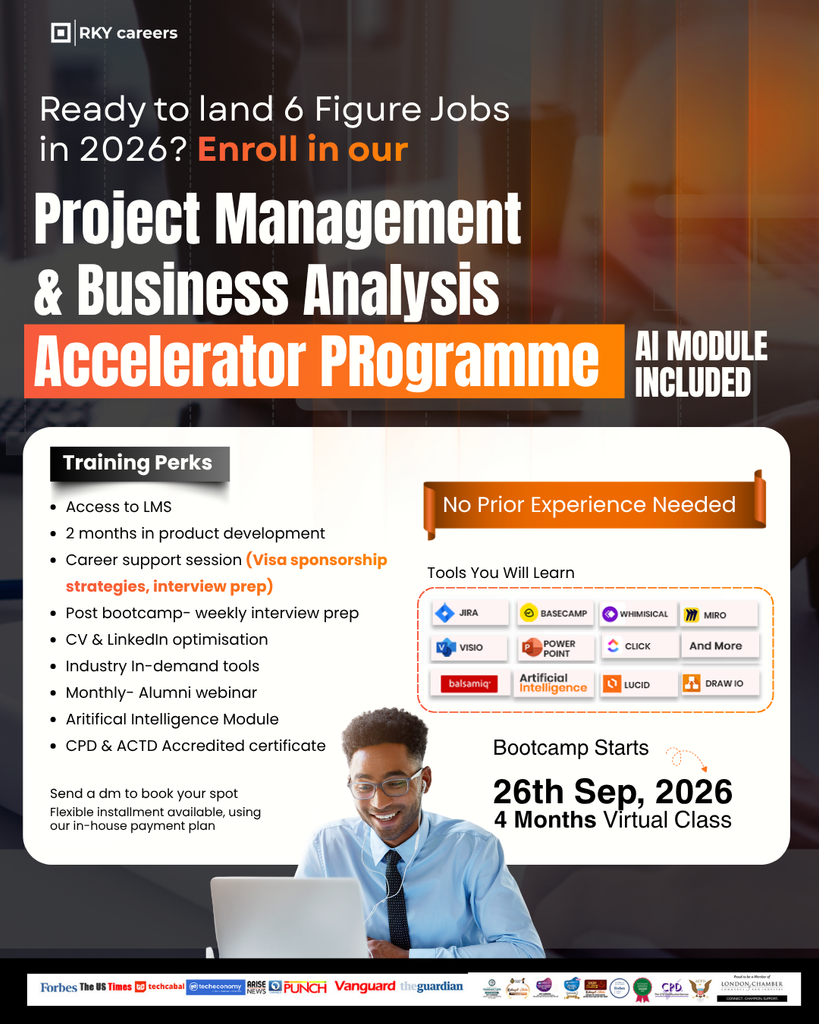
If you are still asking how do you get into project management with practical support, structured training can shorten the learning curve. RKY Careers’ Project Management and Business Analysis Accelerator Programme is designed for career changers, graduates, international professionals, and people moving from operations, administration, or customer service.
The 15-week programme combines live instructor-led learning with a practical project phase. You work in cross-functional teams, practise real delivery, and build project management experience you can discuss with employers. Training covers Agile, Scrum, Kanban, Waterfall, PRINCE2, stakeholder reporting, and project tools.
You also receive career support designed for entry-level project management jobs and progression. Support includes:
- CV and LinkedIn optimisation
- Interview preparation and job-search strategy
- Mentorship and industry insight
- Practical projects and portfolio-building experience
- Collaborative learning with other professionals
That combination can strengthen project management skills while making your project management career path more visible. It also shows how to start a career in project management with structure rather than guesswork.
So, how do you get into project management and learn how to become a project manager? Build skills, prove them through delivery, present your evidence clearly, and get expert support when needed.