Top 5 Jobs With Visa Sponsorship in the UK
Jobs with visa sponsorship in the UK offer exciting opportunities, but where should you begin searching? Are you tired of finding suitable vacancies only to discover employers cannot sponsor international applicants? Perhaps you have valuable experience but struggle to identify companies willing to support your relocation.
Fortunately, your career goals need not end with another disappointing rejection or confusing visa requirement. Understanding sponsorship rules, eligible occupations, and employer expectations can help you make smarter career decisions.
In this guide, I will reveal five promising career paths and practical application strategies. You will also discover how to identify genuine sponsors and improve your chances of employment.
Top 5 Jobs With Visa Sponsorship in the UK in 2026

Finding the right sponsored position requires more than checking salaries and sending applications. You must understand which professions offer realistic opportunities and meet current immigration requirements.
Fortunately, several industries continue recruiting qualified international professionals despite tighter immigration rules. I have identified five career paths worth exploring based on eligibility and transferable skills.
1. Healthcare Professionals: Nurses and Medical Practitioners
Healthcare remains an important employment sector for skilled international professionals seeking opportunities across the UK. Hospitals and specialist healthcare providers recruit qualified nurses, doctors, and other registered clinical professionals.
The NHS Jobs website provides vacancies across healthcare organisations throughout England and Wales. However, each employer must confirm whether the advertised position offers sponsorship.
Common opportunities include:
- Registered nurses working in hospitals and specialist departments.
- Medical practitioners providing patient diagnosis and treatment.
- Physiotherapists supporting rehabilitation and physical recovery.
- Occupational therapists helping patients regain everyday independence.
These positions generally require recognised qualifications, professional registration, and suitable English language skills.
Importantly, overseas care worker recruitment faces different restrictions from nursing and medical recruitment. Therefore, always check current eligibility before applying for healthcare sponsorship opportunities.
2. Software Engineers and IT Professionals
Technology offers attractive career options for experienced developers, cybersecurity specialists, and technical engineering professionals. Many organisations require specialists who can develop reliable systems, protect information, and support digital services.
For example, financial institutions frequently need developers who understand secure transactions and complex software systems. Similarly, established technology companies recruit engineers to maintain applications and improve service delivery.
Relevant positions include:
- Software developers and engineers.
- Cybersecurity specialists.
- DevOps and cloud engineers.
- IT business systems specialists.
UK skilled worker visa jobs in technology often require proven technical experience and strong portfolios.
However, not every advertised technology vacancy meets sponsorship requirements. Therefore, verify the occupation code, salary, employer licence, and sponsorship availability before applying.
3. Engineering Professionals
Engineering provides another possible route for qualified professionals seeking skilled employment across different UK industries. Employers recruit specialists to design infrastructure, maintain essential systems, and manage complex technical projects.
Look: your practical experience can become a major advantage when applying for specialist positions. Employers often value measurable achievements alongside qualifications, especially for experienced technical professionals.
Relevant opportunities include:
- Civil engineers supporting infrastructure development.
- Mechanical engineers designing and maintaining equipment.
- Electrical engineers developing electrical systems.
- Chemical engineers supporting industrial processes.
You can explore opportunities through established engineering companies, construction consultancies, and manufacturing organisations.
However, certain engineering roles require professional qualifications or specific technical experience. Consequently, match your background against each vacancy before requesting Skilled Worker visa sponsorship.
4. Project Managers and Business Analysts
Project managers and business analysts support organisations through change, improvement, and complex business decisions. These careers may suit experienced professionals moving from administration, operations, finance, or customer service.
Project managers oversee budgets, schedules, resources, and delivery risks across different business activities. Meanwhile, business analysts identify organisational problems, gather requirements, and recommend practical improvements.
Relevant opportunities include:
- IT project managers.
- Digital transformation project managers.
- Business analysts.
- Business change managers.
- Technical programme managers.
However, job titles alone do not establish visa eligibility. Some specialist positions qualify, while other roles may fall under different occupation classifications.
Therefore, check each role’s actual responsibilities against current Home Office rules. Relevant project experience, clear communication, and demonstrable business results can strengthen your applications considerably.
5. Finance and Accounting Professionals
Finance remains a potential career destination for qualified accountants, auditors, and experienced financial professionals. Large employers need specialists to manage reporting, financial risks, compliance, and business planning.
UK jobs for international applicants in this sector can include qualified accounting and specialist finance positions.
Common opportunities include:
- Chartered and certified accountants.
- Financial analysts.
- Management accountants.
- Internal and external auditors.
- Financial risk specialists.
However, employers may require recognised accounting qualifications, regulatory knowledge, or experience with British financial standards.
Professional qualifications such as ACCA or CIMA may strengthen applications where employers request them.
Ultimately, the right opportunity depends on your specialist abilities, proposed salary, and the employer’s sponsorship arrangements.
Comparing the Five Career Paths
Each profession offers different entry requirements, making careful career selection particularly important.
| Career Path | Skills Employers Commonly Seek | Important Considerations |
|---|---|---|
| Healthcare | Clinical expertise, patient care, professional registration | Qualifications and professional registration |
| Technology | Programming, cloud systems, cybersecurity | Technical experience and portfolio evidence |
| Engineering | Design, technical analysis, project delivery | Specialist knowledge and qualifications |
| Project Management and Business Analysis | Planning, stakeholder management, problem-solving | Eligible duties and occupation classification |
| Finance | Reporting, auditing, financial analysis | Professional qualifications and technical skills |
These categories represent potential sponsorship pathways rather than guaranteed vacancies or employer commitments.
Additionally, sponsorship depends on current immigration rules, employer recruitment policies, and individual eligibility.
Also Read:
- How to Become a Project Manager in the UK
- I’m a Nigerian Who Needed Visa Sponsorship Jobs, ApplyBuddy Secured an Interview for Me
Understanding UK Visa Sponsorship Requirements Before Applying

Before applying for jobs with visa sponsorship in the UK, understand how sponsorship actually works. A job offer alone does not guarantee permission to work or relocate.
Instead, employers and applicants must satisfy specific Home Office requirements before receiving visa approval. Understanding these conditions can save you considerable time, money, and disappointment.
What Is Skilled Worker Visa Sponsorship?
Skilled Worker visa sponsorship allows approved employers to recruit eligible international professionals for qualifying positions. The employer must hold the correct sponsorship licence and offer a suitable role.
According to the UK Government’s Skilled Worker visa guidance, applicants generally need:
- A genuine job offer from an approved employer.
- An eligible occupation under current immigration rules.
- A salary meeting the applicable minimum requirements.
- A valid sponsorship reference from their employer.
- Evidence of meeting the relevant English language requirement.
Importantly, the Skilled Worker route replaced the previous Tier 2 (General) visa system. Therefore, searches for Tier 2 visa jobs in the UK usually refer to today’s Skilled Worker route. However, individual circumstances may affect the requirements you must meet.
Understanding Salary Thresholds and Eligible Occupations
Salary requirements can determine whether your preferred position qualifies for sponsorship under current immigration rules.
The Home Office salary guidance sets the usual minimum at £41,700 annually. However, applicants must normally earn the higher amount between this threshold and their occupation’s going rate.
For example, a position paying £43,000 might still fail if its going rate exceeds that salary.
Some applicants qualify for lower thresholds based on their occupation or personal circumstances. Furthermore, certain healthcare and education positions follow different salary arrangements.
Before applying, I recommend checking:
- The position’s four-digit occupation code.
- Its classification under current Skilled Worker rules.
- The applicable salary threshold and going rate.
- Any available salary concessions or special conditions.
You should never assume that a high salary automatically guarantees sponsorship eligibility.
What Is a Certificate of Sponsorship?
A certificate of sponsorship is an electronic record assigned by an approved employer. It contains essential information about your sponsored employment and the position you will undertake.
After assigning the record, your employer provides a reference number for your visa application.
Your sponsorship record generally identifies:
- Your sponsoring organisation and licence details.
- Your job title and occupation code.
- Your proposed salary and employment arrangements.
- The relevant sponsorship period and reference number.
According to GOV.UK, applicants must normally apply within three months of receiving their sponsorship certificate.
However, receiving this certificate does not guarantee visa approval. You must still satisfy the relevant immigration requirements.
Why Sponsorship Rules Matter More in 2026
The UK immigration system has changed significantly, making careful eligibility checks increasingly important for international applicants.
According to Home Office immigration statistics published in August 2026, work-related visa grants fell by 18% during the year ending June 2026.
This decline included sponsored and other work routes, reflecting a more restrictive immigration environment.
Here’s the deal: you cannot control national immigration policies or individual employer decisions. However, you can avoid unsuitable applications by understanding current rules before targeting employers.
Therefore, review official guidance regularly rather than relying on outdated recruitment advice.
Also Read:
How to Find UK Companies Offering Visa Sponsorship

Finding genuine employers is one of the biggest challenges international job seekers face today. Many advertised positions appear suitable until you discover the employer cannot provide sponsorship.
Fortunately, you can make your search more effective by checking verified employer information. The right research strategy helps you prioritise promising vacancies and avoid unnecessary applications.
Search the UK Licensed Sponsors List
The UK licensed sponsors list identifies organisations authorised to sponsor qualifying overseas workers. You can access this information through the official Home Office sponsor register.
The register contains licensed organisations, sponsorship categories, and their current licence ratings.
Start your search by following these steps:
- Download the latest official register.
- Search for employers operating within your preferred industry.
- Identify organisations with the appropriate Skilled Worker sponsorship permission.
- Visit each organisation’s official careers website.
- Review vacancies matching your experience and occupation eligibility.
- Confirm sponsorship availability directly with the recruitment team.
However, a licensed employer does not automatically sponsor every advertised vacancy. Consequently, treat the register as a research tool rather than a guaranteed sponsorship directory.
Use Specialist Job Platforms and Employer Websites
Recruitment websites can help you discover UK jobs that sponsor foreign workers across different industries. However, their search results may include expired positions or vacancies without sponsorship.
Useful starting points include:
Search using relevant occupation titles alongside phrases such as “visa sponsorship” or “Skilled Worker sponsorship”.
Additionally, search the employer’s official website to confirm the vacancy remains available. For example, an engineering professional could combine “mechanical engineer” with “visa sponsorship” when searching.
This approach is more effective than searching broad terms without considering your professional background.
Identify Employers With Genuine Sponsorship Opportunities
A company’s presence on the sponsor register demonstrates licensing status, not current recruitment intentions.
Therefore, investigate whether its available positions match your qualifications and immigration requirements.
Useful questions include:
- Does the organisation hold the correct sponsorship licence?
- Is the advertised occupation currently eligible?
- Does the salary meet applicable requirements?
- Does the vacancy explicitly welcome overseas applicants?
- Can the recruitment team confirm sponsorship for this particular position?
You can also explore established employers operating in healthcare, technology, engineering, and financial services.
For example, major organisations such as NHS England and Rolls-Royce have specialist recruitment operations.
However, their individual vacancies may have different sponsorship policies. Always verify each opportunity rather than assuming company size guarantees sponsorship availability.
Avoid Fake Sponsorship Offers and Recruitment Scams
International job seekers can encounter fraudulent recruiters promising guaranteed employment or sponsorship certificates.
Unfortunately, some scammers exploit applicants by requesting large payments before providing genuine employment information.
Protect yourself by checking:
- Whether the employer appears on the official sponsor register.
- Whether the recruiter’s email matches the organisation’s domain.
- Whether the vacancy exists on the official careers website.
- Whether the salary and duties appear realistic.
- Whether the recruiter requests suspicious payments or personal information.
Importantly, an employer must not pass prohibited sponsorship costs onto sponsored workers.
You should also avoid anyone promising guaranteed visa approval. Ultimately, genuine recruitment involves proper assessment, verified documentation, and compliance with immigration requirements.
Also Read:
- How to Get a Data Analyst Job in the UK: Victor’s Success Story With a Recruitment Firm
- What Is a Pro Rata Salary? Meaning and How to Calculate It
How to Improve Your Chances of Securing a Sponsored Job

Even qualified professionals face competition when applying for sponsored employment opportunities across the UK. Employers must evaluate your skills alongside recruitment costs, sponsorship responsibilities, and business requirements.
However, your application strategy can make a meaningful difference when competing for suitable positions. Focus on showing employers exactly how your experience solves their problems.
Tailor Your CV to Each Sponsored Position
Your CV should demonstrate professional value rather than simply describe previous responsibilities and qualifications.
Employers reviewing UK skilled worker visa jobs want clear evidence of relevant skills and achievements.
For example, replace “responsible for managing projects” with a measurable achievement:
“Managed five project deliveries, improving completion times by 20% across multiple departments.”
This statement communicates responsibility, results, and business impact.
When tailoring your CV:
- Match relevant skills against the advertised job requirements.
- Include measurable achievements from previous employment.
- Highlight qualifications directly related to the occupation.
- Use clear headings and consistent formatting.
- Remove unrelated information that weakens your application.
Additionally, ensure your LinkedIn profile supports the professional experience presented on your CV.
Build Practical Skills That Employers Can Assess
Qualifications may establish credibility, but practical evidence helps employers understand your professional capabilities.
For career changers, a portfolio can demonstrate transferable skills developed through realistic business projects.
For example, aspiring business analysts might produce process maps and documented business requirements. Meanwhile, project managers can demonstrate planning, risk management, and stakeholder communication.
Technology professionals can present software projects, while digital specialists can showcase campaign performance and reporting.
You can explore the RKY Careers blog for practical career guidance and development resources. Additionally, relevant professional training can support your transition into a different career path. However, completing a course does not automatically make an occupation eligible for sponsorship.
Prepare for Competency and Technical Interviews
Strong interview preparation can help you demonstrate why an employer should consider your application.
Instead of memorising generic answers, prepare specific examples showing how you solved workplace problems.
The STAR approach provides a useful structure:
- Situation: Explain the workplace challenge.
- Task: Describe your responsibility.
- Action: Explain the steps you personally took.
- Result: Share the measurable outcome.
For example, describe how you improved reporting accuracy or reduced unnecessary project delays.
Furthermore, prepare to discuss your professional qualifications and practical experience confidently.
If sponsorship becomes relevant, explain your immigration position accurately without making assumptions about eligibility.
Focus on Targeted Applications Instead of Volume
Sending hundreds of unsuitable applications can waste valuable time without improving your employment prospects.
Instead, create a shortlist of employers offering positions aligned with your qualifications and experience. For each suitable vacancy, record:
- Employer name and sponsorship licence status.
- Job title, occupation code, and salary.
- Application deadline and recruitment contact.
- Required qualifications and professional experience.
- Application progress and follow-up dates.
Now: imagine reviewing twenty suitable opportunities rather than sending fifty unrelated applications. Your research becomes more manageable, and each submission receives the attention it deserves.
Consequently, you can improve application quality while reducing avoidable mistakes.
Also Read:
- How Tosin Aced His Technical Interview Task and Landed a Data Analyst Role
- What Are Civil Service Jobs?
How to Apply for UK Visa Sponsorship Jobs Successfully

Securing jobs with visa sponsorship in the UK requires careful planning beyond your initial application. You must understand recruitment procedures, prepare supporting documents, and follow the correct immigration process.
Fortunately, breaking the journey into manageable stages can make the process less overwhelming. I recommend treating each application as a carefully planned career investment.
Step 1: Choose Eligible Jobs and Confirm Sponsorship
Before applying, verify that your chosen occupation qualifies under the current Skilled Worker immigration rules.
Next, confirm that the employer holds an appropriate licence and can sponsor your position. Some vacancies advertise sponsorship openly, while others provide limited information about international recruitment.
Therefore, contact the recruitment team when the advertisement does not clearly explain sponsorship arrangements. For UK jobs for international applicants, focus on organisations seeking your specific professional skills.
Additionally, avoid applying for positions where you cannot meet essential qualifications or salary requirements.
This initial screening helps you concentrate your efforts on realistic opportunities rather than unsuitable vacancies.
Step 2: Submit Your Application and Prepare Supporting Documents
Once you identify a suitable vacancy, follow the employer’s application instructions carefully. Some organisations request an online application, while others require a CV and supporting statement.
Prepare relevant documents before submitting your application, including:
- An updated CV tailored to the position.
- Professional qualifications and relevant certificates.
- Evidence of previous employment where required.
- A suitable supporting statement or cover letter.
- Professional registration documents where applicable.
However, immigration documentation requirements differ from standard recruitment requirements.
Therefore, avoid submitting unnecessary sensitive documents before confirming the employer’s legitimate recruitment process. You can also review the official Skilled Worker visa document requirements.
Step 3: Receive Your Job Offer and Sponsorship Certificate
Following successful recruitment, your employer must complete the appropriate sponsorship arrangements before your visa application.
The employer assigns a certificate of sponsorship containing the relevant employment and immigration information.
You must then check the details carefully before proceeding. Confirm that your job title, salary, occupation code, and proposed employment dates are accurate.
Additionally, ensure your employer’s sponsorship information matches the details provided in your offer. Any errors could complicate your application or require corrections before submission.
Remember, securing a job offer represents an important milestone, but immigration approval remains a separate process.
Step 4: Apply for Your Skilled Worker Visa
After receiving your sponsorship reference, complete the appropriate visa application through the official government website.
You will generally need identity documents, supporting information, and evidence of meeting applicable requirements. Depending on your circumstances, additional financial or medical documents may also be necessary.
The UK Government’s visa cost guidance explains application fees, maintenance requirements, and other relevant charges. For example, most applicants must demonstrate £1,270 in available maintenance funds unless an exemption applies.
However, the actual costs depend on your circumstances, visa duration, and occupation. Always check the current rules before making payments or finalising relocation arrangements.
Step 5: Plan Your Relocation and Career Transition
Once your visa receives approval, begin organising your move and preparing for employment. Review your employment contract, accommodation options, travel requirements, and expected living expenses.
Additionally, confirm your start date and onboarding arrangements with your new employer.
Your relocation checklist should cover:
- Suitable accommodation and initial living expenses.
- Employment start dates and workplace requirements.
- Travel documentation and immigration permission.
- Professional registration where necessary.
- Banking, transport, and other settlement arrangements.
However, avoid making irreversible travel commitments before receiving the required immigration approval.
The bottom line: preparation supports a smoother transition from international applicant to UK employee.
Also Read:
- The Power of Resilience and Focus: How I Landed a Business Analyst Role After RKY’s Project Management/Business Analysis Bootcamp
- Questions to Ask When You Get a Job Offer
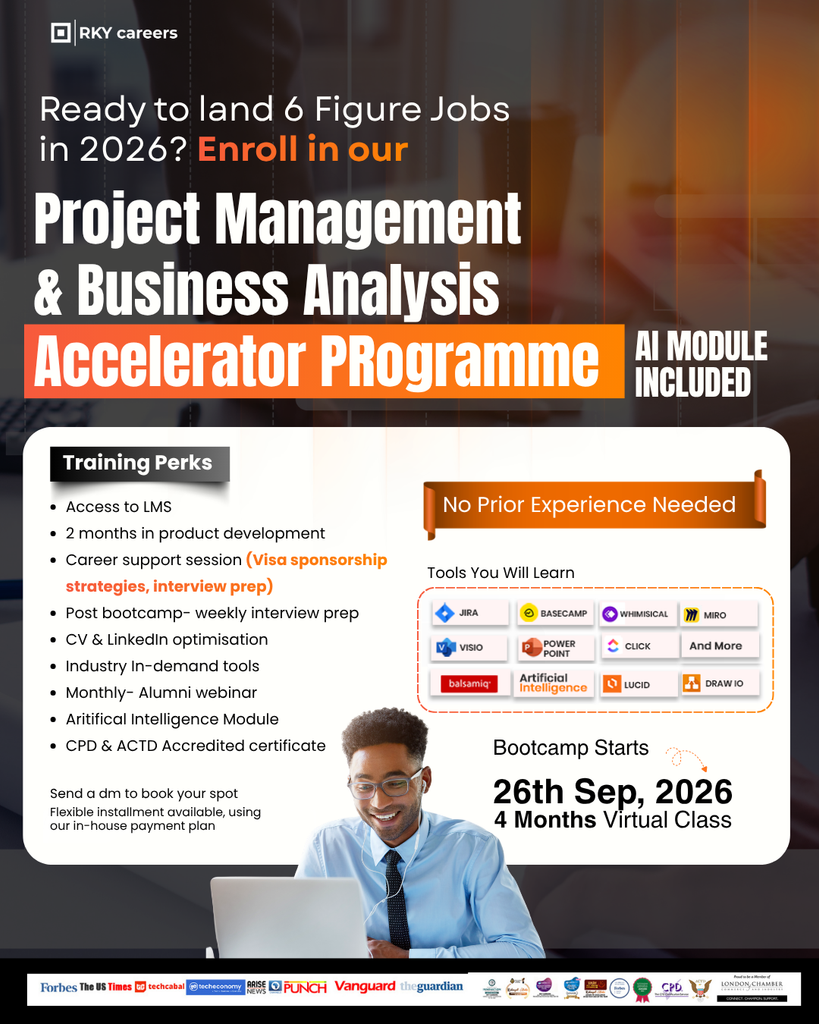
Build a Stronger Career With RKY Careers’ Project Management and Business Analysis Accelerator Programme
Finding jobs with visa sponsorship in the UK becomes more effective when your skills match employer expectations. However, career changers often struggle to demonstrate practical experience in their preferred professional roles.
That is where RKY Careers’ Project Management and Business Analysis Accelerator Programme can support your career development.
This 15-week programme combines seven weeks of live learning with eight weeks of practical projects. Consequently, you gain experience applying project management and business analysis concepts to realistic workplace challenges.
Throughout the programme, you can develop valuable professional capabilities through:
- Live instructor-led training and collaborative learning.
- Practical projects using industry-standard tools.
- Agile, Scrum, Kanban, Waterfall, and PRINCE2 concepts.
- Stakeholder communication, business analysis, and project delivery.
- CV optimisation, interview preparation, and career support.
- Portfolio development through practical project experience.
Furthermore, career changers can use these experiences to communicate their transferable skills more effectively.
You can also explore RKY Careers’ career resources for additional guidance on professional development and job applications.
While training cannot guarantee employment or visa sponsorship, it can improve your professional readiness.
Conclusion
Securing jobs with visa sponsorship in the UK starts with choosing eligible roles and researching genuine employers. Therefore, focus on relevant skills, targeted applications, and current immigration requirements.
Ready to strengthen your career prospects? Explore RKY Careers’ Project Management and Business Analysis Accelerator Programme and take your next step towards professional growth.